

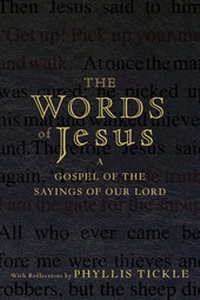
The Words of Jesus
A Gospel of the Sayings of Our Lord with Reflections by Phyllis Tickle
Published on 19. May 2009
192 pages
978-0-470-24195-0 (ISBN)
Description

What if you could encounter the words of Jesus on their own, lifted up from the surrounding narratives and presented in their full power and mystery? That's the question Phyllis Tickle--one of America's most beloved writers on Christian spirituality--asked when she set out to write what she calls a "Sayings gospel." In The Words of Jesus Tickle has compiled and arranged all the sayings of Jesus from the first four books of the New Testament and the first chapter of the Book of Acts in a way that creates an entirely new kind of encounter with the texts. And she has accompanied those sayings with her own personal reflections and commentaries not just on the words themselves but on the One who spoke them.
Reviews / Votes
Harsh. Testy. Uncompromising. These aren't words typicallyassociated with Jesus, but Christian scholar Phyllis Tickle, aformer religion editor of Publishers Weekly, says they oftencame to mind as she wrote her new book, "The Words of Jesus." Thebook, which arrives in stores next week, plucks Jesus' words out ofthe Gospels and Acts, leaving them to stand alone without thecontext of his actions. "His words come as a shock," says Tickle."Readers will get a Jesus they never saw before." He is, of course,still the warm and compassionate man who said "Father, forgivethem" and "Love one another." But when it comes to his mission,Jesus doesn't mince words. "Anyone who loves father or mother morethan me is not worthy of me," he told his apostles. Tickle believesChristians err when they "domesticate Jesus," because they lose asense of his power and the urgency of his message. "Obviously, hehas an enormous amount of love," says Tickle. "But it is the loveof a parent who knows the rules and who isn't going to soften theblow." Jesus was anxious to be understood. He asked Philip, anapostle, "Have I been so long a time among you ... and stillyou do not know me?" It's a question that Tickle's book helps usanswer today. (Newsweek, February 4, 2008) Founding editor of the religion department at PublishersWeekly, Tickle is also the prolific author of God-Talk inAmerica, Recovering the Sacred, and other books. This volume isa thoughtful reflection on the meaning of Jesus's words and theimportance of various contexts for his followers, as well as ontruth that emerges around unconsciously imposed cultural blinders.In the process, Tickle explains much of the thinking behind theEmergent Church movement. She also struggles with how to phrasecertain "words" found with different nuances in more than onecanonical Gospel. The book concludes with a recounting of Jesus'swords from the canonical Gospels and the first chapter of Acts,dividing them into five different contexts, by delivery venue ortopic: words of public teaching, of private instruction, of healingdialog, of intimate conversation, and of postresurrectionencounters. For many readers, this book will fulfill Tickle'sintent: to lead to a new appreciation of Jesus's words and of Jesushimself. Highly recommended for public and seminarylibraries.--Carolyn M. Craft, formerly with Longwood Univ.,Farmville, VA (Library Journal, February 1, 2008) Award-winning author and speaker Tickle (Rediscovering theSacred; The Divine Hours), who is PW's formercontributing editor in religion, chooses to take the "redletter" Bible one step further in this excellent study tool.The first section of this slim volume is a reflective essay on whatTickle learned from extracting the words of Jesus out of theirnarrative context in the Gospels. She writes of Jesus graduallybecoming "the heard" rather than "theseen," stripped of the sentimental images she had grown upwith. She argues that the sayings, taken on their own merit, offera third way between biblical literalists and literary critics:"Jesus was an actualist, not a literalist or a metaphorist...[the words] don't mean; they are." As such, they must beabsorbed with both heart and mind together. Tickle divides thesayings into five categories: public teaching, private instruction,healing dialogue, intimate conversation and postresurrectionencounters. Each saying stands alone but has been given a briefdescriptive title. Tickle used an amalgam of biblical translationsand chronologies to produce a version that is accessible andvibrant. These sayings of Jesus will be a valuable tool toChristians looking for new ways to study and assimilate his coreteachings and character. (Feb.) (Publishers Weekly,December 3, 2007)More details
Other editions
Additional editions
Phyllis Tickle
The Words of Jesus
A Gospel of the Sayings of Our Lord with Reflections by Phyllis Tickle
Book
04/2009
Wiley
€14.87
Article exhausted; check different version

Phyllis Tickle
The Words of Jesus
A Gospel of the Sayings of Our Lord with Reflections by Phyllis Tickle
Book
02/2008
Jossey-Bass
€39.83
Article exhausted; check different version
Person
Phyllis Tickle, founding editor of the religion department at Publishers Weekly, is one of the most highly respected authorities and popular speakers on religion in America today. She is the author of more than two dozen books including the Divine Hours series of prayer manuals. A lector and lay eucharistic minister in the Episcopal Church, Tickle is a senior fellow of the Cathedral College of Washington National Cathedral. For more information go to www.phyllistickle.com and www.allthewordsofjesus.com.
Content
Reflections on the Words of Jesus.
A Gospel of the Sayings of Our Lord.
BOOK I The Words of Public Teaching.
BOOK II The Words of Private Instruction.
BOOK III The Words of Healing Dialogue.
BOOK IV The Words of Intimate Conversation.
BOOK V The Words of Post-Resurrection Encounters.
Acknowledgments.
The Author.
Index to Canonical Sources.
Index to Key Words and Major Themes.
A Reader's Guide for The Words ofJesus (ELIZABETH WIRLS AND LINDA MARKS).
