

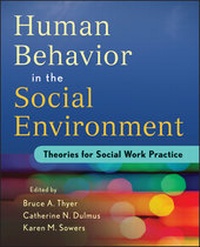
Human Behavior in the Social Environment
Description

More details
Other editions
Additional editions
Persons
Content
Preface xiii
Acknowledgments xxix
About the Editors xxxi
Contributors xxxiii
Chapter 1 Human Behavior and the Social Environment: Exploring Conceptual Foundations 1
Susan I. Stone, Yolanda Anyon, Stephanie Berzin, Sarah Taylor, and Michael J. Austin
Scholarly and Professional Dilemmas Related to Human Behavior and the Social Environment 2
Development of the Human Behavior and Social Environment Construct 7
A Selection of Frameworks That Address Linkages Between Human Behavior and the Social Environment 14
Life Course Approach: An Application 17
The Social Environment: Key Concepts 28
Frameworks for Linking Knowledge to Practice 36
Conclusion 38
Key Terms 39
Review Questions for Critical Thinking 39
Online Resources 40
References 41
Chapter 2 Respondent Learning Theory 47
Bruce A. Thyer
Respondent Learning Processes 49
Naturally Occurring Examples of Respondent Learning in Real Life 56
Experimental Examples of Respondent Learning 59
Examples of Respondent Learning of Psychosocial Problems 62
Using Respondent Learning in Social Work Practice 67
Creating Conditioned Reactions 69
Philosophical Foundations of Respondent Learning 71
Key Terms 74
Review Questions for Critical Thinking 75
Online Resources 75
References 75
Chapter 3 Operant Learning Theory 83
Stephen E. Wong
Historical and Conceptual Origins 83
Basic Theoretical Principles 85
Advanced Theoretical Principles 96
Recent Theoretical Developments 98
Relevance to Social Work Practice 103
Critiques of the Operant Learning Approach 111
Key Terms 112
Review Questions for Critical Thinking 112
Online Resources 113
References 114
Chapter 4 Cognitive-Behavioral Theory 125
Paula S. Nurius and Rebecca J. Macy
Relevance to Contemporary Practitioners 125
Overview of Cognitive-Behavioral Theory 126
Historical and Conceptual Origins 128
Basic Theoretical Principles 132
Advanced Theoretical Principles 140
Recent Theoretical Developments 144
Relevance to Social Work Practice 146
Evidence-Based Foundations 154
Critiques of This Approach 155
Key Terms 157
Review Questions for Critical Thinking 157
Online Resources 158
References 159
Chapter 5 Attachment Theory 165
Michelle Mohr Carney and Phen M. Young
Historical and Conceptual Origins 166
Basic Theoretical Principles 168
Advanced Theoretical Principles 169
Recent Theoretical Developments 171
Relevance to Social Work Practice 173
Critiques of This Approach 182
Key Terms 183
Review Questions for Critical Thinking 183
Online Resources 184
References 184
Chapter 6 Psychosocial Theory 193
Roberta R. Greene
Developmental Theory 193
Historical and Conceptual Origins 194
Basic Theoretical Principles 197
Advanced Theoretical Principles 207
Recent Theoretical Developments 210
Relevance to Social Work Practice 212
Evidence-Based Foundations: Erikson on Erikson 214
Critiques of This Approach 215
Key Terms 219
Review Questions for Critical Thinking 219
Online Resources 220
References 220
Chapter 7 Person-Centered Theory 225
Michael J. Holosko, Jeffrey Skinner, and Catherine A. Patterson
Historical and Conceptual Origins 226
Basic Theoretical Principles 233
Advanced Theoretical Principles 239
Recent Theoretical Developments 243
Relevance to Social Work 244
Assessment 246
Intervention 248
Evidence-Based Foundations 251
Critiques of This Approach 254
Key Terms 257
Review Questions for Critical Thinking 258
Online Resources 258
References 259
Chapter 8 Genetic Theory 263
Laura J. Pankow
The Eukaryotic Cell 266
Chromosomes 268
Reproduction 270
Mitosis 271
Mendelian Genetics 273
The Process of Meiosis 275
Pedigrees 277
DNA and RNA 278
The Genetics of Gender 281
The Human Genome Project 285
Conclusion 291
Key Terms 292
Review Questions for Critical Thinking 292
Online Resources 292
References 294
Chapter 9 Ecosystems Theory 297
Mark A. Mattaini and Kristen Huffman-Gottschling
The Ecosystems Perspective in Social Work 298
The Conceptual Roots of the Ecosystems Perspective 300
Evaluating the Ecosystems Perspective 311
Returning to the Science 314
Mapping Practice 316
Conclusion 318
Key Terms 319
Review Questions for Critical Thinking 319
Online Resources 320
References 320
Chapter 10 Small Group Theory 327
Lorraine Moya Salas, Dominique Roe-Sepowitz, and Craig Winston LeCroy
Definitions 329
History and Conceptual Origins 330
Basic Theoretical Principles 339
Advanced Theoretical Principles 344
Recent Theoretical Developments 350
Relevance to Social Work Practice 353
Evidence-Based Foundations 359
Critiques of This Approach 361
Key Terms 362
Review Questions for Critical Thinking 363
Online Resources 363
References 364
Chapter 11 Family Systems Theory 369
Martha Morrison Dore
Historical and Conceptual Origins 369
Basic Theoretical Principles 377
Advanced Theoretical Principles 379
Recent Theoretical Developments 383
Relevance to Social Work Practice 385
Evidence-Based Foundations 396
Critiques of This Theory 398
Key Terms 401
Review Questions for Critical Thinking 401
Online Resources 401
References 402
Chapter 12 Organizational Theory 411
John E. Tropman and Emily J. Nicklett
Organizational Behavior 411
Historical and Conceptual Origins 414
Basic Theoretical Principles 422
Advanced Theoretical Principles 426
Recent Theoretical Developments 432
Relevance to Social Work Practice 442
Overall Social Work Demographics 443
Evidence-Based Foundations 451
Critiques of This Approach 452
Conclusion 452
Key Terms 453
Review Questions for Critical Thinking 453
Online Resources 453
References 454
Chapter 13 The Potentially Harmful Effects of Theory in Social Work 459
Bruce A. Thyer
Some Harmful Effects of Bad Theory 461
Where Can We Go From Here? 476
Conclusion 481
Key Terms 482
Review Questions for Critical Thinking 482
Online Resources 483
References 484
Author Index 489
Subject Index 499
Chapter 1
Human Behavior and the Social Environment
Exploring Conceptual Foundations
Susan I. Stone, Yolanda Anyon, Stephanie Berzin, Sarah Taylor, and Michael J. Austin
How might the construct known as human behavior and the social environment be conceptualized, and what are some critical issues associated with defining it?Social and behavioral science theories represent a key source of knowledge for social work practice. One core function of social work scholarship is to select, synthesize, and translate this knowledge for specific use within the profession, including research, practice, and social work education. Because these theories have been generated for purposes that are often loosely related to goals and needs of the social work profession, a complex set of factors shape the “borrowing” process, including assessments of fit between theories and professional values, their evidentiary base, and their applicability and transportability to practice.
There is surprisingly little social work literature explicitly addressing theory selection, synthesis, and translation in terms of constructs related to human behavior and development, environmental influences, and their interrelationship (Kondrat, 1992; Zaparanick & Wodarski, 2004). Indirect evidence related to theory selection can be culled from research on the HB&SE (human behavior and the social environment) curriculum and related Council on Social Work Education (CSWE) standards. Content analyses of HB&SE syllabi indicate considerable heterogeneity in theoretical approaches utilized as well as overrepresentation of explanatory theory related to human behavior and development relative to theories related to the social environment (Taylor, Austin, & Mulroy, 2004; Taylor, Mulroy, & Austin, 2004). The most recent CSWE standards (2008) call for the selection of “theories and knowledge from the liberal arts to understand biological, social, cultural, psychological, and spiritual development” (p. 6).
This volume summarizes explanatory theories that are (a) related to human behavior and development in the social environment and (b) can be used to inform social work practice. It represents, in many ways, an important attempt at selection, synthesis (summarizing core theoretical content, assessments of the evidentiary bases of theories), and translation (assessments of applicability to practice) of key concepts that help bring theoretical depth and breadth to the person-in-environment perspective that has historically been central to the social work profession (Cornell, 2006) Although an introductory chapter to a volume such as this might attempt to classify, compare, and/or integrate the various theories presented (e.g., see Robbins, Chatterjee, & Canda, 2009), our overarching aim will be different. Because social work scholars regularly identify and describe theories of potential utility for the profession (e.g., see Green & McDermott, 2010, for a recent example), such an approach seems premature as we are skeptical that there is shared understanding and definitions of cross-cutting dimensions along which theories might be compared. Instead, our goal is to complement the theories summarized in this volume by describing key scholarly and professional dilemmas related to theorizing about human behavior and the social environment (Bloom & Klein, 1996) that we believe are important to consider prior to comparative endeavors.
Specifically, the chapter approaches constructs related to human behavior and the social environment from multiple perspectives: historical, conceptual, and empirical. It is designed to generate discussion of the critical issues that emerge from the utilization of social and behavioral science.
The chapter is organized around the following question: How might the HB&SE construct be conceptualized, and what are some critical issues associated with defining it? To address this question, the following sections include: (a) a discussion of the role of theory in social work research and practice, especially as it relates to the HB&SE knowledge base as well as enduring tensions related to the uses of theory; (b) key highlights of the historical evolution of the HB&SE curriculum as reflected in curriculum standards developed by CSWE and related debates; (c) a presentation of selected frameworks that link human behavior with the social environment in alternative ways and may assist in the translation of HB&SE knowledge into practice; and (d) conclusions and implications for further critical reflection and dialogue.
Scholarly and Professional Dilemmas Related to Human Behavior and the Social Environment
A hallmark of the social work profession is its long-standing contextualist orientation (Weick, 1999), in which so-called person-environment perspectives serve as core components of the social work knowledge base (Cornell, 2006). At the same time, there has been considerable debate about specific elaboration of the relationship between human development, behavior, and the social environment (e.g., Bloom & Klein, 1996). We briefly sketch these debates as they relate to four overarching themes: (1) development of the social work knowledge base, (2) the utility of middle range (domain-specific) theory, (3) appropriate specification of units of analysis (individual, group, community, etc.), and (4) the nature of the relationship between persons and their environments.
Development of the Social Work Knowledge Base
Goldstein (1990) uses a three-part model of explicit and implicit theories, accumulated research, and practice-related experiences and information (e.g., skills, practice, wisdom) to characterize the knowledge base of social work. This model suggests that optimal knowledge development occurs when there is a seamless interconnection between theory, research, and practice. Given that there are a variety of factors relevant to understanding the nature of linkages between theory, research, and practice, we note those that relate to knowledge development in the social sciences in general, as well as those that appear to be uniquely germane to the social work profession.
Theory–Research Linkages
Philosophers of science generally agree that formal theory building and testing is uneven and nonlinear, often serendipitous, related to historical and social contextual factors, and dependent on methodological innovation (Committee on Scientific Principles in Education Research, 2001). Because public support for research also influences the extent to and speed with which theory is developed, limited support for social work research represents an important constraint.
Different mechanisms underlie the linkages between theory, research, and practice, and it is important to underscore key differences between basic and applied research processes. For example, strategies used to test formal theory (theory-research links) may, at times, be quite distinct from those used to assess the efficacy and effectiveness of practice (research-practice links; see Fraser & Gallinsky, 2010; Pedhazur & Schmelkin, 1991).
Theory–Practice Linkages
Because formal theories are necessarily abstract, a complex set of steps may be necessary to link theoretical concepts to practice techniques and principles (Van De Ven & Johnson, 2006). Because the social work profession generally borrows formal theories from other social science disciplines, it is also reasonable to expect some degree of mismatch between available theory and practice applications. For these reasons, scholars from other helping professions (e.g., education and nursing) argue for the development and use of middle range (also referred to as domain-specific) theory because of its potential translatability into practice (Committee on Scientific Principles in Education Research, 2001; Liehr & Smith, 1999; McKenna, 1997). According to Merton (1968, p. 39), middle range theories are “intermediate to the minor working hypotheses evolved in abundance during the day-by-day routine of research, and the all-inclusive speculations comprising a master conceptual scheme.”
Due to the heterogeneity of goals related to theory, research, and practice, the development of the social work knowledge base is complex. Some scholars find little use for the theory–research–practice model and argue that theoretical and empirical knowledge are essentially incompatible or, at best, loosely coupled with practice knowledge (Goldstein, 1990; Weick, 1999). More recently, Thyer (2001) documented fundamental misunderstandings about research processes unique to formal theory testing and a tendency toward the overvaluation of theory building in relationship to other research endeavors that support the development of social work practice.
It is notable that these sources of tension within social work stand in marked contrast to recent appraisals of knowledge development within the professions of education and nursing. In general, these appraisals reflect a shared understanding of (a) the current state of the relevant knowledge base, (b) the types of theory building and integration necessary to further the profession, (c) critical areas for research, and (d) strategies that focus on particularly promising midrange theories that promote linkages to practice (Committee on Scientific Principles in Education Research, 2001; McKenna, 1997; Van De Ven & Johnson, 2006).
The lack of consensus about the conceptual foundation of the relationship between human behavior and the social environment provides critical contextual backdrop of this chapter. Each chapter in this volume traces the development of a...
