

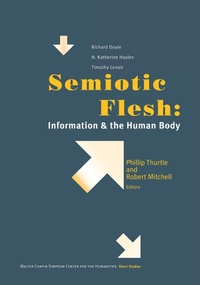
Semiotic Flesh
Description

For much of the 20th century, an apparently solid conceptual wall allowed us to separate information and bodies. Information is that which exists between elements; bodies are the elements themselves. One is abstract the other corporeal. One is intricately involved in signs and syntax, the other in cells and organs. Yet in the last few decades, it has become increasingly clear that this conceptual wall leaks--bodies and information will not stay separate from one another. Data have become flesh just as flesh has become data. Semiotic Flesh marks an important contribution to the emerging field of information studies, providing multiple perspectives on the implications of burgeoning information technologies and biotechnologies.
The essays and responses in this volume focus on the sites where flesh and information productively intermingle, including the strange connections between LSD and DNA research, the implications of computer-assisted surgery, and the role of the human body in virtual reality installations.
More details
Other editions
Additional editions
Persons
Phillip Thurtle is a lecturer in the School of Communications and the Comparative History of Ideas Program at the University of Washington, where he is co-director of the New Media Research Lab. Robert E. Mitchell is a lecturer in comparative literature at the University of Washington. Contributors include Richard Doyle, N. Katherine Hayles, Timothy Lenoir, Peter Oppenheimer, Steven Shaviro, and Kathleen Woodward.
Content
Introduction: Fleshy Data: Semiotics, Information, and the Body--Robert Mitchell and Phillip Thurtle
1. LSDNA: Consciousness Expansion and the Emergence of Biotechnology--Richard Doyle
--Response--Steven Shaviro
2. The Virtual Surgeon: Operating on the Data in an Age of Medialization--Timothy Lenoir
--Response--Peter Oppenheimer
3. Flesh and Metal: Reconfiguring the Mindbody in Virtual Environments--N. Katherine Hayles
--Response--Kathleen Woodward
