

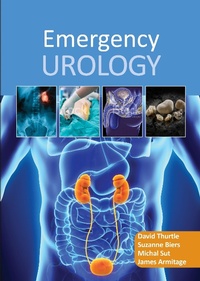
Emergency Urology
Published on 1. March 2017
350 pages
978-1-910079-45-4 (ISBN)
Description

Urology is a specialty that notoriously receives little attention in medical school, yet it makes up a sizeable portion of the workload in emergency departments and also in primary care. Urological emergencies can often be managed simply but require the appropriate knowledge and skills. Emergency urology is often covered very superficially alongside general surgery or in excessive detail within voluminous urology textbooks. This book is different: it will consist of concise, well-structured chapters, with an accessible and easily digestible style. The content will be clinically-based and will include a number of clinical photographs and radiological investigations. This book will appeal to all doctors, including those rotating through surgical and emergency medicine specialties, and those clinicians approaching professional examinations worldwide. Medical students on urology or emergency medicine placements, who are studying for their exams will also find it invaluable. In addition, primary care doctors, specialty nurses in urology and nurses in the emergency department may also appreciate the clinically relevant content of the book. The authors are all dedicated to education and teaching, and have published extensively. In addition, they run a successful emergency urology course in Cambridge, popular with clinicians and senior students alike.
More details
Language
English
Place of publication
Shrewsbury
United Kingdom
Target group
Professional and scholarly
File size
28,77 MB
ISBN-13
978-1-910079-45-4 (9781910079454)
Copyright in bibliographic data and cover images is held by Nielsen Book Services Limited or by the publishers or by their respective licensors: all rights reserved.
Schweitzer Classification
Other editions
Additional editions
David Thurtle | Suzanne Biers | Michal Sut
Emergency Urology
Book
03/2017
TFM Publishing Ltd
€47.00
Shipment within 3-4 weeks
Content
- Emergency UROLOGY
- Title Page
- Copyright
- Contents
- Contributing Authors
- Acknowledgements
- Abbreviations
- Preface
- Chapter 1: Assessing the Unwell Urological Patient
- ABCDE
- HISTORY
- Urinary symptoms
- Pain
- Loin pain
- Scrotal pain
- History of previous urological input or intervention
- Past medical history
- Drug history
- EXAMINATION
- Systemic/general examination
- Kidneys
- Bladder
- Prostate
- Vaginal examination (where clinically relevant)
- Penis
- Scrotum
- Groins
- ROUTINE INVESTIGATIONS
- Bladder scan
- Flow analysis
- Urinalysis
- Urinary or serum beta-human chorionic gonadotrophin (ß-HCG)
- FAST scan (focused assessment with sonography for trauma)
- Blood tests
- IMAGING INVESTIGATIONS
- Computed tomography (CT)
- Ultrasound scan (USS)
- Urethrogram/cystogram
- Magnetic resonance imaging (MRI)
- SEPSIS
- Management
- Early recognition
- Urgent intervention
- Timely escalation
- Chapter 2: Upper Urinary Tract Emergencies
- ACUTE KIDNEY INJURY
- Definition and staging
- Epidemiology
- Causes and classification
- Pre-renal AKI
- Intrinsic AKI
- Acute tubular necrosis
- Contrast-induced AKI (CI-AKI)
- Post-renal AKI
- Presentation
- Investigation
- Management
- Hyperkalaemia
- RENAL COLIC
- Background
- Epidemiology
- Causes
- Presentation
- Symptoms
- Examination
- Investigation
- Treatment
- Scenario 1: Ureteric stone
- Scenario 2: Sepsis with an obstructing stone
- Scenario 3: Staghorn calculi
- Follow-up
- KIDNEY INFECTIONS
- Pyelonephritis
- Causes
- Presentation
- Symptoms
- Examination
- Investigation
- Treatment
- Follow-up
- Specific subtypes of pyelonephritis
- Emphysematous pyelonephritis (EPN)
- Xanthogranulomatous pyelonephritis (XGP)
- Renal/peri-renal abscess
- References
- Chapter 3: Lower Urinary Tract Emergencies
- URINARY RETENTION
- Acute urinary retention
- Presentation
- History
- Examination
- Investigation
- Management
- Benign prostatic enlargement
- Clot retention
- Urethral stricture
- UTI
- Constipation
- Neurological
- Chronic urinary retention
- Symptoms
- Investigation
- Management
- Post-obstructive diuresis
- Management
- Retention with catheterisable stomas
- Important
- HAEMATURIA
- Causes
- Managing patients in the emergency setting
- Bladder washout for clot retention
- Further investigation and management of acute presentation of haematuria
- Managing patients in primary care
- URINARY TRACT INFECTION AND CYSTITIS
- Acute bacterial cystitis
- Causes
- Presentation
- Symptoms
- Examination
- Investigation
- Management
- Catheter-associated UTI
- PROSTATITIS
- Acute bacterial prostatitis
- Presentation
- Examination
- Investigation
- Management
- URETHRITIS
- Presentation and examination
- Investigation
- Management
- References
- Chapter 4: Genitoscrotal Emergencies
- ACUTE SCROTUM
- Testicular torsion
- Pathophysiology
- History
- Examination
- Investigation
- Management
- Torsion of testicular appendage (torted hydatid of Morgagni)
- History
- Examination
- Investigation
- Management
- Epididymo-orchitis
- History
- Examination
- Investigation
- Management
- Scrotal abscess
- History
- Examination
- Investigation
- Management
- Hydrocoele/infected hydrocoele
- History
- Examination
- Investigation
- Management
- Scrotal haematoma
- History
- Examination
- Investigation
- Management
- PENILE EMERGENCIES
- Penile fracture
- History
- Examination
- Investigation
- Management
- Paraphimosis
- Presentation
- Management
- Balanitis
- Diagnosis
- Management
- PRIAPISM
- Types of priapism
- Presentation
- Causes
- History
- Examination
- Investigation
- Management
- Low-flow (ischaemic) priapism
- Stuttering priapism
- Non-ischaemic (high-flow) priapism
- FOURNIER'S GANGRENE
- Pathophysiology
- History
- Examination
- Management
- References
- Chapter 5: Trauma in Urology
- UPPER URINARY TRACT TRAUMA
- Causes
- Presentation
- History
- Examination
- Investigation
- Management
- Renal trauma
- Ureteric trauma
- LOWER URINARY TRACT TRAUMA
- Causes
- Presentation
- Bladder injuries
- Urethral injuries
- Patterns of haematoma associated with anterior urethral injury
- Investigation
- Management
- GENITOSCROTAL TRAUMA
- Testicular trauma
- Presentation
- Investigation
- Management
- Surgical approach
- Zipper injury
- Penile trauma
- Penile amputation
- Management
- Penetrating injury
- Soft tissue injury
- Chapter 6: Special Circumstances
- PAEDIATRIC UROLOGICAL EMERGENCIES
- Acute scrotum in childhood
- Testicular torsion
- Neonatal testicular torsion
- Torted testicular appendage
- Infection
- Trauma
- Idiopathic scrotal oedema
- Henoch-Schönlein purpura (HSP)
- Penile and foreskin problems in children
- Post-circumcision complications
- Paraphimosis
- Voiding problems in children
- Urinary retention
- UROLOGICAL EMERGENCIES IN PREGNANCY
- Pyelonephritis in pregnancy
- History
- Examination
- Investigation
- Management in moderate to severe pyelonephritis
- Acute kidney injury in pregnancy
- History
- Examination
- Investigation
- Management
- Urolithiasis in pregnancy
- History
- Examination
- Investigation
- Management
- Temporary drainage versus definitive treatment
- NEUROGENIC BLADDER
- Autonomic dysreflexia
- Presentation
- Management
- Cauda equina
- Acute spinal cord injury
- Management
- Assessment of other general problems relating to the urinary tract in neuropathic patients
- History
- Examination
- Investigation
- Management
- Protection of the upper renal tracts:
- Management of stress incontinence (i.e. due to sphincter weakness).
- Prevention of recurrent lower urinary tract infections
- ONCOLOGICAL EMERGENCIES
- Malignant spinal cord compression
- History
- Examination
- Investigation
- Management
- Bilateral malignant ureteric obstruction
- History
- Examination
- Investigation
- Management
- POST-OPERATIVE EMERGENCIES
- Inpatient post-operative complications
- Bleeding/haematuria
- Catheter falls out after surgery
- TUR syndrome
- Anuria/oliguria (normal adult urine output = 0.5ml/kg/h)
- Post-catheterisation diuresis
- Compartment syndrome
- Urinary tract infection and sepsis
- Outpatient post-operative complications
- Bleeding/haematuria
- Poor cosmesis and concerns after day-case procedures
- TUBES, PROSTHESES AND ALTERED URINARY TRACT ANATOMY
- Ureteric stents
- Problems
- Nephrostomy tubes
- Problems
- Ileal conduit
- Problems
- History
- Examination
- Investigation
- Management
- Bladder substitute/neobladder
- Problems
- History
- Examination
- Investigation
- Management
- Bladder augmentation (cystoplasty)
- Problems
- History
- Examination
- Investigation
- Management
- Continent catheterisable channels (Mitrofanoff and Monti)
- Problems
- Management
- Artificial urinary sphincters
- Problems
- Management
- References
- Chapter 7: Procedures in Urology
- URETHRAL CATHETERISATION
- Types of catheter
- Specialist catheters
- Technique of urethral catheterisation
- Documentation
- Tips and tricks
- Difficult female catheterisation
- Unable to site a catheter and no specialist help available
- SUPRAPUBIC CATHETERISATION
- Techniques for insertion of a percutaneous SPC
- Trocar-based technique
- Seldinger-based technique
- Replacement/exchange of an existing suprapubic catheter
- Documentation
- CATHETER COMPLICATIONS
- Complications of urethral catheter insertion
- False passage
- Management
- Balloon inflated in the prostatic urethra
- Management
- Difficult female catheterisation
- Management
- Tight phimosis/non-retractile foreskin
- Management
- Paraphimosis
- Management
- Buried penis/genitoscrotal oedema
- Management
- Decompression haematuria
- Management
- Hypospadias
- Meatal stenosis
- Catheter inserted into a ureter
- Management
- Allergic reaction
- Complications of catheters in situ
- Bladder spasms/urinary bypassing/catheter expulsion
- Management
- Blood/debris in the catheter tubing and bag
- Management
- Blockages
- Encrustation and stone formation
- Management
- Catheter-associated UTI (CAUTI)
- Management
- Soft tissue erosion/penile spatulation
- Psychological impact
- Complications of urethral catheter removal
- Unable to deflate balloon and remove catheter
- Management
- Tip left inside the bladder
- Management
- Suprapubic catheter problems
- Management
- LOCAL ANAESTHETIC PENILE BLOCKS
- Indication
- Anatomy
- Technique
- Subcutaneous penile ring block
- Complications
- References
- Chapter 8: Interventional Uroradiology Procedures
- NEPHROSTOMY
- Indications
- Patient preparation
- Procedure
- Outcome
- ANTEGRADE URETERIC STENT INSERTION
- Indications
- Patient preparation
- Procedure
- Outcome
- ILEAL CONDUIT ACCESS AND URETERIC STENTING
- Indications
- Patient preparation
- Procedure
- Outcome
- MITROFANOFF IMAGING/ACCESS
- Indications
- Patient preparation
- Procedure
- Outcome
- RENAL EMBOLISATION
- Indications
- Patient preparation
- Procedure
- Embolic agents
- Outcome
- DRAINAGE OF COLLECTIONS
- Indications
- Patient preparation
- Procedure
- Outcome
- References
- Appendix 1: EXAMPLE EMERGENCY DEPARTMENT PROTOCOL FOR SUSPECTED SEPSIS
- Appendix 2: THE ABCDE APPROACH
- Underlying principles
- First steps
- Airway (A)
- Breathing (B)
- Circulation (C)
- Disability (D)
- Exposure (E)
- Additional information
- Index
- Back Cover
