

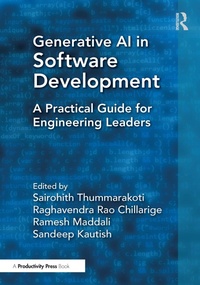
Generative AI in Software Development
A Practical Guide for Engineering Leaders
Will be published approx. on 23. June 2026
374 pages
978-1-040-85000-8 (ISBN)
Description

Generative AI in Software Development: A Practical Guide for Engineering Leaders explores how large language models and generative tools are fundamentally changing the way software is created, tested, and maintained. This isn't a theoretical or academic deep dive; it's a practical, grounded guide for developers, product teams, and tech leaders who want to understand how generative AI can be embedded into real-world software workflows. From writing and debugging code to generating UI components, managing APIs, and automating deployment tasks, this book shows how AI is becoming a true co-developer.
What sets this book apart is its balance: it's not just for hardcore engineers nor is it a high-level overview filled with buzzwords. Instead, it sits at the intersection technical enough to be useful but accessible enough for product managers and decision-makers. The industry is at an inflection point where AI-assisted development is no longer optional; it's become essential. This book fills the gap for those who want to move beyond the hype and see exactly how generative AI can speed up development, improve code quality, and change the economics of software delivery.
What sets this book apart is its balance: it's not just for hardcore engineers nor is it a high-level overview filled with buzzwords. Instead, it sits at the intersection technical enough to be useful but accessible enough for product managers and decision-makers. The industry is at an inflection point where AI-assisted development is no longer optional; it's become essential. This book fills the gap for those who want to move beyond the hype and see exactly how generative AI can speed up development, improve code quality, and change the economics of software delivery.
More details
Language
English
Place of publication
London
United Kingdom
Publishing group
Taylor & Francis Ltd
Target group
Professional and scholarly
Product notice
Reflowable
Illustrations
50 Tables, black and white; 80 Line drawings, black and white; 80 Illustrations, black and white
File size
23,64 MB
ISBN-13
978-1-040-85000-8 (9781040850008)
Copyright in bibliographic data and cover images is held by Nielsen Book Services Limited or by the publishers or by their respective licensors: all rights reserved.
Schweitzer Classification
Other editions
Additional editions
Sairohith Thummarakoti | Raghavendra Rao Chillarige | Ramesh Maddali
Generative AI in Software Development
A Practical Guide for Engineering Leaders
Book
approx. 06/2026
1st Edition
Productivity Press
€179.50
Not yet published
Sairohith Thummarakoti | Raghavendra Rao Chillarige | Ramesh Maddali
Generative AI in Software Development
A Practical Guide for Engineering Leaders
Book
approx. 06/2026
1st Edition
Productivity Press
€56.00
Not yet published
Persons
Sairohith Thummarakoti is a Lead Architect specializing in intelligent automation, AI-powered cloud infrastructure, and healthcare technology. He has authored multiple books on AI and cloud computing and has peer-reviewed over 300 research papers for leading IEEE and Springer journals and conferences. As the Founding Chair of the IEEE Computer Society - Columbia Section, he regularly delivers invited talks, faculty development programs, and training sessions for academic and industry audiences worldwide.
Dr. Chillarige Raghavendra Rao, retired Senior Professor at the University of Hyderabad's School of Computer & Information Sciences, holds a PhD in Statistics and an M.Tech in Computer Science & Engineering from Osmania University. Over his career, he supervised 15 PhDs, published 200+ papers, and secured two international patents in simulation, modeling, and knowledge discovery. Founder Secretary of the Indian Society for Rough Sets, he has contributed to nationally significant projects in aerospace, defense, and transportation. His accolades include the Acharya Rathna (2019) and Bhisma Acharya Award (2021-22).
Dr. Sandeep Kautish, Director of the Institute of Innovation at Physics Wallah, Noida, India, brings over two decades of experience in academia and academic leadership. He holds a PhD in Computer Science specializing in intelligent systems in social networks, with research spanning healthcare analytics, business analytics, data mining, and information systems. With 100+ publications (31 in JCR Q1) and 3000+ citations, he has authored or edited more than 20 books and developed a 2022 hybrid-cloud DDoS mitigation method published in IEEE Transactions on Industrial Informatics. He also holds a 2019 patent on AI-driven solar energy equipment and has organized 10+ conferences and 15+ faculty development programs in India and abroad.
Dr. Ramesh Maddali combines deep expertise in mathematics and computer science with a PhD in Operations Research from the University of Hyderabad to tackle complex problems. Now an Assistant Professor at Alcorn State University, he leverages optimization and analytics to create efficient, cost-aware GenAI pipelines, fine-tune prompts, and integrate rigorous evaluation and testing to deliver reliable, production-ready code. His background in modeling and applied analytics enables him to solve high-impact challenges at the intersection of AI and software engineering. He has a strong track record of applying theoretical frameworks to practical, real-world systems. His work bridges academic research and industry needs, ensuring AI-driven solutions are both innovative and operationally sound.
Dr. Chillarige Raghavendra Rao, retired Senior Professor at the University of Hyderabad's School of Computer & Information Sciences, holds a PhD in Statistics and an M.Tech in Computer Science & Engineering from Osmania University. Over his career, he supervised 15 PhDs, published 200+ papers, and secured two international patents in simulation, modeling, and knowledge discovery. Founder Secretary of the Indian Society for Rough Sets, he has contributed to nationally significant projects in aerospace, defense, and transportation. His accolades include the Acharya Rathna (2019) and Bhisma Acharya Award (2021-22).
Dr. Sandeep Kautish, Director of the Institute of Innovation at Physics Wallah, Noida, India, brings over two decades of experience in academia and academic leadership. He holds a PhD in Computer Science specializing in intelligent systems in social networks, with research spanning healthcare analytics, business analytics, data mining, and information systems. With 100+ publications (31 in JCR Q1) and 3000+ citations, he has authored or edited more than 20 books and developed a 2022 hybrid-cloud DDoS mitigation method published in IEEE Transactions on Industrial Informatics. He also holds a 2019 patent on AI-driven solar energy equipment and has organized 10+ conferences and 15+ faculty development programs in India and abroad.
Dr. Ramesh Maddali combines deep expertise in mathematics and computer science with a PhD in Operations Research from the University of Hyderabad to tackle complex problems. Now an Assistant Professor at Alcorn State University, he leverages optimization and analytics to create efficient, cost-aware GenAI pipelines, fine-tune prompts, and integrate rigorous evaluation and testing to deliver reliable, production-ready code. His background in modeling and applied analytics enables him to solve high-impact challenges at the intersection of AI and software engineering. He has a strong track record of applying theoretical frameworks to practical, real-world systems. His work bridges academic research and industry needs, ensuring AI-driven solutions are both innovative and operationally sound.
Content
PART I: FOUNDATIONS OF GENERATIVE AI IN DEVELOPMENT, 1. Understanding Generative AI in Plain Language, 2. The Evolution of Software Development, PART II: APPLYING GENERATIVE AI ACROSS THE SOFTWARE LIFECYCLE, 3. Ideation and Planning with AI, 4. Designing User Interfaces with AI, 5. Writing and Generating Code, 6. Debugging, Testing, and Refactoring, 7. Backend and API Development, 8. Deployment, DevOps, and Automation, PART III: BEYOND CODE-PEOPLE, PROCESSES, AND POSSIBILITIES, 9. Building AI-Augmented Teams, 10. Governance, Ethics, and Ownership , 11. Case Studies from the Field, PART IV: WHAT'S NEXT AND HOW TO PREPARE, 12. Agentic Workflows and AI Agents, 13. Building a Generative AI Application: A Case Study on an AI Travel Planner, 14. Future-Proofing Your Skills and Stack: Strategies for Software Leaders in the Age of Generative AI
