

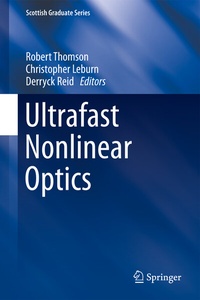
Ultrafast Nonlinear Optics
Description

The field of ultrafast nonlinear optics is broad and multidisciplinary, and encompasses areas concerned with both the generation and measurement of ultrashort pulses of light, as well as those concerned with the applications of such pulses. Ultrashort pulses are extreme events - both in terms of their durations, and also the high peak powers which their short durations can facilitate. These extreme properties make them powerful experiment tools. On one hand, their ultrashort durations facilitate the probing and manipulation of matter on incredibly short timescales. On the other, their ultrashort durations can facilitate high peak powers which can drive highly nonlinear light-matter interaction processes.
Ultrafast Nonlinear Optics covers a complete range of topics, both applied and fundamental in nature, within the area of ultrafast nonlinear optics. Chapters 1 to 4 are concerned with the generation and measurement of ultrashort pulses. Chapters 5 to 7 are concerned with fundamental applications of ultrashort pulses in metrology and quantum control. Chapters 8 and 9 are concerned with ultrafast nonlinear optics in optical fibres. Chapters 10 to 13 are concerned with the applications of ultrashort pulses in areas such as particle acceleration, microscopy, and micromachining.
The chapters are aimed at graduate-student level and are intended to provide the student with an accessible, self-contained and comprehensive gateway into each subject.
More details
Other editions
Additional editions
Persons
Ultrafast Optics Group
School of Engineering and Physical Sciences
Heriot-Watt University,
Edinburgh
EH14 4AS
UK
Professor Derryck T. Reid
Ultrafast Optics Group
School of Engineering and Physical Sciences
Heriot-Watt University,
Edinburgh
EH14 4AS
UK
Dr Christopher G. Leburn
Ultrafast Optics Group
School of Engineering and Physical Sciences
Heriot-Watt University,
Edinburgh
EH14 4AS
UK
