

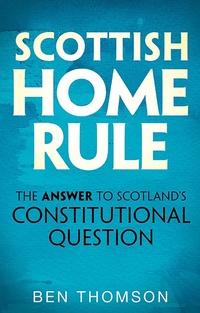
Scottish Home Rule
The Answer to Scotland's Constitutional Question
Published on 17. September 2020
176 pages
978-1-78885-378-1 (ISBN)
Description

Every debate about the Scottish constitution should include the topic of Scottish Home Rule, and if there is to be another referendum in Scotland then Home Rule should definitely be one of the options on the ballot paper.
Home Rule is not widely understood being seen by many Unionists as the slippery slope to Independence and by Independence supporters as a Unionist proposal to retain sovereignty over Scotland. It is however a strong proposal in its own right with a separate history from Independence and a more likely stepping-stone to Federalism.
This book is a much-needed statement for the merits of Scottish Home as the best solution for Scotland. It covers the history and support for the Home Rule option from 1860s, a clear structure for what Home Rule is and how Home Rule could improve both Scotland as well be a framework for constitutional reform across the UK.
Home Rule is not widely understood being seen by many Unionists as the slippery slope to Independence and by Independence supporters as a Unionist proposal to retain sovereignty over Scotland. It is however a strong proposal in its own right with a separate history from Independence and a more likely stepping-stone to Federalism.
This book is a much-needed statement for the merits of Scottish Home as the best solution for Scotland. It covers the history and support for the Home Rule option from 1860s, a clear structure for what Home Rule is and how Home Rule could improve both Scotland as well be a framework for constitutional reform across the UK.
Reviews / Votes
'Home Rule plays large in the Scottish political imagination ... this is elegantly captured in Thomson's argument that there is a third way between the status quo and full independence that could deliver a sustainable settlement ... a well-argued, thorough case for modern Scotland to take an alternative path' * New Statesman * 'Serious, commendable and ... elegant, with a plan that seeks to offer a middle way in the struggle between unionism and independence that currently divides Scotland' -- Joyce McMillan * Scotsman *More details
Language
English
Place of publication
Edinburgh
United Kingdom
Publishing group
Birlinn General
Illustrations
Diagrams; Maps
File size
1,25 MB
ISBN-13
978-1-78885-378-1 (9781788853781)
Copyright in bibliographic data and cover images is held by Nielsen Book Services Limited or by the publishers or by their respective licensors: all rights reserved.
Schweitzer Classification
Other editions
Additional editions
Book
09/2020
Birlinn Ltd
€32.39
Article exhausted; check different version
Persons
Professor Ben Thomson CBE, FRSE was educated at Edinburgh University. Between 1997 and 2010 he was chief executive and then chair of the Scottish investment bank Noble Group. He founded the think tank, Reform Scotland in 2007, and chaired the campaigns for greater fiscal responsibility (2010), DEVO PLUS (2012) and Scottish Home Rule (2016). He is currently chair of Inverleith, Planet Organic and and a visiting professor at the Business School of Dundee University.
Content
- Intro
- Title
- Copyright
- Contents
- Foreword
- Preface
- Introduction
- Part 1. The History of Scottish Home Rule
- 1. Introduction
- 2. Pre-First World War
- Daniel O'Connell and Catholic Emancipation
- Charles Stewart Parnell and Irish Home Rule
- Gladstone's Irish Home Rule Bills
- The Scottish Home Rule Association and Home Rule All Round
- The Liberal Party and the Government of Scotland Bill
- 3. Post-First World War to the Establishment of the Scottish Parliament
- John MacCormick and the Birth of the Scottish National Party
- The Rise of the SNP and the First Devolution Referendum
- The Second Devolution Referendum
- The New Scottish Parliament and Further Constitutional Reform
- 4. The Independence Referendum and Its Aftermath
- Alex Salmond and the Referendum on Independence
- The Smith Commission
- The Campaign for Scottish Home Rule
- Scotland Act 2016
- Brexit and Calls for a Second Independence Referendum
- Part 2. The Structure of Scottish Home Rule
- 5. What Is Home Rule?
- 6. Home Rule in the Modern World
- 7. The Division of Powers
- General Reservations
- Specific Reservations
- 8. Financing Home Rule
- 9. Fiscal Power
- 10. The Pros and Cons of Devolving Fiscal Powers
- 11. A Fiscal Settlement for Home Rule
- 12. Social Cohesion Fund
- 13. Funding the Deficit
- 14. A Scottish Treasury
- 15. A Constitution for Home Rule
- 16. Why Home Rule Now?
- Part 3. The Potential of Scottish Home Rule
- 17. Introduction
- 18. Reform of the Tax System
- Making Tax Simpler
- Three Principal Taxes
- 19. Ideas for Welfare Reform
- Citizen's Basic Income
- Negative Income Tax
- 20. A New Pensions System
- 21. Enhanced Local Democracy
- Local Financial Responsibility
- Reviving Local Democracy
- 22. Towards a Federal UK
- Federal Constitution
- Governance of England
- UK Federal Parliament
- Constitutional Court
- Constitutional Convention
- Conclusion
- Bibliography
- Appendices
- Appendix I Summary of UK Parliament Powers Under a Home Rule Settlement
- Appendix II Summary of Current Scottish Parliament Powers
- Appendix III Summary of New Scottish Parliament Powers Under a Home Rule Settlement
- Index
