

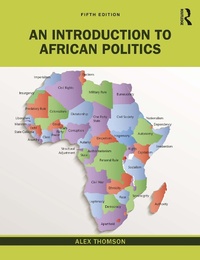
An Introduction to African Politics
5th Edition
Published on 30. December 2022
354 pages
978-1-000-81782-9 (ISBN)
Description

This fully updated fifth edition of An Introduction to African Politics is an ideal textbook for those new to the study of this fascinating continent.
Charting trends in government over six decades of the post-colonial era, the book tackles key questions such as: How have African states made sense of their colonial inheritance? How relevant are ethnic and religious identities? Why have some states collapsed and others prospered? Why did the one-party state fail? Why is contemporary Africa now dominated by electoral authoritarian states, and not the multi-party democracies promised in the 1990s?
Key features include:
thematically organised, with chapters exploring issues such as colonialism, ethnicity, nationalism, religion, social class, ideology, legitimacy, authority, sovereignty and democracy;
new five-part structure makes clearer Africa's political evolution over time;
new chapter on the emergence of 'hybrid states' and 'electoral authoritarianism';
more coverage of twenty-first century governance trends such as China's impact, the changing role of the military, different uses of 'client-patron' networks, Western conditionality and the 'Africa rising' debate;
colour presentation of maps, photos and data;
boxed case studies including Mali, Tanzania, Nigeria, Botswana, Cote d'Ivoire, Uganda, Somalia, Ghana, the Democratic Republic of the Congo, Tunisia and Angola;
each chapter concludes with key terms and definitions, questions and further reading.
An Introduction to African Politics is essential reading for students seeking an accessible introduction to the complex social relationships and events that characterise the politics of post-colonial Africa.
Charting trends in government over six decades of the post-colonial era, the book tackles key questions such as: How have African states made sense of their colonial inheritance? How relevant are ethnic and religious identities? Why have some states collapsed and others prospered? Why did the one-party state fail? Why is contemporary Africa now dominated by electoral authoritarian states, and not the multi-party democracies promised in the 1990s?
Key features include:
thematically organised, with chapters exploring issues such as colonialism, ethnicity, nationalism, religion, social class, ideology, legitimacy, authority, sovereignty and democracy;
new five-part structure makes clearer Africa's political evolution over time;
new chapter on the emergence of 'hybrid states' and 'electoral authoritarianism';
more coverage of twenty-first century governance trends such as China's impact, the changing role of the military, different uses of 'client-patron' networks, Western conditionality and the 'Africa rising' debate;
colour presentation of maps, photos and data;
boxed case studies including Mali, Tanzania, Nigeria, Botswana, Cote d'Ivoire, Uganda, Somalia, Ghana, the Democratic Republic of the Congo, Tunisia and Angola;
each chapter concludes with key terms and definitions, questions and further reading.
An Introduction to African Politics is essential reading for students seeking an accessible introduction to the complex social relationships and events that characterise the politics of post-colonial Africa.
Reviews / Votes
"This introduction to African politics provides a solid overview of the continent, through the presentation of a succession of thematic issues illustrated by the presentation of detailed case studies. The chapters' didactic approach and its systematic treatment of the interplay between state, civil society and external interests contributes to draw a comparative and global perspective that should help readers to get a better grasp of the rise of Africa phenomenon."Daniel C. Bach, CNRS Research Professor Emeritus, University of Bordeaux, France
"This new edition builds upon the insightful and penetrating observations and arguments of its predecessors. Balanced - giving in to neither excessive optimism nor pessimism - but inspiring. It makes African politics something living, human and seriously aspirational. A student of Africa could ask for no better introduction."
Stephen Chan OBE, SOAS University of London, UK
"In what is arguably the best textbook available on African politics, Alex Thomson offers an exhaustive and perceptive analysis of the African state and civil society in historical perspective, from the indigenous to colonialism and post (or neo) colonialism. The topics covered include, ideology; ethnicity; religion; social class; legitimacy; coercion and sovereignty. Each chapter is usefully complemented by a country case-study. In my opinion, this new edition of An Introduction to African Politics constitutes an excellent resource for undergraduate students but will also greatly benefit laypersons interested in the subject."
Guy Martin, Winston-Salem State University, USA
"A book that keeps on giving: this fifth edition remains the seminal introduction to African politics - an academically rigorous first read for students, business and policy interested in Africa."
Alex Vines OBE, Africa Director, Chatham House, UK
More details
Edition
5th edition
Language
English
Place of publication
London
United Kingdom
Publishing group
Taylor & Francis Ltd
Target group
College/higher education
Product notice
Reflowable
Illustrations
30 Tables, black and white; 14 Line drawings, color; 7 Line drawings, black and white; 5 Halftones, color; 17 Halftones, black and white; 19 Illustrations, color; 24 Illustrations, black and white
ISBN-13
978-1-000-81782-9 (9781000817829)
Copyright in bibliographic data and cover images is held by Nielsen Book Services Limited or by the publishers or by their respective licensors: all rights reserved.
Schweitzer Classification
Other editions
Additional editions

Alex Thomson
An Introduction to African Politics
Book
12/2022
5th Edition
Routledge
€160.93
Shipment within 15-20 days
Alex Thomson
An Introduction to African Politics
Book
12/2022
5th Edition
Routledge
€78.20
Shipment within 15-20 days
Person
Alex Thomson is an academic with three decades experience of teaching and researching African politics. He is currently a lecturer at Coventry University in the United Kingdom.
Content
Part 1: Introductions and the Historical Inheritance 1. Introduction: State, civil society and external interests 2. History: Africa's pre-colonial and colonial inheritance Part 2: The Dominant African State, 1960s-1970s 3. Ideology: Nationalism, socialism, populism and state capitalism 4. Ethnicity and religion: 'Tribes', gods and political identity 5. Social class: The search for class politics in Africa 6. Legitimacy: Neo-patrimonialism, personal rule and the centralisation of the African state 7. Coercion: Military intervention in African politics 8. Sovereignty I: External influences on African politics Part 3: The Weakened Africa State, 1980s-1990s 9. Sovereignty II: Neo-colonialism, structural adjustment and Africa's political economy 10. Authority: The crises of accumulation, governance and state collapse Part 4: The Re-fashioned African State, 1990s-present 11. Democracy: Multi-party elections re-legitimising the African state? 12. Hybrid regimes: 'Africa rising', stalled transitions, or something in-between? Part 5: Conclusions 13. Conclusions: The changing relationship between state, civil society and external interests in post-colonial Africa
