
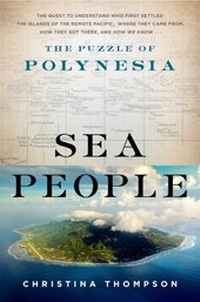
Sea People
Description
Alles über E-Books | Antworten auf Fragen rund um E-Books, Kopierschutz und Dateiformate finden Sie in unserem Info- & Hilfebereich.
For more than a millennium, Polynesians occupied the remotest islands in the Pacific Ocean, an enormous triangle stretching from Hawaii to New Zealand to Easter Island. Sailing in large, double-hulled canoes, without the benefit of maps, writing, or metal tools, these ancient mariners were the first and, until the era of European discovery, the only people ever to have reached this part of the globe. Today, they are widely acknowledged as the world's greatest navigators.
But how did the earliest Polynesians reach these far-flung islands? How did they conquer the largest ocean on the planet? Diving deep into the history of the Pacific, Christina Thompson explores this epic migration, following the trail of the many sailors, linguists, archaeologists, and geographers who have puzzled over this story in a quest to discover who these ancient voyagers were, where they came from, and how they managed to colonize every habitable island in the vast region of remote Oceania.
Sea People combines the wonder of pursuit and the drama of a gripping historical puzzle in a vivid tour of one of the most captivating regions in the world.
All prices
More details
Other editions
Additional editions
Person
Christina Thompson is the editor of Harvard Review and the author of Come On Shore and We Will Kill and Eat You All: A New Zealand Story, which was shortlisted for the Douglas Stewart Prize for Non-fiction and the William Saroyan International Prize for Writing. Her essays and criticism have appeared in numerous publications, including Vogue, the American Scholar, the Journal of Pacific History, and three editions of Best Australian Essays. She is the recipient of numerous fellowships and awards, including a National Endowment for the Arts Creative Writing Fellowship, a Writer's Grant from the Australia Council, and a National Endowment for the Humanities Public Scholar Award. A dual citizen of the US and Australia, she lives outside of Boston with her family.

System requirements
File format: ePUB
Copy protection: Adobe-DRM (Digital Rights Management)
System requirements:
- Computer (Windows; MacOS X; Linux): Install the free reader Adobe Digital Editions prior to download (see eBook Help).
- Tablet/smartphone (Android; iOS): Install the free app Adobe Digital Editions or the app PocketBook before downloading (see eBook Help).
- E-reader: Bookeen, Kobo, Pocketbook, Sony, Tolino and many more (not Kindle).
The file format ePub works well for novels and non-fiction books – i.e., „flowing” text without complex layout. On an e-reader or smartphone, line and page breaks automatically adjust to fit the small displays.
This eBook uses Adobe-DRM, a „hard” copy protection. If the necessary requirements are not met, unfortunately you will not be able to open the eBook. You will therefore need to prepare your reading hardware before downloading.
Please note: We strongly recommend that you authorise using your personal Adobe ID after installation of any reading software.
For more information, see our ebook Help page.
File format: ePUB
Copy protection: Watermark-DRM (Digital Rights Management)
System requirements:
- Computer (Windows; MacOS X; Linux): Use a reading software that can process the file format ePUB: e.g., Adobe Digital Editions or FBReader – both free (see eBook Help).
- Tablet/Smartphone (Android; iOS): Before downloading, install the free app Adobe Digital Editions (see eBook Help).
- E-reader: Bookeen, Kobo, Pocketbook, Sony, Tolino and many more (not Kindle).
The file format ePUB works well for novels and non-fiction books – i.e., „flowing” text without complex layout. On an e-reader or smartphone, line and page breaks automatically adjust to fit the small displays.
This eBook uses Watermark-DRM, a „soft” copy protection. This means that there are no technical restrictions to prevent illegal distribution. However, there is a personalised watermark embedded in the eBook that can be used to identify the purchaser of the eBook in the event of misuse and to provide evidence for legal purposes.
For more information, see our eBook Help page.