

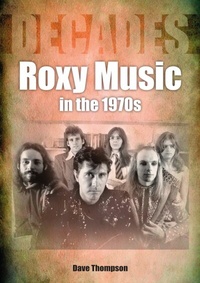
Roxy Music
Description

Between 1972 and 1976. and then again following their 1979 reunion, Roxy Music were arguably the most exciting, ambitious and vivacious band in the world. They comprised a core four piece of vocalist Bryan Ferry, guitarist Phil Manzanera, horn player Andy Mackay and drummer Phil Thompson, but also featured, at different times, Brian Eno and Eddie Jobson. Emerging during 1972's long, hot summer of glam rock, the band coud never be readily pigeonholed. The greatest records they made became, some of the greatest records of the age. 'Virginia Plain,' 'Pyjamarama,' 'Street Life,' 'All I Want Is You,' 'Love is the Drug,' 'Trash' and 'Dance Away' were the hits, but even the deepest cuts on the band's first five albums became anthems for a generation. Roxy were no ordinary band in other ways, too, as Ferry, Manzanera, Mackay and Eno all embarked upon solo careers, which, between them, were responsible for a complex catalogue of songs that stretches from vintage ballads to electronica, from Wagner's Valkyries to David Bowie's Low. This book encompasses all of that, documenting the histories of both band and band members, while analysing and detailing every album and single released by the Roxy family throughout the decade.
Dave Thompson is author of over 150 books, including the autobiographies of Sylvain Sylvain (New York Dolls), Walter Lure (the Heartbreakers), Motown legends Eddie and Brian Holland and Judy Dyble (Fairport Convention). His other books include biographies of David Bowie, Hawkwind, Roger Waters, Robert Plant, Sparks, John's Children, Jeff Beck and Kurt Cobain. Among his most recent publications are The Grunge Diaries 1990-1994, I Feel Love and Rozz Williams in his Own Words and Beyond (all 2021). Thompson's writing has also appeared in Mojo, Record Collector, Rolling Stone, Melody Maker, Q, Alternative Press and Goldmine. He lives in Delaware, USA.
All prices
More details
Other editions
Additional editions
Content
Beginnings
There are two ways to tell the Roxy Music story. One is to delve into background and biography, to tell how Washington, County Durham-born Bryan Ferry was a Fine Arts student with a sideline in local bands The Banshees, The Gas Board and City Blues (none of which went anywhere); was a former schoolmaster teaching pottery to the youth of Holland Park; an aspiring singer who auditioned for King Crimson but didn't get the job; how he met former Westminster choirboy Andy Mackay through an ad Ferry placed in Melody Maker; how Mackay introduced Brian Eno to the mix (an aspiring avant-gardist whose inability to play any instrument had already seen him recruited to the Portsmouth Sinfonia): of whom, a lot more later); how drummer Paul Thompson came down from Newcastle with his own string of previous bands behind him (but at least he'd cut a record - the crunching blues of 'Got A Bad Leg' - with the wonderfully-named Smokestack Crumble), and so forth. That's one way of doing it.
The other is to follow the musical threads that led first to Roxy and then in a score of other directions, while focusing only on the core members of the band - those we have already met, of course, and the one we haven't: London-born, Cuba-raised guitarist Phil Manzanera.
Other members came and went. Former The Nice guitarist Davy O'List was an ultimately ill-fitting recruit in the band's early days. Ex-Curved Air keyboardist Eddie Jobson unenviably replaced Eno in the lineup, and saw out the end of Roxy's first era. And every time you turned around, they seemed to have another bassist: including past-and-future members of The Big 3, Quatermass, King Crimson, Family, Milk 'N' Cookies and Sparks. Each of these and more will come and go here, because nobody can deny that they were in Roxy Music. But they were never Roxy itself. In which case, the story begins.
September 1970: Quiet Sun - Demos
Personnel:
Phil Manzanera (aka Philip Targett-Adams): guitar
Charles Hayward: drums
Bill MacCormick: bass
Dave Jarrett: keyboards
Tracks: 'Trot', 'Years Of The Quiet Sun'*
Available on: The Manzanera Archives Rare One
Manzanera, Hayward and MacCormick had already been playing together as Pooh and the Ostrich Feather when in 1970, they were reborn as Quiet Sun: a band modelled almost wholly on their love for - and friendship with - Soft Machine. MacCormick's mother worked alongside Robert Wyatt's as a teaching assistant at Dulwich Prep, at a time when Wyatt and his fellow Softs were living on nearby Dalmore Street. The Softs were initially closest to MacCormick's older brother Ian (better-known as journalist/author Ian 'I. Mac' MacDonald), but the young Bill was also a regular visitor to the house: watching as Messrs. Wyatt, Hopper, Ratledge and Dean rehearsed in the front room, studiously oblivious to the complaints of the neighbours. Their influence quickly rubbed off.
Pooh and the Ostrich Feather (I. Mac coined the name) had started life as a covers band, honing their chops on Cream, Jefferson Airplane and a clutch of blues covers. They made their live debut with a three-song showcase at general arts show The Summer Miscellany, staged in Dulwich College's Great Hall, and the school remained their primary audience thereafter.
Slowly, however, they began to morph as Hayward and Manzanera began contributing their own compositions. The band's first original was the latter's 'Marcel My Dada'. MacCormick recalls:
Soft Machine had become the major influence in the '69-70 period, for no other reason than they were the band I knew personally and they were, pretty much, everyone's favourite at the time. Robert Wyatt was instrumental in broadening our musical tastes, especially on the jazz side, and my brother and I were lucky to have a very good music section on our local library. We had always listened to a lot of 19th-century music (Beethoven, Brahms, Tchaikovsky, etc.), and then my brother moved into Stravinsky, Prokofiev and Shostakovich. Then it was on to Berg, Messiaen, etc. Charles (Hayward) was also into the obscure and downright weird. When we started to rehearse at his parents' house in Camberwell, he would play us the newest stuff he had found, during our tea breaks: things like the United States of America's first album. We also got into world music: gamelan, Bulgarian folk singing, Indian music, etc.
By the time all three members were out of school (Manzanera and MacCormick left in 1969; Hayward the following year), Quiet Sun were almost wholly instrumental. 'It was during rehearsals at Phil's mum's place that I started to learn the bass parts', says MacCormick, 'otherwise we would have been unable to rehearse'. Unfortunately, they had to drop most of the vocals, because 'I could either play bass or sing, but not really both. I did do some singing on. demos, but it wasn't a strength'.
Advertisements in Melody Maker called for 'a keyboard player in the Ratledge style', a bass player and a sax player. Dave Jarrett was first to answer their call, followed by a former Army bandsman: saxman and flautist Dave Monaghan. MacCormick: 'Dave was quite a bit older than us, and though he played on the first demos we recorded, his need for money was too pressing and he had to get a paid gig somewhere. We sent out the demos as a five-piece, but carried on as a four-piece. Quiet Sun was the name arrived at under which the demos were sent to record companies, journalists, etc.'.
The band's first demo comprised two songs - Manzanera's 'Trot', and 'Years Of The Quiet Sun' written by McCormick and his brother, and developing into a ten-minute piece cut deep within Soft Machine territory - noodling keys, relentless bass, splashy percussion and Monaghan's melodic horns - all shot through with occasional (and already unmistakably Manzanera-shaped) guitar. It was, initially, a well-starred offering. Melody Maker's Richard Williams was then authoring a column devoted to unknown bands' demo tapes, and Quiet Sun soon received their first-ever press mention. However, it was also their last: for now at least.
Already, Quiet Sun was operating on the very fringes of early-1970s prog, as Manzanera recalls: 'We spent much more time rehearsing than playing. We used to work up these amazing things and just practice them. It was very difficult to get gigs!'. Or to attract any further attention.
The labels to whom the tape had been sent, began responding. CBS turned the band down flat, and so did Liberty and Island. Indeed, the latter suggested 'Perhaps the guy who wrote the superb literate handout (that accompanied the tape) should stick to handouts ... I didn't think any of your music is that suitable for our label. Actually, I am not too knocked out with it, it seems to lack a lot of bite'. I. Mac - the author of that handout - certainly heeded that advice. The band members, however, were less prone to listen, because, amidst all the rejections, there came one ray of hope. Warner Brothers were impressed, and they wanted to hear more.
December 1970: The Portsmouth Sinfonia - Beethoven Today, Queen Elizabeth Hall, London
Personnel: Gavin Bryars, John Farley, Adrian Rifkin, James Lampard, Robin Mortimore, Brian Eno and others.
What became known as (but was never intended to be) the 'worst orchestra in the world' - The Portsmouth Sinfonia - was formed at Portsmouth Arts College in May 1970 as a one-off entrant in a spoof talent contest being organised by music teacher Gavin Bryars. The notion of an orchestra whose members needed to be either non-musicians or, if they could play something, take on an altogether different instrument, was not Bryars' alone. Fellow experimentalist Cornelius Cardew's similarly-inclined Scratch Orchestra got off the ground around a year earlier. As a short article in Source magazine (Issue 10) pointed out, however, the Sinfonia 'had nothing to do with ... the fringe of chaos (the Scratch Orchestra's stated destination); its members were interested in playing the popular classics to the best of their ability, without the gloss of technical expertise, but with a true enthusiasm for the enjoyment of their real entertainment value'. Neither was the talent show to be their sole adventure. So well-received was the Sinfonia's debut performance that they were soon plotting further shows. A flexi disc featuring that debut gig's version of the 'William Tell Overture' was distributed, and new blood was constantly offering to join the Sinfonia's ranks.
One such was an Ipswich-born student named Brian Eno. '(I'm) not sure exactly how I met Brian', Bryars mused, 'but he told me that he used to come to the concerts that John Tilbury and I did on the South Bank in 1969-71'. Now Eno was working for printmaker Ian Tyson, who handled many of Bryars' experimental scores, and when Bryars moved out of his small Kilburn flat for a new home in Ladbroke Grove, Eno moved in. By the time of the pre-Christmas Beethoven Today, he was the orchestra's clarinetist, adopting the instrument solely because his father could play it. Eno, on the other hand, couldn't. He, too,...
