

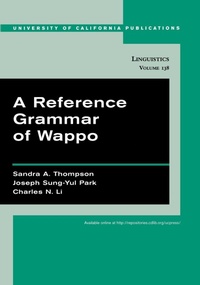
A Reference Grammar of Wappo
1st Edition
Published on 5. June 2006
190 pages
978-0-520-91610-4 (ISBN)
Description

Wappo is an indigenous language, generally regarded as a language isolate, which was once spoken in the Russian River Valley, just north of San Francisco, California. This reference grammar is based on the speech of Laura Fish Somersal, its last fluent speaker, who died in 1990, and represents the most extensive data and grammatical research ever done on this language. The grammar focuses on morphosyntax, particularly nominal, verbal, and clausal structures and clause combining patterns, from a functional/typological perspective.
More details
Other editions
Additional editions
Sandra A. Thompson | Joseph Sung-Yul Park | Charles N. Li
A Reference Grammar of Wappo
Book
06/2006
1st Edition
University of California Press
€55.80
Article not available at the moment
Persons
Sandra A. Thompson and Charles N. Li are Professors of Linguistics at the University of California at Santa Barbara. Joseph Sung-Yul Park is an Assistant Professor of English at the National University of Singapore.
Content
- Cover
- Contents
- List of Tables
- Preface
- Acknowledgements
- Abbreviations
- 1. PHONEMIC INVENTORY AND TRANSCRIPTION
- 2. WORD ORDER
- 3. THE NOUN PHRASE
- 3.1 Order of Elements
- 3.2 Associative Phrases
- 3.3 Case
- 3.3.1 Nominative: -i
- 3.3.2 Accusative: -Ø
- 3.3.3 Dative: -thu
- 3.3.4 Benefactive: -ma
- 3.3.5 Instrumental: -thi?
- 3.3.6 Comitative: -k'a
- 3.3.7 Genitive: -me?
- 3.3.8 Locative
- 3.3.9 Case in noun phrases
- 3.4 Number
- 3.5 Demonstratives
- 3.6 Conjoined NPs
- 3.7 Quantifiers
- 3.8 Non-referential Noun Phrases
- 3.9 Pronouns
- 3.9.1 Personal pronouns
- 3.9.2 Reflexive and reciprocal pronouns
- 3.9.3 The third-person co-referential pronoun
- A. Non-body-part genitives
- B. Complex sentences with dependent clauses
- 4. THE VERB PHRASE
- 4.1 Tense and Aspect
- 4.1.1 Habitual/progressive [ = DUR]
- A. Habitual use
- B. Progressive use
- 4.1.2 Stative [ = STAT
- -khi?]
- A. Simple states
- B. Resultant states
- 4.1.3 Past for actions [ = PST
- -ta?]
- A. Transitive verbs
- B. Intransitive verbs with no resulting state
- 4.1.4 Inchoative [ = INCH
- -is / -es]
- 4.1.5 Future [ = FUT
- -ya:mi? and -si?]
- A. -ya:mi?, more certain
- B. -si?, less certain
- 4.2 Paradigms
- 4.3 Verb Classes
- 4.3.1 DUR classes
- 4.3.2 IMP classes
- 4.3.3 INF classes
- 4.3.4 Pattern of epenthesis in verb paradigms
- A. The A form and B form
- B. Further stem changes
- B.1 DUR forms
- B.2 PST forms
- B.3 STAT forms
- B.4 FUT forms
- B.5 IMP forms
- B.6 NEG forms
- B.7 NEG:FUT and NEG:IMP forms
- B.8 INF forms
- B.9 CAUS forms
- B.10 PASS forms
- B.11 PURP forms
- B.12 -mime? 'go out and X' and -miti? 'go do X' forms
- C. Derivation of paradigms
- 4.4 Directional Prefixes
- 4.4.1 Speaker-oriented directional prefixes
- A. ma- and te-
- A.1 ma- 'away from speaker'
- A.2 te- 'toward speaker'
- B. mu- and tu- (used with a restricted set of verbs)
- B.1 mu- 'away from speaker (far)'
- B.2 tu- 'toward the speaker (from far away)'
- C. mo?o- 'away from speaker' and to?o- 'towards speaker'
- D. mo- 'away from speaker' and to- 'towards speaker'
- E. meh- 'away from speaker' and teh- 'towards speaker'
- 4.4.2 Non-speaker-oriented directional prefixes
- A. ho- 'around'
- B. meh- 'up'
- C. c'a- 'off, away'
- D. c'ah- 'out'
- E. pah- 'put together'
- F. pi- 'accidentally'
- 4.5 Mood
- 4.5.1 k'ah 'desiderative'
- 4.5.2 keye 'optative'
- 4.5.3 ne?-khi? 'deontic'
- 4.6 Imperative
- 4.7 Negation
- 4.8 Passive
- 4.9 Adverbs
- 4.10 Classificatory Verbs: Semantically Specific Verbs of Position and Motion
- 4.11 Evidentiality
- 4.12 The Reflexive and Reciprocal
- 4.12.1 The reflexive
- 4.12.2 The reciprocal
- 5. SIMPLE CLAUSE TYPES
- 5.1 Declarative Clauses
- 5.2 Questions
- 5.2.1 Yes-no questions
- 5.2.2 Question-word questions
- A. The position and use of question words
- B. The "indefinite" prefix i-
- C. Question words as indefinite pronouns
- 5.3 Comparatives
- 5.4 Predicate Nominal Clauses
- 5.5 Existential and Possession Clauses
- 5.5.1 Existential clauses
- 5.5.2 Possession clauses
- 6. COMPLEX SENTENCES
- 6.1 Conjunctions
- 6.1.1 wey 'and'
- 6.1.2 k'ota 'but'
- 6.1.3 cel' 'then'
- 6.1.4 thu? 'so, that's why'
- 6.2 Relativization
- 6.2.1 "Internal Head" constructions
- 6.2.2 The "postposing" strategy
- 6.2.3 "Free" relatives
- 6.3 Causative
- 6.3.1 The suffixal causative
- A. The form of suffixal causative verbs
- B. The form and function of suffixal causative clauses
- 6.3.2 The periphrastic causative
- 6.3.3 The choice between the suffixal and the periphrastic causative
- 6.3.4 The prefixal causative
- 6.4 Sentential Complements
- 6.4.1 Infinitive complements
- A. Subject infinitives
- B. Non-subject infinitives
- 6.4.2 Non-infinitive complements
- 6.4.3 Indirect questions
- A. Indirect question-word questions
- B. Indirect yes-no questions
- 6.5 Adverbial Clauses
- 6.5.1 Purpose clauses
- 6.5.2 Temporal clauses
- A. wen 'when'
- B. su?u 'after'
- C. yela 'before'
- 6.5.3 Conditionals
- A. cel' 'if'
- B. kha COND:NEG
- Appendix: Additional Verb Paradigms
- Bibliography
