

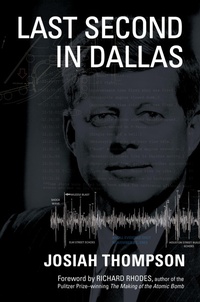
Last Second in Dallas
Description

In this long-awaited follow-up to his critically acclaimed 1967 classic, Six Seconds in Dallas, Josiah Thompson reveals major new forensic discoveries since the year 2000 that overturn previously accepted ?facts? about the Kennedy assassination. Together they provide what no previous book on the assassination has done?incontrovertible proof that JFK was killed in a crossfire.
Last Second in Dallas is not a conspiracy book. No theory of who did it is offered or discussed. Among the discoveries: The test showing that all recovered bullet fragments came from Oswald's rifle was mistaken. Several fragments could have come from bullets of any manufacturer and any caliber. The sudden two-inch forward movement of the president's head in the Zapruder film just before his head explodes is revealed to be an optical illusion caused by the movement of Zapruder's camera. This leaves without further challenge clear evidence that this shot came from a specific location to the right front of the limousine. Detailed analysis of film frames matched by the newly validated acoustic evidence show a second shot struck the president's head from behind less than a second later. Result: two killing shots to the head from opposite directions in the final second of the shooting?hence the book's title.
At once a historical detective story and a deeply personal narrative by a major figure in the field, Last Second in Dallas captures the drama and sweep of events, detailing government missteps and political bias as well as the junk science, hubris, and controversy that have dogged the investigation from the beginning. Into this account Thompson weaves his own eventful journey, that of a Yale-educated scholar who in 1976 resigned his tenured professorship in philosophy to become a private investigator in San Francisco, developing a national reputation.
Profusely illustrated, Last Second in Dallas features dozens of archive photographs, including Zapruder film frames reproduced at the highest clarity ever published.
More details
Other editions
Additional editions
Person
Josiah Thompson investigated numerous high-profile murder cases during his thirty-five-year career specializing in criminal defense, including the Oklahoma City bombing as defense investigator for Timothy McVeigh. Thompson's publications include two books on the Danish existentialist thinker Søren Kierkegaard and a memoir about his jump from professor to detective, Gumshoe. He and his wife Nancy live in northern California.
Content
Foreword by Richard Rhodes
Preface
Acknowledgments
Part I Beginnings?The 1960s
1. Dealey Plaza
2. LIFE Magazine
3. Witnesses: The Bystanders
4. Witnesses: The Police Officers
5. Witnesses: The Railroad Men
6. ?A Matter of Reasonable Doubt?
7. Puzzling the Pieces
8. Six Seconds in Dallas
9. Shooting Melons . . . and Coconuts, Pineapples, and Water Jugs . . .
Part II Aftermath?The 1970s
10. Changes?and a Good Night America Shocker
11. Acoustics
12. The House Select Committee on Assassinations
Part III Breaking the Impasse?The 2000s
13. Breaking the Impasse: The Puzzle Piece That Wasn't
14. Breaking the Impasse: The Blur Illusion
15. Breaking the Impasse: The Crucial Piece?the Final Shot
16. The Medical Evidence
Part IV The Signal in the Noise?2013-2017
17. The Ad Hoc Committee on Ballistic Acoustics
18. The Crosstalk Silver Bullet
19. The Resurrection of the Acoustics
20. ?I'll Check It?
21. Ramsey Panel Redux
22. Journey to the Lair of the Master
23. In the Cold Light of Science
24. The Last Second
Epilogue
Appendix A. Quantitative Analysis of Crosstalk Found in Audio Recorded During the JFK Assassination, James Barger
Appendix B. Signal Processing Results for Both DPD Audio Files, Richard Mullen
Notes
Illustration Credits
Index
About the Author
A photo gallery follows page 212
