

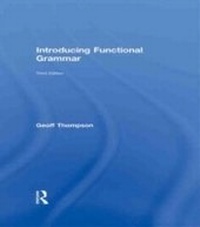
Introducing Functional Grammar
3rd Edition
Published on 18. July 2013
328 pages
978-1-135-98320-8 (ISBN)
Description

Introducing Functional Grammar, third edition, provides a user-friendly overview of the theoretical and practical aspects of the systemic functional grammar (SFG) model.
No prior knowledge of formal linguistics is required as the book provides:
An opening chapter on the purpose of linguistic analysis, which outlines the differences between the two major approaches to grammar - functional and formal.
An overview of the SFG model - what it is and how it works.
Advice and practice on identifying elements of language structure such as clauses and clause constituents.
Numerous examples of text analysis using the categories introduced, and discussion about what the analysis shows.
Exercises to test comprehension, along with answers for guidance.
The third edition is updated throughout, and is based closely on the fourth edition of Halliday and Matthiessen's Introduction to Functional Grammar. A glossary of terms, more exercises and an additional chapter are available on the product page at: https://www.routledge.com/9781444152678.
Introducing Functional Grammar remains the essential entry guide to Hallidayan functional grammar, for undergraduate and postgraduate students of language and linguistics.
No prior knowledge of formal linguistics is required as the book provides:
An opening chapter on the purpose of linguistic analysis, which outlines the differences between the two major approaches to grammar - functional and formal.
An overview of the SFG model - what it is and how it works.
Advice and practice on identifying elements of language structure such as clauses and clause constituents.
Numerous examples of text analysis using the categories introduced, and discussion about what the analysis shows.
Exercises to test comprehension, along with answers for guidance.
The third edition is updated throughout, and is based closely on the fourth edition of Halliday and Matthiessen's Introduction to Functional Grammar. A glossary of terms, more exercises and an additional chapter are available on the product page at: https://www.routledge.com/9781444152678.
Introducing Functional Grammar remains the essential entry guide to Hallidayan functional grammar, for undergraduate and postgraduate students of language and linguistics.
Reviews / Votes
This... is a more detailed and user-friendly introductionto an approach to grammar through meaning and function. Functional
grammar is presented here in a context that enables a broader
socio-cultural orientation to be shown of how language works. Thompson
does this with clarity and the engagement of his readers in the course
of ten chapters ... The book also provides a detailed index,
suggestions for answers to exercises, a comprehensive list of
references, as well as five pages of further reading, related to each
chapter. This is especially helpful for beginners and researchers, not
to mention teachers ... [It] serves as a most worthwhile introduction
to systemic functional grammar and should be on the bookshelf of those
working in the TESOL field.
Margaret Bade, NZSAL
More details
Edition
3rd edition
Language
English
Place of publication
London
United Kingdom
Publishing group
Taylor & Francis Ltd
Target group
College/higher education
Edition type
Revised edition
Product notice
Reflowable
Illustrations
Over 100 figures
File size
16,86 MB
ISBN-13
978-1-135-98320-8 (9781135983208)
Copyright in bibliographic data and cover images is held by Nielsen Book Services Limited or by the publishers or by their respective licensors: all rights reserved.
Schweitzer Classification
Other editions
Additional editions
Geoff Thompson
Introducing Functional Grammar
Book
10/2014
3rd Edition
Routledge
€63.90
Shipment within 10-20 days
Geoff Thompson
Introducing Functional Grammar
Book
07/2013
3rd Edition
Routledge
€186.70
Shipment within 15-20 days
Person
Geoff Thompson is Honorary Senior Fellow at the School of English, University of Liverpool.
Content
Foreword
Acknowledgements
Chapter 1: The purposes of linguistic analysis
Chapter 2: Recognizing clauses and clause constituents
Chapter 3: An overview of functional grammar
Chapter 4: Interacting: the interpersonal metafunction
Chapter 5: Representing the world: the experiential metafunction
Chapter 6: Organizing the message: the textual metafunction - theme
Chapter 7: Organizing the message: the textual metafunction - cohesion
Chapter 8: Clauses in combination
Chapter 9: Grammatical metaphor
Chapter 10: Implications and applications of functional grammar
Answers to exercises
Further reading
References
Index
Acknowledgements
Chapter 1: The purposes of linguistic analysis
Chapter 2: Recognizing clauses and clause constituents
Chapter 3: An overview of functional grammar
Chapter 4: Interacting: the interpersonal metafunction
Chapter 5: Representing the world: the experiential metafunction
Chapter 6: Organizing the message: the textual metafunction - theme
Chapter 7: Organizing the message: the textual metafunction - cohesion
Chapter 8: Clauses in combination
Chapter 9: Grammatical metaphor
Chapter 10: Implications and applications of functional grammar
Answers to exercises
Further reading
References
Index
