

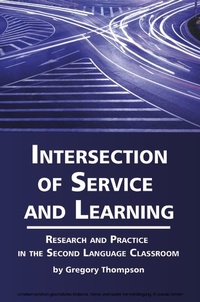
Intersection of Service and Learning
Research and Practice in the Second Language Classroom
1st Edition
Published on 1. April 2013
181 pages
978-1-61735-894-4 (ISBN)
Description

This book on service-learning provides a current view of service-learning research in the second language classroom and practical applications for the acquisition of both cultural knowledge as well as the different language modalities. This book helps in understanding how using service-learning in the language classroom can facilitate language acquisition. The author addresses many of the challenges faced by teachers in the second language classroom as they try to implement service-learning programs in their curriculum. Based on the research as well as the experience of the author and other practitioners in the field, suggestions are given in each chapter as to how to maximize student learning and acquisition of specific aspects of a language as well as on the formation of successful programs and service-learning experiences. These suggestions are integrated into the individual chapters based on the focus of the unit.
This text shows how service-learning allows students real world application of the language they are learning in the classroom. This text discusses how service-learning assists students in contextualizing their learning and seeing the reality of their field of study and the applicability of their language classes to settings that they encounter in their own communities. Finally, at all levels teachers, professors, and administrators are being asked to provide standards and assessments to demonstrate achievement and excellence in their different fields. This text addresses how service-learning aids students in meeting these proficiency standards and helps them achieve many of the goals set forth by national and international foreign/second language learning organizations.
All prices
More details
Other editions
Additional editions
Gregory Thompson
Intersection of Service and Learning
Research and Practice in the Second Language Classroom
Book
11/2012
Information Age Publishing
€62.40
Shipment within 3-4 weeks
Content
- Front Cover
- Intersection of Service and Learning
- Research and Practice in the Second Language Classroom
- CONTENTS
- 1. Introduction and History of Service-Learning in the Language Classroom 1
- 2. Service-Learning and Second Language Acquisition Theories 19
- 3. The Acquisition of Reading and Writing Through Service-Learning 37
- 4. The Acquisition of Speaking and Listening Through Service-Learning 49
- 5. The Acquisition of Culture Through Service-Learning 71
- 6. Using Service-Learning With Heritage Language Students 83
- 7. Service-Learning and Language Acquisition in the Study Abroad Context 99
- 8. The Future of Service-Learning in the Second Language Classroom 113
- Intersection of Service and Learning
- Research and Practice in the Second Language Classroom
- by
- Gregory Thompson University of Central Florida
- Information Age Publishing, Inc.
- Charlotte, North Carolina www.infoagepub.com
- Preface
- Acknowledgments
- CHAPTER 1
- Introduction and History of Service-Learning in the Language Classroom
- Reciprocity
- Reflection
- Development
- Meaningful Service
- Civic Responsibility
- Diversity
- History of Service-Learning
- Why Do Service-Learning?
- 1. It combines skills and knowledge with civic responsibility (Zlotkowski, 1998).
- 2. It is an interaction between people and helps make connections to other people.
- 3. It is experiential as well as academic.
- 4. In a "natural environment," "the focus is on the content of the communication rather than the form" (Mullaney, 1999).
- 5. There is a "need for building a relationship between what is taught in the classroom and what is utilized in the real world" (Hale, 1999).
- 6. Students will comprehend the "depth and complexity" of culture and will "understand more realistically the nature of human institutions, behavior, and culture" (Berry and Chisholm, 1999).
- 7. Service-learning has the "capacity to further international and intercultural literacy, knowledge, and sensitivity" (Berry and Chisholm, 1999).
- Standards-Based Education
- Communication
- Cultures
- Connections
- Comparisons
- Communities
- Service-Learning in Higher Education
- Notes
- Table 1.1. Benefits of Service-Learning
- Figure 1. 1. Relationship between service, learning, and the application of skills.
- Figure 1. 2. Five Cs from the American Council for the Teaching of Foreign Languages.
- Figure 2. 1. Types of input and feedback.
- CHAPTER 2
- Service-Learning and Second Language Acquisition Theories
- Input
- Output
- Interaction /Feedback
- Transfer of Learning
- Thorough and Diverse Practice
- Explicit Abstraction
- Active Self-Monitoring
- Arousing Mindfulness
- Using a Metaphor or Analogy
- Pedagogical Typologies
- Zone of Proximal Development
- Table 2.1. Typology of Service-Learning Pedagogical Frames
- CHAPTER 3
- The Acquisition of Reading and Writing Through Service-Learning
- Using guided reflections
- (a) What is the situation that is causing me to feel uneasy?
- (b) What actually happened?
- (c) What would the textbooks say to do?
- (d) How is this (situation) like or unlike those cases described in theory? (p. 308).
- Types of written discourse
- Translations
- Power Point Presentations
- Researched Biography
- Other types of written discourse
- 1. Clearly link the service experience to the course content and learning objectives.
- 2. Structure reflection in terms of description, expectations, and the criteria for assessing the activity.
- 3. Schedule reflection assignments regularly during the semester so that students can practice and develop the capacity to engage in deeper and broader reflection.
- 4. Provide feedback to help students improve critical analysis.
- 5. Include opportunities for students to explore and clarify their values.
- Conclusion
- CHAPTER 4
- The Acquisition of Speaking and Listening Through Service-Learning
- Study #1
- Location
- Participants
- Procedures
- Assignments
- Instruments
- Results and Discussion
- Study #2
- Conclusions
- Notes
- Figure 4. 2. Questionnaire results for SPN 4410.
- Figure 4. 1. Questionnaire results for SPN 3760.
- Figure 4. 3. Questionnaire results comparing SPN 3760 and SPN 4410 level of agreement.
- CHAPTER 5
- The Acquisition of Culture Through Service-Learning
- Critical consciousness theory
- Motivation and the acquisition of culture
- Six Benefits to Using Service-Learning in the Classroom
- 1. Expand students' awareness and understanding of social problems and their ability to address or personally respond to such problems.
- 2. Enable students to learn from a different segment of society than that with which he or she would normally interact.
- 3. Break down racial and cultural barriers through the process of students' reaching out and building bridges between different demographic groups.
- 4. Introduce students to an experiential style of learning.
- 5. Teach students the meaning of service, patience, cross-cultural understanding, interdependence, humility, and simplicity.
- 6. Teach students tools for self-evaluation and critical analysis of institutions, social systems, and their own contribution to and effect on a given community (p. 10).
- Developing Intercultural Sensitivity
- Conclusions
- Figure 6. 1. Nonnative and heritage students' perceptions of service-learning during the semester
- CHAPTER 6
- Using Service-Learning with Heritage Language Students
- Introduction
- Methodology
- Participants
- Procedures
- Instruments
- Results and Discussion
- Qualitative Results
- Conclusions
- Note
- Figure 6. 2. Heritage students' responses to the benefits of using service-learning for establishing career goals, promoting cultural understanding, and developing language skills.
- Table 7.1. Learning Outcomes, Teaching Strategies, and Logistical Needs for Program
- Table 7.1. (Continued)
- CHAPTER 7
- Service-Learning and Language Acquisition in the Study Abroad Context
- Use of homestay or dormitories while studying abroad
- Oral proficiency and study abroad
- Developing a service-learning program for study abroad
- 1. interact with, recognize, articulate, and understand definitions and principles of TESOL and sustainability projects abroad
- 2. recognize and analyze cross-cultural communication between various cultures
- 3. recognize and relate various theories and views about sustainability and English as an International Language and the applications of those theories/views to current practices
- 4. ore clearly understand the relationship between sustainability and tourism development (including the ethics of the English as a Foreign Language)
- 5. recognize and examine sustainability and educational practices that produce a more equitable and environmentally responsible society
- 6. recognize the impact of development on rural communities, including issues related to language study, job creation, and environmental impact
- and
- 7. critically analyze global issues of sustainability and English as an International Language, including linkages between the United States and other nations.
- Conclusions
- CHAPTER 8
- The Future of Service- Learning in the Second Language Classroom
- Recognition for service-learning
- Skill development through service-learning
- Assessing student success
- Technology and service-learning
- Future of service-learning
- 1. Establish and develop some relationships with some community service agencies near you. Most of these agencies are volunteer dependent and will jump at the chance of connecting your students with their programs. And with a good working relationshi...
- 2. Make sure the service is really service. In other words, do the activities that your students engage in really help people?
- 3. Spend at least 3-4 consecutive weeks at the same worksite. This develops a rapport between students and the people with whom they're working, and it gives students a chance to become more comfortable. There is inevitably an "ice breaking" pe...
- 4. Make sure the activities that the students are engaged in involve personal interaction with others. Remember that one of the main goals of this is providing meaningful language contexts. Students spending 2 hours digging a ditch by themselves may ...
- 5. Model the kind of involvement you expect from them. Don't just drop them off and pick them up. Participate in the service, setting an example for them to follow.
- 6. Challenge your students to take initiatives. If they sit back and wait for others to interact with them, they will miss opportunities to develop their English. Some students will be reluctant to step out of their comfort zones. But with some encou...
- 7. Pair quiet students with more outgoing ones. This will help increase the comfort level for quiet students, while encouraging them to step out.
- 8. Have students keep a journal for taking notes on their experiences and reflections. This will provide a basis for later classroom activities and language tasks and will help students track their journey.
- 9. Make sure you bring the service back into the classroom. The amount of reading and research on the issues which students do in the classroom will depend on their level and the space you have in your curriculum. But be sure that you connect the ser...
- 10. Be patient with your students and with the service-learning developments. It can take some time to find opportunities that work for your program. But with continual evaluation and student feedback, service-learning can have a great impact on your...
- References
- Appendix B: Results from Service-Learning Survey
- Appendixes
- Appendix A
- Student Evaluation
- At the beginning of the semester:
- Throughout the semester:
- Reflecting on the course and the entire service-learning experience:
- Appendix C: Service-Learning Contract
- Appendix D: Service-Learning Assignment Guidelines
- Appendix E: Oral Presentation Guidelines
- Background Information
- Appendix F
- Appendix G: Samples of Agencies
- Appendix H: Service-learning syllabus from an advanced Spanish conversation course
- Service-learning Project
- Service-Learning Partner Locations
- Service-Learning Reflections
- Guidelines
- 1. First you must determine where you want to conduct your service.
- 2. Let your professor know where you want to work. He/She will then tell you the contact person at your site. You must have his/ her approval for your choice and a signed agreement must be signed by you, the agency contact person, and your professor.
- 3. You should begin your service as soon as possible.
- 4. If circumstances arise that require a change in your schedule or limit your involvement, contact your professor and your site supervisor immediately. Do now wait until AFTER an emergency to let them know.
- Some Helpful Information
- Attendance and Participation
- News Presentations
- 1. Very natural
- with fluency.
- 2. Some pauses
- sometimes simple.
- 3. Long pauses
- interference from English or another language.
- 1. Well developed ideas
- clear and to the point.
- 2. Ideas mostly well developed, fairly clear and relevant.
- 3. Ideas not well developed
- unclear.
- 1. Broad in range
- precise.
- 2. Generally adequate for the course level.
- 3. Mostly inadequate or inaccurate
- interference from English or another language.0-6
- 1. Very accurate grammar
- appropriate for the course level.
- 2. Mostly accurate
- errors do not impeded comprehensibility.
- 3. Mostly inaccurate
- incomprehensible.
- 1. Excellent organization
- of great interest to the audience.
- 2. Good organization
- of some interest to the audience.
- 3. Disorganized
- of little interest to the audience.
- Group Presentations
- 1. Very natural
- with fluency.
- 2. Some pauses
- sometimes simple.
- 3. Long pauses
- interference from English or another language.
- 1. Well-developed ideas
- clear and to the point.
- 2. Ideas mostly well developed, fairly clear and relevant.
- 3. Ideas not well developed
- unclear.
- 1. Broad in range
- precise.
- 2. Generally adequate for the course level.
- 3. Mostly inadequate or inaccurate
- interference from English or another language.
- 1. Very accurate grammar
- appropriate for the course level
- no errors already discussed in class.
- 2. Mostly accurate
- errors do not impeded comprehensibility.
- 3. Mostly inaccurate
- incomprehensible
- many errors already discussed in class.
- 1. Excellent contribution to the success of the presentation
- of great interest to the audience
- excellent use of visual materials and handout.
- 2. Good contribution to the success of the presentation
- of some interest to the audience
- good use of visual materials and handout.
- 3. Poor contribution to the success of the presentation
- of little interest to the audience
- poor use of visual materials and handout.
- Individual Presentations
- 1. Very natural
- with fluency.
- 2. Some pauses
- sometimes simple.
- 3. Long pauses
- interference from English or another language.
- 1. Well-developed ideas
- clear and to the point
- excellent (exposition/argumentation).
- 2. Ideas mostly well developed, fairly clear and relevant
- good (exposition/argumentation).
- 3. Ideas not well developed
- unclear
- poor (exposition/ argumentation).
- 1. Broad in range
- precise.
- 2. Generally adequate for the course level.
- 3. Mostly inadequate or inaccurate
- interference from English or another language.
- 1. Very accurate grammar
- appropriate for the course level
- no errors already discussed in class.
- 2. Mostly accurate
- errors do not impeded comprehensibility.
- 3. Mostly inaccurate
- incomprehensible
- many errors already discussed in class.
- 1. Excellent organization
- of great interest to the audience
- excellent use of visual materials and handout.
- 2. Good organization
- of some interest to the audience
- good use of visual materials and handout.
- 3. Disorganized
- of little interest to the audience
- poor use of visual materials and handout.
- Writing Exercises
- Exams
- Grade Scale
- Figure 6.4. Non-native and heritage students' reflections on the entire service-learning experience.
- Figure 6.3. Non-native and heritage students' perceptions before the service-learning experience.
- About the Author
- Index
- Back Cover

