

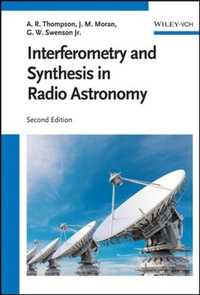
Interferometry and Synthesis in Radio Astronomy
2nd Edition
Published on 20. November 2008
XXIII, 692 pages
978-3-527-61785-2 (ISBN)
Description

Comprehensive, authoritative coverage of interferometric techniques for radio astronomy
In this Second Edition of Interferometry and Synthesis in Radio Astronomy, three leading figures in the development of large imaging arrays, including very-long-baseline interferometry (VLBI), describe and explain the technology that provides images of the universe with an angular resolution as fine as 1/20,000 of an arcsecond.
This comprehensive volume begins with a historical review followed by detailed coverage of the theory of interferometry and synthesis imaging, analysis of interferometer response, geometrical relationships, polarimetry, antennas, and arrays. Discussion of the receiving system continues with analysis of the response to signals and noise, analog design requirements, and digital signal processing.
The authors detail special requirements of VLBI including atomic frequency standards, broadband recording systems, and antennas in orbit. Further major topics include:
* Calibration of data and synthesis of images
* Image enhancement using nonlinear algorithms
* Techniques for astrometry and geodesy
* Propagation in the neutral atmosphere and ionized media
* Radio interference
* Related techniques: intensity interferometry, moon occultations, antenna holography, and optical interferometry
Interferometry and Synthesis in Radio Astronomy, Second Edition is comprehensive in that it provides an excellent overview of most radio astronomical instrumentation and techniques.
In this Second Edition of Interferometry and Synthesis in Radio Astronomy, three leading figures in the development of large imaging arrays, including very-long-baseline interferometry (VLBI), describe and explain the technology that provides images of the universe with an angular resolution as fine as 1/20,000 of an arcsecond.
This comprehensive volume begins with a historical review followed by detailed coverage of the theory of interferometry and synthesis imaging, analysis of interferometer response, geometrical relationships, polarimetry, antennas, and arrays. Discussion of the receiving system continues with analysis of the response to signals and noise, analog design requirements, and digital signal processing.
The authors detail special requirements of VLBI including atomic frequency standards, broadband recording systems, and antennas in orbit. Further major topics include:
* Calibration of data and synthesis of images
* Image enhancement using nonlinear algorithms
* Techniques for astrometry and geodesy
* Propagation in the neutral atmosphere and ionized media
* Radio interference
* Related techniques: intensity interferometry, moon occultations, antenna holography, and optical interferometry
Interferometry and Synthesis in Radio Astronomy, Second Edition is comprehensive in that it provides an excellent overview of most radio astronomical instrumentation and techniques.
Reviews / Votes
"this edition meets current demands by providing a comprehensive account of the techniques used today." (La Doc STI, May 2001)"...the up-to-date edition of Thompson...with its exhaustive bibliography, becomes the indispensable source of background for those already in, or considering, radio astronomy." (The Observatory, Vol. 122, No. 1166, February 2002)
More details
Other editions
Additional editions
A. Richard Thompson | James M. Moran | George W. Swenson
Interferometry and Synthesis in Radio Astronomy
Book
07/2024
2nd Edition
Wiley-VCH
€189.00
Available immediately
AR Thompson
Interferometry and Synthesis in Radio Astronomy
Software
12/2007
Wiley-VCH
€282.45
No shipping information available

A. Richard Thompson | James M. Moran | George W. Swenson
Interferometry and Synthesis in Radio Astronomy
Book
05/2001
2nd Edition
Wiley-VCH
€175.00
Article exhausted; check for reprint
Persons
A. RICHARD THOMPSON, PhD, has been associated with the National Radio Astronomy Observatory in numerous capacities for more than 27 years.
JAMES M. MORAN, PhD, is a senior scientist at the Smithsonian Astrophysical Observatory and Professor of Astronomy at Harvard University.
GEORGE W. SWENSON, Jr., PhD, is Professor Emeritus of Electrical Engineering and of Astronomy at the University of Illinois at Urbana-Champaign.
JAMES M. MORAN, PhD, is a senior scientist at the Smithsonian Astrophysical Observatory and Professor of Astronomy at Harvard University.
GEORGE W. SWENSON, Jr., PhD, is Professor Emeritus of Electrical Engineering and of Astronomy at the University of Illinois at Urbana-Champaign.
Content
Preface to the Second Edition.
Preface to the First Edition.
Introduction and Historical Review.
Introductory Theory of Interferometry and Synthesis Imaging.
Analysis of the Interferometer Response.
Geometric Relationships and Polarimetry.
Antennas and Arrays.
Response of the Receiving System.
Design of the Analog Receiving System.
Digital Signal Processing.
Very-Long-Baseline Interferometry.
Calibration and Fourier Transformation of Visibility Data.
Deconvolution, Adaptive Calibration, and Applications.
Interferometer Techniques for Astrometry and Geodesy.
Propagation Effects.
Van Cittert-Zernike Theorem, Spatial Coherence, and Scattering.
Radio Interference.
Related Techniques.
Principal Symbols.
Author Index.
Subject Index.
Preface to the First Edition.
Introduction and Historical Review.
Introductory Theory of Interferometry and Synthesis Imaging.
Analysis of the Interferometer Response.
Geometric Relationships and Polarimetry.
Antennas and Arrays.
Response of the Receiving System.
Design of the Analog Receiving System.
Digital Signal Processing.
Very-Long-Baseline Interferometry.
Calibration and Fourier Transformation of Visibility Data.
Deconvolution, Adaptive Calibration, and Applications.
Interferometer Techniques for Astrometry and Geodesy.
Propagation Effects.
Van Cittert-Zernike Theorem, Spatial Coherence, and Scattering.
Radio Interference.
Related Techniques.
Principal Symbols.
Author Index.
Subject Index.
