

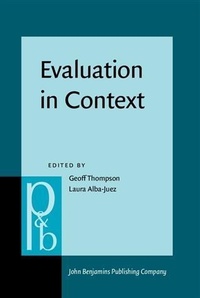
Evaluation in Context
1st Edition
Published on 4. February 2014
XI, 418 pages
978-90-272-7072-6 (ISBN)
Description

It is now an acknowledged fact in the world of linguistics that the concept of evaluation is crucial, and that there is very little - if any - discourse that cannot be analyzed through the prism of its evaluative content. This book presents some of the latest developments in the study of this phenomenon. Released more than a decade later than Hunston and Thompson's (2000) Evaluation in Text, Evaluation in Context is designed as its sequel, in an attempt to continue, update and extend the different avenues of research opened by the earlier work. Both theoretical and empirical studies on the topic are presented, with the intention of scrutinizing as many of its dimensions as possible, by not only looking at evaluative texts, but also considering the aspects of the discursive context that affect the final evaluative meaning at both the production and reception stages of the evaluative act. The editors' main objective has been to gather contributions which investigate the manifold faces and phases of evaluation by presenting a wide variety of perspectives that include different linguistic theories (e.g. Axiological Semantics, Functionalism or Politeness Theory), different levels of linguistic description (e.g. phonological, lexical or semantic), and different text types and contexts (e.g. the evaluation found in ironic discourse, the multimodality of media discourse or the world of politics, just to name a few). The volume can be of use not only for scholars who study the evaluative function of language, but also for students who wish to pursue research in the area.
More details
Other editions
Additional editions
Geoff Thompson | Laura Alba-Juez
Evaluation in Context
Book
02/2014
John Benjamins Publishing Co
€104.94
Shipment within 10-15 days
Persons
Content
- Evaluation in Context
- Editorial page
- Title page
- LCC data
- Dedication page
- Table of contents
- Acknowledgements
- Preface
- Section 1. Introduction
- 1. The many faces and phases of evaluation
- 1. The interdisciplinary study of values and its evolution through time
- 2. Evaluation as a multifarious, context-dependent phenomenon
- 3. Our definition of evaluation
- 4. About this book
- Notes
- References
- Section 2. Theoretical considerations and approaches to evaluation
- 2. The emergence of axiology as a key parameter in modern linguistics
- 1. Introduction
- 2. The axiological parameter in the structuralist tradition
- 2.1 French-speaking structuralist linguists
- 2.2 Structuralist linguists from other origins
- 3. The axiological parameter in the transformational-generative tradition
- 3.1 The axiological component and the meaning of good in the semantic theory of Jerrold J. Katz and
- 3.2 The heterogeneous contributions of Edward S. Klima and Maria L. Grzegorek
- 4. Conclusions
- Acknowledgements
- Notes
- References
- 3. Affect and emotion, target-value mismatches, and Russian dolls
- 1. Introduction
- 2. ATTITUDE in the appraisal model
- 3. Issues in ATTITUDE
- 3.1 Issue 1: the scope of affect
- 3.2 Issue 2: Target/Value mismatches
- 3.3 Issue 3: the 'Russian doll' syndrome
- 4. Conclusion
- Notes
- References
- 4. Appraising Appraisal
- 1. Introduction
- 2. Outline of APPRAISAL choices
- 2.1 ATTITUDE
- 2.2 GRADUATION
- 3. Three challenges of APPRAISAL analysis
- 4. Methodology for analysis - one view of its role in reader positioning
- 5. One methodology
- 6. Conclusions
- Notes
- References
- 5. The evaluative palette of verbal irony
- 1. Introduction
- 2. Theoretical background
- 2.1 Evaluation in Linguistics and Philosophy
- 2.2 Irony and evaluation
- 3. Discussion and analysis
- 4. Empirical study
- 4.1 The survey
- 4.2 Results
- 5. Conclusions
- Notes
- References
- 6. The implementation of the axiological parameter in a verbal subontology for NLP
- 1. Introduction
- 2. The axiological axis in the verbal lexicon: theoretical remarks
- 3. Axiological representation and distribution in FGKB core ontology
- 3.1 Syntactic features of MPs: Operators
- 3.2 Conceptual features of MPs: Predications and satellites
- 3.3 Distribution of basic and terminal concepts among the metaconcepts
- 3.4 Distribution of concepts from the core ontology in the axiologically-loaded dimensions
- 4. Conclusions
- Acknowledgement
- Notes
- References
- 7. The evaluative function of situation-bound utterances in intercultural interaction
- 1. Introduction
- 2. Characteristics of Situation-Bound Utterances
- 3. Do SBUs have evaluative functions?
- 4. Role of context in processing SBUs in intercultural encounters
- 4.1 Context and semantic analyzability
- 4.2 Context-dependency
- 4.3 Context and common ground
- 5. Conclusion
- References
- 8. Prosody, information structure and evaluation
- 1. Introduction
- 2. Information structure
- 2.1 Basic distinctions
- 2.2 Duration and the repetition of background information
- 3. Evaluation in language
- 4. Research questions
- 5. Research procedure and results
- 5.1 Pilot test
- 5.2 Main test
- 5.3 Cross-dialectal differences
- 6. The evaluative function of prosodic lengthening
- 7. Conclusions
- Notes
- References
- 9. The evaluation of intonation: pitch range differences in English and in Spanish
- 1. Introduction
- 2. Experimental procedure
- 2.1 Data recording
- 2.2 Stimuli
- 2.3 Perception test
- 3. Results
- 4. Discussion
- 5. Conclusion
- References
- Section 3. Evaluation in different contexts
- 10. "An astonishing season of destiny!" Evaluation in blurbs used for advertising TV series
- 1. Introduction
- 2. Advertising language and the DVD blurb
- 3. Corpus and methodology
- 3.1 Corpus
- 3.2 Methodology
- 4. Findings
- 4.1 Step 1
- 4.2 Step 2
- 4.3 Step 3: Moving beyond the "raw" corpus
- 5. Testing the findings
- 6. Conclusion
- Notes
- References
- Appendix
- 11. Graduation within the scope of Attitude in English and Spanish consumer reviews
- 1. Aims and framework of the study
- 2. The corpus
- 3. The Appraisal system
- 3.1 Main categories
- 3.2 Graduation within the scope of Attitude
- 4. Results and discussion
- 4.1 Global findings
- 4.2 Specific findings
- 5. Conclusions and suggestions for further research
- Notes
- References
- 12. Register diversification in evaluative language: the case of scientific writing
- 1. Introduction
- 2. Techniques for a corpus-based analysis of evaluation
- 2.1 Extraction of modal adverbs and evaluative patterns
- 2.2 Extracting instances with constraints in syntagmatic context
- 3. Analyses of evaluative expressions in context
- 3.1 Analysis 1 - evaluative expressions specific to scientific language
- 3.2 Analysis 2 - evaluative expressions across scientific disciplines
- 3.3 Analysis 3 - evaluative expressions and their syntagmatic context
- 4. Summary and discussion
- Notes
- References
- 13. The role of negative-modal synergies in Charles Darwin's Origin of Species
- 1. Introduction
- 1.1 Motivation and research questions
- 1.2 Darwin's The Origin of Species and The Voyage of the Beagle
- 2. Theoretical background
- 3. Data and method
- 4. Results
- 4.1 Keyword analysis
- 4.2 Types of stance
- 5. Discussion: Discourse functions and types of stance
- 5.1 High subjective stance: First person personal pronouns, verbs of cognition, modal verbs and ne
- 5.2 Objective stance
- 5.3 Bare disclaims (strong negative assertion)
- 6. Conclusion
- Notes
- References
- 14. Exploring academic argumentation in course-related blogs through ENGAGEMENT
- 1. Introduction
- 2. Blogs as a space for academic argumentation
- 2.1 Use of blogs in the course
- 3. Methodology
- 4.
- 4.1 Engagement strategies: Quantitative analysis
- 4.2 Engagement strategies: Qualitative analysis of argument construction in blogs
- 4.3 Pedagogical implications
- 5. Conclusion
- References
- 15. Multimodal analysis of controversy in the media
- 1. Introduction
- 2. Multimodal analysis
- 3. Sample and study
- 4. Text analysis
- 4.1 Evaluative elements in text
- 4.2 Voice
- 4.3 Headlines
- 4.4 Images
- 5. Discussion
- 6. Conclusions
- References
- 16. The expression of evaluation in weekly news magazines in English
- 1. Introduction
- 2. Background
- 3. Data and methodology
- 4. Linguistic patterns and strategies in the expression of evaluation in news magazines
- 4.1 Pattern A: Copular constructions
- 4.2 Pattern B: Clefts and other focus constructions
- 4.3 Pattern C: Lexical markers
- 4.4 Pattern D: Markers of modality
- 4.5 Pattern E: Further devices
- 5. The place of evaluation in news articles and implications for the organization of the text
- 5.1 Evaluative markers that help organize the discourse
- 6. Conclusion
- Notes
- References
- Appendix
- 17. Evaluative phraseological choice and speaker party/gender
- 1. Situating the study
- 1.1 Preliminaries
- 1.2 Aim(s) and issues
- 1.3 Methodology
- 1.4 Research design and data: the corpus/ corpora
- 2. The study: it is * time to/ for/ that: Quantitative findings
- 3. The study: it is * time to/ for/ that: From quantitative to qualitative findings
- 3.1 An overview of interpersonal meanings in the corpora
- 3.2 What is it time for who to do?
- 3.3 Coupling evaluation and transitivity in HoR
- 3.4 Additional specifically gendered findings
- 4. Parting thoughts
- Notes
- References
- Appendix
- 18. Evaluation in emotion narratives
- 1. Introduction1
- 2. Data
- 3. Sample narrative 'Hijo no quiere salir'
- 4. Evaluation: sharing feelings
- 4.1 Pragmatic markers as stallers
- 4.2 Profusion of imagery and details
- 4.3 Dialogue
- 4.4 Repetitions and repairs
- 5. Conclusions
- Notes
- References
- Appendix
- 19. Evaluative discourse and politeness in university students' communication through SNSs
- 1. Introduction and aims of the study
- 2. Theoretical framework: politeness and appraisal theory
- 3. Data and method
- 3.1 Interactional vs. transactional function
- 4. Distinctive features of SNSs that facilitate the production of appraisal and positive politeness
- 4.1 Interactional vs. transactional function
- 4.2 Interpersonal versus ideational meaning
- 4.3 Dialogic frame
- 5. Results: appraisal and positive politeness in the construction of communities of shared feelings
- 6. Conclusions
- Acknowledgments
- References
- Index
