

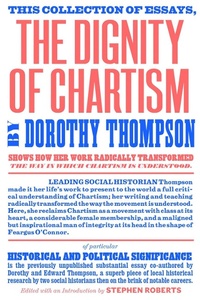
The Dignity of Chartism
Published on 19. May 2015
240 pages
978-1-78168-850-2 (ISBN)
Description

This is the first collection of essays on Chartism by leading social historian Dorothy Thompson, whose work radically transformed the way in which Chartism is understood. Reclaiming Chartism as a fully blown working-class movement, Thompson intertwines her penetrating analyses of class with groundbreaking research uncovering the role played by women in the movement.
Throughout her essays, Thompson strikes a delicate balance between on-the-ground accounts of local uprisings, snappy portraits of high-profile Chartist figures as well as rank-and-file men and women, and more theoretical, polemical interventions.
Of particular historical and political significance is the previously unpublished substantial essay coauthored by Dorothy and Edward Thompson, a superb piece of local historical research by two social historians then on the brink of notable careers.
Throughout her essays, Thompson strikes a delicate balance between on-the-ground accounts of local uprisings, snappy portraits of high-profile Chartist figures as well as rank-and-file men and women, and more theoretical, polemical interventions.
Of particular historical and political significance is the previously unpublished substantial essay coauthored by Dorothy and Edward Thompson, a superb piece of local historical research by two social historians then on the brink of notable careers.
More details
Edition
Ebook UK & RoW
Language
English
Place of publication
London
United Kingdom
Product notice
Reflowable
ISBN-13
978-1-78168-850-2 (9781781688502)
Copyright in bibliographic data and cover images is held by Nielsen Book Services Limited or by the publishers or by their respective licensors: all rights reserved.
Schweitzer Classification
Other editions
Additional editions
Persons
Dorothy Thompson (1923-2011) was a social historian, a leading expert on the Chartist movement, including The Chartists, Outsiders: Class, Gender and Nation and Queen Victoria.
Stephen Roberts is historian of Victorian Britain, with a particular interest in Chartism. He has written or edited a number of well-known books on this subject. He was taught, as both an undergraduate and postgraduate, by Dorothy Thompson. He is currently Visiting Research Fellow in Victorian History at Newman University, Birmingham.
Stephen Roberts is historian of Victorian Britain, with a particular interest in Chartism. He has written or edited a number of well-known books on this subject. He was taught, as both an undergraduate and postgraduate, by Dorothy Thompson. He is currently Visiting Research Fellow in Victorian History at Newman University, Birmingham.
Content
- Intro
- Halftitle Page
- Title Page
- Copyright Page
- Dedication
- Contents
- Acknowledgements
- Editorial Note
- Introduction: Rethinking the Chartist Movement: Dorothy Thompson (1923-2011) by Stephen Roberts
- I. Interpreting Chartism
- 1. Chartism as an Historical Subject
- 2. The Languages of Class
- 3. Who Were 'the People' in 1842?
- 4. Women Chartists
- 5. 'The Question "What is a Chartist?" Answered': Chartist Tracts
- 6. Chartist Autobiographies
- II. A Local Study
- 7. Chartism in the Industrial Areas
- 8. 'The Dignity of Chartism': Halifax as a Chartist Centre (with E. P. Thompson)
- III. The Leaders of the People
- 9. 'The Most Well-Loved Man': Feargus O'Connor
- 10. 'A Radical until the End of His Days': George Julian Harney
- 11. 'The Best-Remembered Chartist': Ernest Jones
- 12. 'Two of the Most Influential of Radical Voices': John Fielden and Joseph Sturge
- IV. Repercussions
- 13. The Chartists in 1848
- 14. The British State and Chartism
- 15. The Post-Chartist Decades
- V. Looking Back
- 16. Reflections on Marxist Teleology
- Further Reading
- Index
