

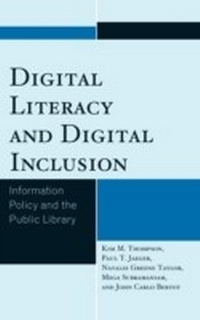
Digital Literacy and Digital Inclusion
Information Policy and the Public Library
1st Edition
Published on 20. August 2014
200 pages
978-0-8108-9272-9 (ISBN)
Description

Digital Literacy and Digital Inclusion: Information Policy and the Public Library examines the interrelationships between digital literacy, digital inclusion, and public policy, emphasizing the impacts of these policy decisions on the ability of individuals and communities to successfully participate in the information society.
This book is the first detailed consideration of digital literacy and digital inclusion as policy problems and as core issues in information policy and libraries. The unique features of this book include
drawing together the key themes and findings from the discourse on digital literacy and digital inclusion widely spread among many fields;analyzing digital literacy and digital inclusion as policy issues, both being driven and regulated by policy;building on a wealth of original research conducted by the authors using different quantitative and qualitative data collection approaches on four different continents when analyzing these issues, providing unique examples, case studies, and perspectives; using information behavior theory to provide important insights about these issues at individual, community, and political levels; providing recommendations to inform practice in libraries and help libraries to frame their advocacy for public policies that support literacy and inclusion; and providing policy recommendations to improve the creation and implementation of policy instruments that promote digital literacy and digital inclusion.
The authors of this book have been involved in this research for many years, and their experience provides a broad view across the literature, inherent problems, and national perspectives. This breadth allows this book to offer comprehensive policy recommendations, solutions, and best practices for an area that is fragmented in discourse, practice, and policy.
This book is the first detailed consideration of digital literacy and digital inclusion as policy problems and as core issues in information policy and libraries. The unique features of this book include
drawing together the key themes and findings from the discourse on digital literacy and digital inclusion widely spread among many fields;analyzing digital literacy and digital inclusion as policy issues, both being driven and regulated by policy;building on a wealth of original research conducted by the authors using different quantitative and qualitative data collection approaches on four different continents when analyzing these issues, providing unique examples, case studies, and perspectives; using information behavior theory to provide important insights about these issues at individual, community, and political levels; providing recommendations to inform practice in libraries and help libraries to frame their advocacy for public policies that support literacy and inclusion; and providing policy recommendations to improve the creation and implementation of policy instruments that promote digital literacy and digital inclusion.
The authors of this book have been involved in this research for many years, and their experience provides a broad view across the literature, inherent problems, and national perspectives. This breadth allows this book to offer comprehensive policy recommendations, solutions, and best practices for an area that is fragmented in discourse, practice, and policy.
More details
Edition
1. Auflage
Language
English
Place of publication
New York
United States
Publishing group
Bloomsbury Publishing Plc
ISBN-13
978-0-8108-9272-9 (9780810892729)
Copyright in bibliographic data and cover images is held by Nielsen Book Services Limited or by the publishers or by their respective licensors: all rights reserved.
Schweitzer Classification
Other editions
Additional editions
Kim M. Thompson | Paul T. Jaeger | Natalie Greene Taylor
Digital Literacy and Digital Inclusion
Information Policy and the Public Library
Book
08/2014
Rowman & Littlefield Publishers
€123.10
Shipment within 10-20 days
Persons
Kim M. Thompson, PhD, is lecturer in the School of Information Studies of the Charles Sturt University and an affiliate faculty member of Information Policy and Access Center (iPAC) in the College of Information Studies at the University of Maryland. Her research and teaching focus on information poverty and the physical, intellectual, and socio-cultural supports for and barriers to information access. Her articles are found in the Journal of Documentation, Public Library Quarterly, Library Quarterly, and Library and Information Science Research, among others.
Paul T. Jaeger, PhD, JD, is associate professor and diversity officer of the College of Information Studies and co-director of the Information Policy and Access Center at the University of Maryland. He is the author of more than one hundred and thirty journal articles and book chapters. This is his ninth book. His other recent books include Information Worlds: Social Context, Technology, and Information Behavior in the Age of the Internet with Gary Burnett; and Public Libraries and the Internet: Roles, Perspectives, and Implications. Dr. Jaeger is co-editor of Library Quarterly and the Information PolicyBook Series from MIT Press, and associate editor of Government Information Quarterly.
Natalie Greene Taylor is a research associate and doctoral candidate of the Information Policy and Access Center (iPAC) in the College of Information Studies at the University of Maryland. She has published articles in Library and Information Science Research, Public Library Quarterly, Information Polity, and International Journal of Public Administration in the Digital Age, among others.
Mega Subramaniam,PhD, is assistant professor and associate director of the Information Policy and Access Center (iPAC) in the College of Information Studies at the University of Maryland. She is the co-editor of School Library Research, and she has published articles in Library Quarterly, School Library Research, Library Trends, Journal of Librarianship and Information Science, and many more.
John Carlo Bertot, PhD, is professor and co-director of the Information Policy and Access Center in the College of Information Studies at the University of Maryland. He is president of the Digital Government Society of North America and serves as chair of the International Standards Organization's Library Performance Indicator (ISO 11620). Bertot is editor of Government Information Quarterly and Co-Editor of Library Quarterly.
Paul T. Jaeger, PhD, JD, is associate professor and diversity officer of the College of Information Studies and co-director of the Information Policy and Access Center at the University of Maryland. He is the author of more than one hundred and thirty journal articles and book chapters. This is his ninth book. His other recent books include Information Worlds: Social Context, Technology, and Information Behavior in the Age of the Internet with Gary Burnett; and Public Libraries and the Internet: Roles, Perspectives, and Implications. Dr. Jaeger is co-editor of Library Quarterly and the Information PolicyBook Series from MIT Press, and associate editor of Government Information Quarterly.
Natalie Greene Taylor is a research associate and doctoral candidate of the Information Policy and Access Center (iPAC) in the College of Information Studies at the University of Maryland. She has published articles in Library and Information Science Research, Public Library Quarterly, Information Polity, and International Journal of Public Administration in the Digital Age, among others.
Mega Subramaniam,PhD, is assistant professor and associate director of the Information Policy and Access Center (iPAC) in the College of Information Studies at the University of Maryland. She is the co-editor of School Library Research, and she has published articles in Library Quarterly, School Library Research, Library Trends, Journal of Librarianship and Information Science, and many more.
John Carlo Bertot, PhD, is professor and co-director of the Information Policy and Access Center in the College of Information Studies at the University of Maryland. He is president of the Digital Government Society of North America and serves as chair of the International Standards Organization's Library Performance Indicator (ISO 11620). Bertot is editor of Government Information Quarterly and Co-Editor of Library Quarterly.
Content
Acknowledgments
List of Acronyms
List of Figures and Tables
Preface
Chapter 1: Introduction and Overview
Chapter 2: The Evolution of the Digital Society
Chapter 3: Defining Digital Literacy and Digital Inclusion
Chapter 4: Public Policy, Literacy, and Inclusion
Chapter 5: Libraries as Institutions of Digital Literacy and Inclusion
Chapter 6: Models of Digital Inclusion: South Korea, the Netherlands, and Australia
Chapter 7: Moving Toward Digital Inclusion: Colombia, Honduras, and Ghana
Chapter 8: Recommendations for Policy, Practice, Advocacy, and Research
References
About the Authors
List of Acronyms
List of Figures and Tables
Preface
Chapter 1: Introduction and Overview
Chapter 2: The Evolution of the Digital Society
Chapter 3: Defining Digital Literacy and Digital Inclusion
Chapter 4: Public Policy, Literacy, and Inclusion
Chapter 5: Libraries as Institutions of Digital Literacy and Inclusion
Chapter 6: Models of Digital Inclusion: South Korea, the Netherlands, and Australia
Chapter 7: Moving Toward Digital Inclusion: Colombia, Honduras, and Ghana
Chapter 8: Recommendations for Policy, Practice, Advocacy, and Research
References
About the Authors
