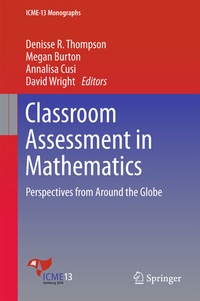
Classroom Assessment in Mathematics
Description

This book consists of 13 papers developed by participants in the ICME 13 Topic Study Group 40 on Classroom Assessment. The individual papers discuss various aspects of classroom assessment, focusing particularly on formative assessment as assessment for learning, and are grouped into four main sections: Examples of Classroom Assessment in Action, Technology as a Tool for Classroom Assessment, Statistical Models for Formative Assessment, and Engaging Teachers in Formative Assessment. The book opens with a brief discussion of the use of formative assessment as a critical component of the teaching-learning process and concludes with an overview of lessons learned and ideas for future research. It is of interest to classroom teachers, university teacher educators, professional development providers and school supervisors.
Reviews / Votes
"This book provides a resourceful information about the formative assessment in the field of math education. As a new and developing concept, formative assessment needs to be studied and addressed from more perspectives. This volume is a good start. Teachers, researchers, educators, policy makers can take this book as a resource to consider in what way formative assessment can be better used as an integral instrument to promote students' learning of math." (Bingqian Wei, MAA Reviews, November 29, 2018)More details
Other editions
Additional editions