

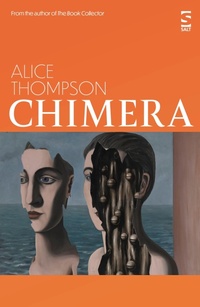
Chimera
Published on 15. May 2023
192 pages
978-1-78463-255-7 (ISBN)
Description

Alice Thompson's gripping, deep space novel sees scientist and dream investigator Artemis travelling to the distant moon of Oneiros. Her ship, the Chimera has been sent to look for organisms that will help assuage Earth's global warming, but it becomes clear on the journey that there are other disturbing reasons for the mission.
Accompanied by dryads, sophisticated AIs with synthetic bodies, nothing is quite as it seems, even desire. This is a story of transfiguration, dreams and identity. Are we just a template of memories and experiences, or is there something that makes us uniquely human?
Accompanied by dryads, sophisticated AIs with synthetic bodies, nothing is quite as it seems, even desire. This is a story of transfiguration, dreams and identity. Are we just a template of memories and experiences, or is there something that makes us uniquely human?
Reviews / Votes
Chimera is a restatement of that old science fiction question "What is it that makes us human?", but Thompson takes a very distinctive approach, the notion of "dreams as poetic metaphors of thought" allowing for explorations of the nature of consciousness and where it resides, the fear of losing one's identity, the omnipresence of AI, the frightening implications of virtual reality and the suggestion of forces powerful enough to override both machine programming and human nature - all overlapping and interacting with each other in interesting and inventive ways. -- Alastair Mabbott * The Herald * Set in a not-so-distant future, Alice Thompson's eighth work of fiction, Chimera, is just that: a chimera of a novel. It also happens to be the name of the spaceship sent on a follow-up expedition to the Moon Oneiros. The mission is to look for micro-organisms that might alleviate the critical levels of carbon dioxide on Earth. But soon enough, we sense there is also a darker purpose. -- Afric McGlinchey * Bookmunch * The book opens with a prologue in which a couple have been reunited following the woman's return from Oneiros, a distant moon. Whatever happened during her mission has left her with impaired memory, and lacking the resentments felt before she left. She starts to write a novel, and it is this that makes up the bulk of the tale. -- Jackie Law * neverimitate * Alice Thompson is one of British fiction's best kept secrets. She has produced playful and provocative novels in several genres - supernatural, espionage, crime and postmodern metafiction. Chimera, her first book in eight years, is profound, accessible and entertaining sci-fi. -- Andy Hedgecock * Morning Star * Novels about artificial intelligence are formally obliged to ask what it means to be human ... this conundrum is the crankhandle of Chimera's inventively unsettling plot. It will have you second-guessing the schlockier details: the technocratic ruling class being called the "ElITe", a character opening a dryad's "cranium hardware" and deadpanning the line: "his sense of self had gone askew". It will also convince you that giving away our dreams and words on the cheap might prove just as catastrophic as pillaging the Earth. -- Ash Caton * The Glasgow Review of Books * Chimera's great accomplishment is its articulation of the feeling that, when we look out to space, we see the same planets and stars that ancient civilizations saw. Certainly it seems signifificant that, when the crew reaches the base on Oneiros, a virtual reality programme depicts their surroundings as a Roman villa - "an odd combination of ancient opulence and high-tech". Life on a spaceship can be austere, devoid of warmth or desire, even fresh air. Thompson counterbalances her account of this existence with the oldest set of references in the English-speaking world. She gives us an AI named Troy, a fountain of poetry and philosophy (everything from Plato to e. e. cummings). His role, it seems, is to process human history as the crew crosses the cosmos, "faster than the speed of light", into unknown territory. -- Lily Herd * TLS *More details
Language
English
Place of publication
Cambridge
United Kingdom
Illustrations
Not illustrated
File size
0,45 MB
ISBN-13
978-1-78463-255-7 (9781784632557)
Copyright in bibliographic data and cover images is held by Nielsen Book Services Limited or by the publishers or by their respective licensors: all rights reserved.
Schweitzer Classification
Other editions
Additional editions
Person
Alice Thompson was born in Edinburgh. She is the former keyboard player of post-punk eighties band, The Woodentops. She won The James Tait Black Memorial Prize for Justine. Her second novel, Pandora's Box, was shortlisted for The Stakis Prize for Scottish Writer of the Year. Her other novels are Pharos, The Falconer, The Existential Detective, Burnt Island, The Book Collector and, most recently, Chimera. She is a lecturer in Creative Writing at Edinburgh University.
Content
- Intro
- TITLE PAGE
- DEDICATION
- EPIGRAPH
- CONTENTS
- PROLOGUE
- SHIP
- CHAPTER 1
- CHAPTER 2
- CHAPTER 3
- CHAPTER 4
- CHAPTER 5
- CHAPTER 6
- CHAPTER 7
- CHAPTER 8
- CHAPTER 9
- CHAPTER 10
- CHAPTER 11
- CHAPTER 12
- CHAPTER 13
- MOON
- CHAPTER 14
- CHAPTER 15
- CHAPTER 16
- CHAPTER 17
- CHAPTER 18
- CHAPTER 19
- CHAPTER 20
- CHAPTER 21
- CHAPTER 22
- CHAPTER 23
- CHAPTER 24
- CHAPTER 25
- CHAPTER 26
- CHAPTER 27
- EARTH
- CHAPTER 28
- CHAPTER 29
- CHAPTER 30
- CHAPTER 31
- CHAPTER 32
- EPILOGUE
- ACKNOWLEDGEMENTS
- ABOUT THIS BOOK
- ABOUT THE AUTHOR
- ALSO BY ALICE THOMPSON
- COPYRIGHT
