

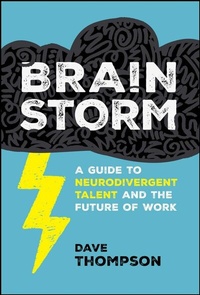
Brainstorm
Description

Redesign the Future of Work with Neurodiversity in Mind
Brainstorm: A Guide to Neurodivergent Talent and the Future of Work is a bold, practical guide to rebuilding work from the ground up. It shows that inclusion is more than the right thing to do, it is essential to business success. With raw honesty, sharp storytelling, and real-world tools, Brainstorm challenges tired corporate narratives and equips leaders, managers, and teams to unlock overlooked talent. Drawing on the voices of people across industries and ways of thinking, including trailblazers, business leaders, and academics, it highlights how work must be built for every kind of mind.
Written by Dave Thompson, a pioneering self-advocate, educator, and innovator in the field of neurodiversity employment for over a decade, this book shows readers how to:
- Build environments that empower people across every cognitive profile
- Rethink "accommodations" as Success Enablers that fuel performance and growth
- Foster psychological safety, allyship, and trust in teams of every size
- Rethink hiring, management, and retention practices to expand your talent pipeline
- Tackle real workplace obstacles like communication breakdowns, burnout, and bias
For employers of all sizes and industries, Brainstorm delivers an urgent call to action: stop forcing people to fit a system that was not designed for them. Instead, rewire the system itself and watch innovation, productivity, and engagement surge, and see everyone win.
More details
Other editions
Additional editions
Person
DAVE THOMPSON is an educator, strategist, and TEDx speaker who helps organizations better understand, hire, support, and leverage the strengths of neurodivergent professionals. An early-identified ADHDer and dyslexic thinker, he grew up navigating systems not built for brains like his and now works to redesign them. Dave, a Visiting Scholar at Vanderbilt University's Frist Center for Autism and Innovation, speaks to audiences from Fortune 500 leaders to professionals and advocates, bringing lived experience, systems expertise, and big-picture thinking to complex change. Outside of work, he's a dad, a husband, and a former New Yorker living near Nashville.
This is just the beginning. Join us at www.BrainstormNeurodiversity.com
Content
Introduction xi
Chapter 1 We're Not What's Broken: Understanding Neurodivergence 1
Chapter 2 Enter the Next Normal: Exploring Neurodiversity in an Evolving Workplace 13
Chapter 3 Make the Case: Understanding Why Neuroinclusion Matters 27
Chapter 4 Tackle the Truth: Challenging Bias and Stereotypes 41
Chapter 5 Let People Show Up: Building Safety and Shifting Culture 55
Chapter 6 Save the Environment: Designing Workspaces 67
Chapter 7 Sync or Swim: Rethinking Communication 83
Chapter 8 Let People Deliver: Empowering Individual Success 99
Chapter 9 Manage What Matters: Leading with Clarity and Trust 115
Chapter 10 Humanize Hiring: Moving from Outreach to Onboarding 135
Chapter 11 Break Through Barriers: Removing Systemic Roadblocks 155
Chapter 12 Put It into Practice: Making Change Sustainable 171
Conclusion 183
Doodle Descriptions 191
Notes 199
Acknowledgment 217
About the Author 221
Index 223
CHAPTER 1
We're Not What's Broken: Understanding Neurodivergence
Why don't we see penguins in the middle of a hot, dry desert? Or elephants on icebergs? Or dolphins in bathtubs? Of course, it's not because of anything wrong with them. Each has evolved to thrive in specific surroundings. A penguin's feathers keep it warm in the cold, not cool in the heat. An elephant's feet are designed to hold up their enormous weight on solid ground. A bathtub, even a big one, lacks the salinity, filtration, oxygenation, and temperature control a dolphin requires. We commonly celebrate each of these creatures' uniqueness as a strength, but they weren't built to thrive just anywhere.
Biodiversity refers to the variety of life, encompassing plants, animals, microbes, and ecosystems. More diversity means more stability and adaptability. Each species plays a different role. When environments shift, some organisms survive, adjust, or adapt. Nature thrives when it's not all the same.1 When considering a vacation, more of us would likely pick a place that's teeming with life than one that can't sustain more than a few tough critters.
This compares well to neurodiversity, which is a natural, positive biological reality. The wider the variation in how we think, learn, communicate, and perceive the world, the better off we all are. Put simply, nature tells us that more brains are better.
So, what's the problem?
In this chapter, we'll challenge the idea that neurodivergent people need fixing and demonstrate how most struggles stem not from the person but from a poor fit between the brain and its environment.
A World Built for Some
Today's workplace didn't evolve naturally; it was built by imperfect humans to meet immediate human wants and needs. Everything from social norms to math, software, cars, and office buildings: these are fabricated neuronormative frameworks, meaning they're aligned with neurotypical behaviors, communication styles, and learning patterns.2
Take reading, for example: While it may seem like it's an essential part of being human, it's one of the newest things we've asked our brains to do. Our species has been around for about 300,000 years, but reading only showed up roughly 7,000 years ago. We weren't built for it but rather reward those who adapt to it.3
Billions of brains move through this socially constructed workplace ecosystem, no two alike. For ND thinkers, that can make us feel like penguins in the desert.
When something only fits some of us while others are left floundering or missing, the whole system suffers. But even those who, from an outside perspective, seem tailor-made for these boxes, like a bigshot CEO, are part of neurodiversity. And they can likely name some things that don't quite work for them. Their privilege, autonomy to do things differently, and the resources at their disposal are often the only differences. I've seen the concept as a helpful entry point to fostering broader engagement in building something better for everyone, regardless of whether they identify as ND or not.
Neurodivergent means your brain is different. It's not a diagnosis or disorder, but rather a way of describing natural cognitive variation. The term flips the script from a medical model to a social one, asking, "What needs to change around this person?" instead of, "What's wrong with them?"
The neurodiversity paradigm tells us that the bar should not be set by those who fit the mold. In fact, there shouldn't be a bar or a mold. Research tells us that "there is no universally optimal profile of brain functioning-just a wide range of ways brains can work."4
Branding matters, and this rebrand has significant real-world benefits. How we talk about cognitive differences shapes how people are treated, as well as how we see ourselves. Research demonstrates that deficit-based language activates stress responses and reinforces stigma, while strength-based language supports emotional resilience and inclusion.5
Who We Are
Commonly, the ND identity has been adopted by, and associated with, people with cognitive differences, including ADHD, which is known to affect attention, energy, and impulse control. But ADHD can also fuel drive, spontaneity, and creative problem-solving.6 JetBlue founder David Neeleman once said that "with the disorganization, procrastination and inability to focus, and all the other bad things that come with ADHD, there also come creativity and the ability to take risks."7 I spoke with David for this book, and in Chapter 11, you'll hear how those same traits helped him reimagine air travel and lead with purpose.
Autism, which shapes how someone experiences communication, sensory input, and social connection, is also associated with deep focus, attention to detail, and creative problem-solving.8 John Elder Robison is an engineer, entrepreneur, and renowned autism advocate who designed onstage effects for bands like KISS and Pink Floyd, founded a high-end European car restoration business, and helped pioneer neurodiversity advocacy at universities. He believes that "autistic people have unique contributions to make to the world because of their difference," and his story illustrates that well.9
Dyslexia comes with challenges in reading and spelling, but often brings strengths in visual thinking, pattern recognition, and innovation.10 Dr. Catherine Drennan, a biochemist and professor at MIT, has said there "is no dyslexia ceiling," emphasizing that her neurodivergent thinking helped unlock breakthroughs in enzyme structure and scientific visualization. Her story is a powerful example of how dyslexia can enhance pattern recognition and creative problem-solving in even the most technical fields.11
These big three are a great place to start, but they just scratch the surface. We shouldn't consider the concept of ND thinking as anything less than limitless. We'll be hearing from many ND voices throughout the book whose identities span far beyond these descriptors. Let's discuss a few more identities to get us thinking differently about what neurodivergence might mean.
Synesthesia links the senses. For example, some people might see music or hear colors.12 Pharrell Williams, American musician, songwriter, record producer, and fashion designer, describes "When you're hearing music, you see it in color. I know when something is in key because it either matches the same color or it doesn't feel right."13
Prosopagnosia is a condition that makes it hard, or impossible, to recognize faces.14 Brad Pitt has spoken publicly about his suspected prosopagnosia, saying, "It's a mystery to me, man. I can't grasp a face," a challenge that has left others misreading him as distant or rude. "So many people hate me because they think I'm disrespecting them," he explained, highlighting the social strain that often comes with being misunderstood.15
People with aphantasia don't visualize things in their minds.16 Blake Ross, co-creator of Firefox, discovered this identity as an adult, describing his mind as "a computer without a monitor." Yet he built one of the most successful browsers of all time.17
Left-handedness might not be a diagnosis, but it is a brain difference that requires adapting to a right-handed world. Jimi Hendrix famously flipped and restrung his guitar to suit his left-handed playing style. He didn't adjust to the instrument; he made the instrument adjust to him.18
My teachers blamed my left hand for my handwriting struggles, never considering that I was also dyslexic. Desks, scissors, spiral notebooks, guitars, and even chalkboards assume you're right-handed, forcing constant workarounds, adapting, contorting. Experiences like these are a common thread that bonds ND thinkers together.
Neurodivergence is an identity. While neurodivergent has gained massive attention since it was coined in 2000, others may refer to themselves using other words, like neurodistinct or even neurospicy.19 Many don't align themselves with the neurodiversity movement at all.
What We Aren't
We're not a monolith, and we don't exist in a vacuum. We have different lived experiences. Our brains, experiences, and perspectives are vast. Charlotte Valeur, a corporate governance leader and neurodiversity advocate diagnosed as autistic at 52, put it this way: "We are everywhere in everything, all layers, all cultures, but all marginalised to degrees, which is something that needs to stop."20
Even within our brains, we're not just one thing. There's a high degree of co-occurrence of these differences. About 25 to 40 percent of individuals with ADHD also have dyslexia.21 Many of us also navigate other marginalized identities, including those who are LGBTQIA+, disabled, or from racial and ethnic groups historically excluded from opportunity. These overlapping identities act as margin multipliers, intensifying the social hurdles and power imbalances we face.
Individual support needs vary greatly. Eileen Shaklee, a neurodivergent mother of a son with high support needs, reminds us that no one should need to...
