

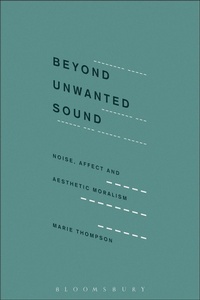
Beyond Unwanted Sound
Noise, Affect and Aesthetic Moralism
1st Edition
Published on 9. February 2017
216 pages
978-1-5013-1333-2 (ISBN)
Description

Noise is so often a 'stench in the ear' - an unpleasant disturbance or an unwelcome distraction. But there is much more to noise than what greets the ear as unwanted sound.
Beyond Unwanted Sound is about noise and how we talk about it. Weaving together affect theory with cybernetics, media histories, acoustic ecology, geo-politics, sonic art practices and a range of noises, Marie Thompson critiques both the conservative politics of silence and transgressive poetics of noise music, each of which position noise as a negative phenomenon. Beyond Unwanted Sound instead aims to account for a broader spectrum of noise, ranging from the exceptional to the banal; the overwhelming to the inaudible; and the destructive to the generative. What connects these various and variable manifestations of noise is not negativity but affectivity. Building on the Spinozist assertion that to exist is to be affected, Beyond Unwanted Sound asserts that to exist is to be affected by noise.
Beyond Unwanted Sound is about noise and how we talk about it. Weaving together affect theory with cybernetics, media histories, acoustic ecology, geo-politics, sonic art practices and a range of noises, Marie Thompson critiques both the conservative politics of silence and transgressive poetics of noise music, each of which position noise as a negative phenomenon. Beyond Unwanted Sound instead aims to account for a broader spectrum of noise, ranging from the exceptional to the banal; the overwhelming to the inaudible; and the destructive to the generative. What connects these various and variable manifestations of noise is not negativity but affectivity. Building on the Spinozist assertion that to exist is to be affected, Beyond Unwanted Sound asserts that to exist is to be affected by noise.
Reviews / Votes
[Thompson's] overarching narrative is contemporary and relevant with interesting examples ... A thoroughly engaging read. * The Wire * Beyond Unwanted Sound establishes Marie Thompson is one of the most exciting scholars of sound, noise and music. Theoretically adventurous, this book weaves together thinkers as disparate as Michel Serres, Murray Schafer and Claude Shannon, building a strong theoretical edifice for the closely-observed case studies which follow. Thompson's analysis of the creative work of Throbbing Gristle, Christian Marclay, Diamanda Galas and dozens of others make this a rich survey of the ways in which sound, noise and music disrupt situations, assert identities and invite moral judgments. * Will Straw, Professor of Communications, McGill University, Canada * Marie Thompson shows 'noise' to be essential to any medium or communicative act by deftly mobilising an eclectic set of resources - from Spinoza and Shannon to Diamanda Galas. Unwanted sound is incisively characterised as relationally, contextually affirmed, rather than as an objectifiable, morally appreciable phenomenon. We are thus urged to heed sound that might tomorrow be heard as new music, as a creatively organised affective force that 'once-was-noise'. Beyond Unwanted Sound is definitely a wanted, and thoroughly needed, contribution to the fast growing field of sound studies. * Sally Jane Norman, Professor of Performance Technologies, Sussex Humanities Lab, University of Sussex, UK * Go ahead and try not to listen to the provocative and insinuating stylings of this Spinozist noise-merchant! Just be forewarned that Marie Thompson's compelling book will redistribute the capacities of your body and its sensorium in ways that bring crystal clarity to the clamorous. Brilliantly engaging with theories of affect, Thompson shows how noise - stretching beyond annoyance and avoidance - is deeply constitutive in setting the terms of relation, opening up potentials that can often be joyous, even generative. Witness how noise thrives in places - musical and otherwise - where you perhaps least expect it. If there was ever a book that deserved to be turned up to ten (eleven?), it is this one! * Gregory J. Seigworth, co-editor of The Affect Theory Reader and Capacious: Journal for Emerging Affect Inquiry and Professor, Millersville University, USA *More details
Edition
1. Auflage
Language
English
Place of publication
New York
United States
Publishing group
Bloomsbury Publishing PLC (Digital)
ISBN-13
978-1-5013-1333-2 (9781501313332)
Copyright in bibliographic data and cover images is held by Nielsen Book Services Limited or by the publishers or by their respective licensors: all rights reserved.
Schweitzer Classification
Other editions
Additional editions
Book
02/2017
Bloomsbury Academic USA
€55.89
Shipment within 15-20 days
Person
Marie Thompson is a Lecturer in Media, Sound and Culture at Lincoln School of Film and Media, University of Lincoln, UK. She is the co-editor of Sound, Music, Affect: Theorizing Sonic Experience (Bloomsbury, 2013).
Content
Introduction: Noise - A Useless Concept?
Chapter 1: What Noise Has Been: Subject-Oriented and Object-Oriented Definitions
Chapter 2: What Does Noise Do?
Chapter 3: The Parasite and its Milieu
Chapter 4: From Negativity to Affectivity: Thinking of Noise as Affect
Chapter 5: Acoustic Ecology, Aesthetic Moralism and the Politics of Silence
Chapter 6: Exposure, Sensation and the Transgressive Poetics of Noise Music
Conclusion: Broadening the Spectrum
Bibliography
Index
Chapter 1: What Noise Has Been: Subject-Oriented and Object-Oriented Definitions
Chapter 2: What Does Noise Do?
Chapter 3: The Parasite and its Milieu
Chapter 4: From Negativity to Affectivity: Thinking of Noise as Affect
Chapter 5: Acoustic Ecology, Aesthetic Moralism and the Politics of Silence
Chapter 6: Exposure, Sensation and the Transgressive Poetics of Noise Music
Conclusion: Broadening the Spectrum
Bibliography
Index
