

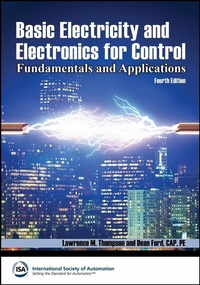
Basic Electricity and Electronics for Control: Fundamentals and Applications, 4e Textbook & Lab Workbook Set
Description

This proven, time-tested book, Basic Electricity and Electronics for Control: Fundamentals and Applications, teaches readers about electricity and electronics in industrial measurement and control. It is designed to be student-focused, with an emphasis on practical applications. Even when covering mathematical and algebraic concepts, the explanations are clear and easy to understand without relying on complex operations or math. However, a basic understanding of mathematics is necessary to fully grasp and apply the content.
Safety remains a top priority, and this book offers detailed guidance on measuring electrical quantities safely and effectively. It also thoroughly explains how to use digital and analog meters, bridges, power supplies, solid-state circuitry, oscilloscopes and analog-to-digital converters.
In addition to expanding on the topics in the previous edition, the Fourth Edition now includes a lab workbook that helps students better understand the material through exercises that simulate real-world tasks in vocational, industrial and occupational fields. Together, the textbook and workbook will support student success in any basic technician training course.
More details
Other editions
Additional editions
Persons
Lawrence (Larry) M. Thompson was the owner and general manager of ESdat Co. (Electronic Systems: development and training company), a consulting firm specializing in industrial data communications. Throughout his distinguished career, Thompson served as a technician, technical trainer, and course developer in electronics, measurement/control, and computer networking. A 20-year veteran of the US Air Force, Thompson specialized in maintaining electronic encryption equipment during his service. His post-military industrial experience included positions as a technician, test engineer, and test engineering supervisor for numerous companies.
Thompson held a bachelor's degree in applied arts and science from Tarleton State University and worked on a master's degree in computer science at the University of Texas. He retired from his role as Department Chair for E-Commerce Technology at Texas State Technical College to run his own consulting business full time. He served as an adjunct instructor for the International Society of Automation (ISA) for more than 35 years. He wrote several books, including ISA's Industrial Data Communications and Basic Electrics/Electronics for Control, and was a Certified Automation Professional (CAP).
Dean Ford, CAP, PE, is the Managing Principal Engineer at Luminary Automation and Engineering, LLC, a firm he cofounded. His entire 25-plus year career has involved automation systems engineering and consulting. Initially stumbling into the profession via a co-op opportunity at Anheuser-Busch in 1994, he fell in love with the automation. The ability to see how things are made and learn the science and processes behind automation energize him.
Ford develops and leads a dedicated and passionate staff of automation professionals. He is a licensed Control Systems Engineer in 24 states and a Certified Automation Professional (CAP). Ford is a senior member of the International Society of Automation (ISA), and he participates in many industry standards committees. He is an active member of many industry groups including the American Water Works Association (AWWA), Water Environment Federation (WEF), and Smart Water Networks Forum (SWAN). He serves on the Government Relations and Workforce Development committees for the Automation Federation, educating the public and policy makers about the critical role automation plays in the future. Ford also serves as the chair of the AWWA Water Utility Technology and Automation Committee (WUTAC).
Content
A Note from Larry Thompson xvii
Acknowledgments xix
About the Authors xxi
Introduction xxiii
Prologue xxv
Introduction 1
Module 1 Electrical Basics 3
Module 1: Objectives 3
Module 2 Basic Electric Characteristics 39
Module 3 Electrical Measurement Tools 91
Module 4 Bridges 137
Module 5 AC Measurement 157
Module 6 Solid-State Components 179
Module 7 Operational Amplifiers 209
Module 8 Analog and Digital Conversion 231
Module 8 Objectives 231
Module 9 Digital Logic 257
Module 10 Industrial Applications 275
Appendix A: Resistors 291
Appendix B: Module Review Answers 299
Index 325
1
Electrical Basics
This module discusses the basics of electrical current flow and the laws governing the relationship between potential measured in voltage, resistance measured in ohms, and the resulting energy transfer called current measured in amperes (colloquially, amps).
Module 1: Objectives
After successfully completing this module, you will be able to:
Demonstrate that there must be a potential difference for work to be done (or current to flow).
Determine if there is a complete path to and from the source for current to flow.
Define and determine the three most commonly measured electrical values: volts, amps, and ohms.
Learn how to convert very large and very small numbers into a significant number form.
Explain Kirchhoff's first and second laws and Ohm's law, and solve circuit value problems requiring knowledge of those laws.
Determine total resistance values for series and parallel circuits.
Module 1A: Energy
Simply stated, for any work to be performed, there must be sufficient energy to accomplish the work. What is energy? Physics tells us that work is described as "force through a distance." An electric current can transfer energy; that is, the "source" of energy can be physically separated from the point where the work is to be performed. An electric current will transfer energy from the source (where the energy is located) to accomplish work at the load. The energy in an electric current will perform the work as well as transfer the energy from some distance.
But how do we define electrical energy?
Potential
For there to be energy for work to be performed, there must be a difference in the levels of energy at the point where the work is to be performed. This is a commonsense or an intuitive concept. Water will not flow unless the source water is at a higher level. In fact, the water analogy was the first to be used for electric concepts.
If there is no water in the tower, then there will be no water pressure. The height of a water column determines the pressure exerted at the bottom of the column. In the case of Figure 1-1, this pressure causes a flow of water through the water wheel. The pressure at the bottom of the drain is the lowest pressure in the system. Energy has been transferred from the water tower through the water wheel because of the difference in pressure between the water tower and at the drain. This is the first of a series of important observations: If there is no pressure difference, there is no energy to be transferred or transformed. Because of the difference in energy, fluid will flow in the piping, operate the water wheel, and exhaust at the drain. The pressure difference itself did not power the water wheel; the flow did. But there would be no flow without the difference in pressure. Pressure itself is potential energy. Pressure is defined as force over an area (e.g., pounds per square inch). Potential energy does not perform work but has the potential to perform work. When a fluid is in motion, some of the pressure is transformed into kinetic energy. Kinetic energy is force in motion. It does the work; it is the force acting through a distance. Because the discoverers of electricity could not see current and could not conceive of it, they merely observed and recorded its behavior. For an intuitive (as opposed to mathematical) explanation, we will perform the same procedure.
Figure 1-1. Water tower, wheel, and drain.
Charge and Current
Because the early discoverers of electricity could not visualize it, they equated it to water flow. They called electrical flow current. Not terribly original, but it gets the point across. If there is no electrical pressure difference, there will be no electric current flow. An electric current performs the work. Although there are many explanations of how current flow is constituted, the concept we will use is that an electrical current is "a movement of charge." There are two (and only two) types of charges: negative and positive. (Although studies in quantum behavior indicate partial charges might exist, this text reflects classic physics.) Whether an item has a net negative or net positive charge depends on who is observing it and what their net charge might be. Figure 1-2 illustrates this fact.
Figure 1-2. Difference in charge.
In Figure 1-2, it is easy to see that the circles with the negatives and positives will have a difference in charge between them, and that if you observe a negative circle from any positive circle, it is indeed negative. Similarly, if you observe positive circles from any negative one, they are indeed positive. But what about observing from the more and less positive circles? If you use the less positive circle as your reference, then the one with more positives will be positive. However, if you observe the less positive circle using a more positive circle as your reference, it will appear to be negative. But they are both positive, right? The observation that both are positive could only come from an independent observer, one with a different (and presumably more negative) reference relative to the two positive objects. All charge is relative. This point is critical to remember throughout measurement. You must establish a reference or zero point. Although the reference might appear to be charged when observed from an independent location, the reference is our measurement's zero, so we may only determine the charge differences relative to our reference.
Complete Path
For an electrical current to flow, there must be a complete path from the point of high pressure to the point of low pressure. This concept is different from the water tower analogy, yet it is still easy to grasp. To conduct electricity, conductors are used. These are the pipes in the water tower analogy. Conductors are made of materials that easily pass electrical charges. Insulators are made of materials that do not easily conduct electricity. Conductors, such as wires, are usually made of metals like copper or aluminum. Insulators are made of materials such as rubber, plastic, and some ceramics. Insulated wires (the most common kind) have an insulator wrapped around the wire to keep the charges from contacting the environment. Kirchhoff1 stated that "no more charge could leave a point than arrived at that point," meaning that for a circuit to work, it must return a charge to the source for every charge the source emits into the circuit. This means there must be a complete circuit from the source's negative lead to the source's positive lead, that is, a complete path. Figure 1-3 illustrates a complete conductive path. Note that the charge emitted by the negative post returning to the positive post must also be performed internally in the battery from the positive post to the negative post to have a complete path. In lead acid batteries, this process is performed by the chemical interaction between the electrolyte and the lead plate.
The source develops the electric pressure or potential (difference in charge). This source could be a battery, a generator, or any method of generating a difference in charge. Again, this difference in charge is known as potential or, more formally, electromotive force (E). It is the electrical pressure that will cause current to flow in the conductors (drawn as connecting lines in Figure 1-3). There must be a conductive path from the negative side, through the load, to the positive side of the source. If there is no conductive path, there will be no way to equalize the difference in charge, and nothing to relate one terminal to the other. If you are at the positive terminal and measure the difference along the conductor to the positive end of the load, there will be no difference in charge. (Note: This may not be precisely true depending on the measuring equipment, as explained in later sections, but for our purposes at this time, any difference will not be significant.) The same can be said for the negative terminal of the source through the conductor to the negative terminal of the load. Notice in Figure 1-3 that the entire battery potential is across the load as the conductors extend the battery connections to the load.
Figure 1-3. The complete conductive path.
Now the potential can force work to be done. Whatever the load is (heating a resistance, turning a motor, lighting a lamp, etc.), energy will be used. This is work. There is one hard-and-fast rule for energy: "there is no free lunch." In other words, moving, heating, cooling, or changing something in any way generally involves work, and the energy to perform that work must be provided.
Module 1A: Summary 1
For work to be performed, there must be the energy difference available to perform that work. For an electric current to flow, there first must be a potential difference, or an electromotive force.
Electromotive force can move charges through conductors.
Conductors pass charges easily; insulators do not.
For a potential to cause an electric current, there must be a complete conductive path between the negative (cathode) and positive (anode) terminals of the source of...
