

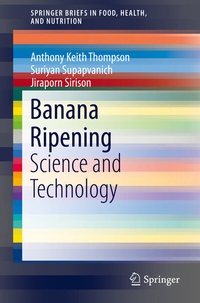
Banana Ripening
Science and Technology
1st Edition
Published on 4. September 2019
XIV, 143 pages
978-3-030-27739-0 (ISBN)
Description

The technology used to ripen bananas is affected by a wide range of factors, including the cultivar, growing conditions, harvesting method, and maturity at which the fruit are harvested and handled. Various post harvest treatments applied to fruit can also impact ripening. While many textbooks have been dedicated to Musa (bananas and plantains), none have focused exclusively on the ripening process.
The commercial ripening of bananas and the chemical changes that occur thereby are considered here in detail. In developed, temperate countries where bananas are imported, successful ripening technologies have evolved. Most bananas, however, are marketed locally in the country where they are grown, and often the ripening technologies used have economic and health implications. This brief offers an in-depth discussion of not only the implications of these technologies, but also of alternative ripening methods and their commercial applications. For an understanding of both the chemical basis by which bananas ripen and the technologies used to control the process, look no further than this essential text.More details
Series
Language
English
Place of publication
Cham
Switzerland
Publishing group
Springer International Publishing
Target group
Professional and scholarly
Product notice
Reflowable
Illustrations
XIV, 143 p. 48 illus., 29 illus. in color.
File size
4,19 MB
ISBN-13
978-3-030-27739-0 (9783030277390)
DOI
10.1007/978-3-030-27739-0
Schweitzer Classification
Other editions
Additional editions
Anthony Keith Thompson | Suriyan Supapvanich | Jiraporn Sirison
Banana Ripening
Science and Technology
Book
09/2019
Springer
€53.49
Shipment within 7-9 days
Persons
Dr. Anthony Keith Thompson is a visiting professor in the Faculty of Agro-Industry at King Mongkut's Institute of Technology in Ladkrabang, Thailand.
Dr. Suriyan Supapvanich is a professor in the Department of Agricultural Education at King Mongkut's Institute of Technology.
Dr. Jiraporn Sirison is a professor in the Faculty of Agro-Industry at King Mongkut's Institute of Technology
Dr. Suriyan Supapvanich is a professor in the Department of Agricultural Education at King Mongkut's Institute of Technology.
Dr. Jiraporn Sirison is a professor in the Faculty of Agro-Industry at King Mongkut's Institute of Technology
Content
Ch 1: Introduction.- Ch 2: Preharvest effects.- Ch 3: Fruit ripening.- Ch 4: Postharvest treatments to control ripening.- Ch 5: Initiation of ripening.- Ch 6: Ripening Technology.- Ch 7: Conclusions.
