

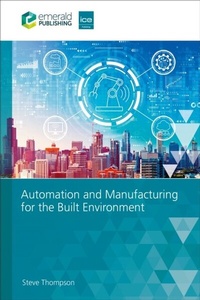
Automation and Manufacturing for the Built Environment
1st Edition
Published on 20. January 2025
288 pages
978-1-83608-600-0 (ISBN)
Description

Automation and Manufacturing for the Built Environment is a plain-language guide to the application of automation and manufacturing technologies and processes to the delivery and operation of the built environment. Covering the full asset lifecycle, the book provides a straightforward guide to a wide range of technologies, showing where they fit and the benefits that they have, with real-world examples of their applications.
Coverage in the book includes
new models to assess the potential benefits and impacts of new technologies, and to consider their implications
how automation and manufacturing-led approaches can complement each other to address longstanding construction industry challenges
overview of automation and manufacturing technologies likely to offer greatest value in the short, medium and long-term
"no-regret" decisions that can be made today that will be of value in the future, including development of structured product data, logical data models and use of generative design tools
the crucial roles of planning and connectivity between technologies
2035 scenarios based on adoption of different automation and manufacturing-led models.
The book also presents assessments on the potential levels of automation that different technologies are likely to deliver up to 2035, the wider benefits they can deliver and impacts on the future of work.
Automation and Manufacturing for the Built Environment will be of interest to a wide range of construction professionals seeking information in the very latest developments in the industry, including clients; senior managers; digital leads, information and BIM managers; engineers; architects; and planners. It is equally applicable to small and large enterprises.
Coverage in the book includes
new models to assess the potential benefits and impacts of new technologies, and to consider their implications
how automation and manufacturing-led approaches can complement each other to address longstanding construction industry challenges
overview of automation and manufacturing technologies likely to offer greatest value in the short, medium and long-term
"no-regret" decisions that can be made today that will be of value in the future, including development of structured product data, logical data models and use of generative design tools
the crucial roles of planning and connectivity between technologies
2035 scenarios based on adoption of different automation and manufacturing-led models.
The book also presents assessments on the potential levels of automation that different technologies are likely to deliver up to 2035, the wider benefits they can deliver and impacts on the future of work.
Automation and Manufacturing for the Built Environment will be of interest to a wide range of construction professionals seeking information in the very latest developments in the industry, including clients; senior managers; digital leads, information and BIM managers; engineers; architects; and planners. It is equally applicable to small and large enterprises.
More details
Language
English
Place of publication
Bingley
United Kingdom
Target group
Professional and scholarly
ISBN-13
978-1-83608-600-0 (9781836086000)
Copyright in bibliographic data and cover images is held by Nielsen Book Services Limited or by the publishers or by their respective licensors: all rights reserved.
Schweitzer Classification
Other editions
Additional editions
Steve Thompson
Automation and Manufacturing for the Built Environment
Book
01/2025
ICE Publishing
€82.00
Shipment within 3-4 weeks
Person
Steve Thompson is an architect with over 30 years of experience within the built environment, more than 20 of which have been spent developing new products, building systems and business models incorporating manufacturing and automation technologies.
Content
Section 1 - Setting the scene
Chapter 1. Introduction;
Chapter 2. The built environment;
Chapter 3. The construction industry;
Chapter 4. Why automation and manufacturing;
Chapter 5. Learning from other industries;
Chapter 6. The modelling framework;
Section 2 - Enable
Chapter 7. Enabling change and manufacturing-led construction;
Chapter 8. No-regret decisions;
Chapter 9. Connectivity platforms;
Chapter 10. Product and service data;
Section 3 - Define
Chapter 11. Defining the need;
Chapter 12. Requirements management;
Chapter 13. Product platforms;
Section 4 - Systemise
Chapter 14. Pre-manufacturing and integration models;
Section 5 - Automate
Chapter 15. Technology timeline;
Chapter 16. Business casing construction delivery;
Chapter 17. Design automation & manufacturing;
Chapter 18. Supply chain management & procurement automation;
Chapter 19. Integration automation;
Chapter 20. In-use automation & manufacturing; Section 6 - Optimise
Chapter 21. Circularity enablement;
Chapter 22. The future of work;
Chapter 23. Looking ahead - an automated construction industry: 2030 scenarios;
Chapter 24. Conclusion
Chapter 1. Introduction;
Chapter 2. The built environment;
Chapter 3. The construction industry;
Chapter 4. Why automation and manufacturing;
Chapter 5. Learning from other industries;
Chapter 6. The modelling framework;
Section 2 - Enable
Chapter 7. Enabling change and manufacturing-led construction;
Chapter 8. No-regret decisions;
Chapter 9. Connectivity platforms;
Chapter 10. Product and service data;
Section 3 - Define
Chapter 11. Defining the need;
Chapter 12. Requirements management;
Chapter 13. Product platforms;
Section 4 - Systemise
Chapter 14. Pre-manufacturing and integration models;
Section 5 - Automate
Chapter 15. Technology timeline;
Chapter 16. Business casing construction delivery;
Chapter 17. Design automation & manufacturing;
Chapter 18. Supply chain management & procurement automation;
Chapter 19. Integration automation;
Chapter 20. In-use automation & manufacturing; Section 6 - Optimise
Chapter 21. Circularity enablement;
Chapter 22. The future of work;
Chapter 23. Looking ahead - an automated construction industry: 2030 scenarios;
Chapter 24. Conclusion
