

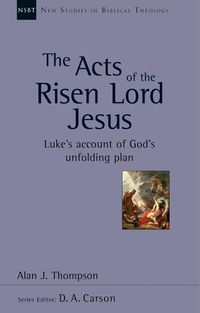
The Acts of the Risen Lord Jesus
Description

When the book of Acts is mentioned, a cluster of issues spring to mind, including speaking in tongues and baptism with the Holy Spirit, church government and practice, and missionary methods and strategies. At the popular level, Acts is more often mined for answers to contemporary debates than heard for its natural inflections. Instead of using Acts as a prooftext, this New Studies in Biblical Theology volume brings a biblical-theological framework to the account to expose Luke's major themes as they relate to the book as a whole. With this framework in place, Alan Thompson argues that Acts is an account of the 'continuing story' of God's saving purposes. Consequently we find that Luke wants to be read in light of the Old Testament promises and the continuing reign of Christ in the inaugurated kingdom. Read in this way as a snapshot of God's dynamic, unfolding kingdom, the book of Acts begins to regain the deep relevance it had in the first century. Addressing key issues in biblical theology, the works comprising New Studies in Biblical Theology are creative attempts to help Christians better understand their Bibles. The NSBT series is edited by D. A. Carson, aiming to simultaneously instruct and to edify, to interact with current scholarship and to point the way ahead.
More details
Other editions
Additional editions
Person
Content
- Intro
- Title
- Copyright
- Contents
- Series preface
- Author's preface
- Abbreviations
- Introduction
- Reassurance concerning God's purposes: the purpose(s) of the book of Acts
- Excursus: assumptions concerning authorship, audience and interpreting Acts
- 1 Living 'between the times': the kingdom of God
- The sovereignty of God
- The kingdom of God
- The continuing reign of the Lord Jesus
- Suffering: the fullness of the kingdom has yet to come
- Conclusion
- Excursus: an expositional outline of Acts
- 2 The hope of Israel: the resurrection and the arrival of the last days
- Resurrection hope
- Resurrection in Luke's Gospel
- Resurrection in Acts
- Jesus' death and the resurrection in Acts
- Preaching the gospel in Acts
- Table 1: Major evangelistic speeches in Acts
- Conclusion
- Table 2: Verbs used in Acts to describe the action of apostolic preaching
- Table 3: Summary descriptions of the message preached in Acts
- 3 Israel and the Gentiles: the kingdom and God's promises of restoration
- Kingdom restoration and Israel? (Acts 1:6-8)
- Pentecost and 'all Israel' (Acts 2)
- Samaria and the restoration of Israel (Acts 8:1-25)
- Outcasts and the restoration of Israel (Acts 8:26-40)
- The Servant who restores Israel and brings salvation to the Gentiles (Acts 13:47)
- The rebuilding and restoring of David's fallen tent (Acts 15:13-18)
- Conclusion
- 4 The promise of the Father: the gift of the Holy Spirit
- The prophetic hope of the Spirit
- The kingdom of God and the promised eschatological gift of the Spirit
- The Holy Spirit is bestowed by the risen and exalted Lord Jesus
- God's empowering presence
- A restored people of God
- One people of God
- Faith, repentance, baptism and the reception of the Spirit in Acts
- Conclusion
- 5 The end of an era: the temple system and its leaders
- The debate about the temple in Acts
- The Davidic King, the last days and the temple (Acts 1 - 3)
- The temple, temple leadership and Jesus' universal authority (Acts 3 - 5)
- Stephen, the temple and Jesus (Acts 6 - 7)
- Conclusion
- 6 The end of an era: the law is no longer the direct authority for God's people
- The debate about the law in Acts
- Jesus: the one to whom the law pointed has now come
- Apostolic leadership and authority
- Sensitivity to Jewish beliefs about the law
- Conclusion
- 7 Concluding summary
- Bibliography
- Index of authors
- Index of Scripture references
- Index of ancient sources
