

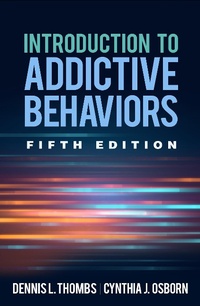
Introduction to Addictive Behaviors
5th Edition
Published on 5. April 2019
442 pages
978-1-4625-3926-0 (ISBN)
Description

Students in clinical psychology, counseling, social work, and nursing; beginning substance abuse counselors; practicing mental health professionals without extensive training in addictions. Serves as a text in advanced undergraduate- and graduate-level courses such as Addiction Treatment/Counseling, Substance Abuse and Addiction, Psychology of Addiction, Social Work Practice with Addictions/Substance Abuse, and Addictive Behavior.
More details
Other editions
Additional editions
Dennis L. Thombs | Cynthia J. Osborn
Introduction to Addictive Behaviors, Fifth Edition
Book
06/2019
5th Edition
Guilford Press
€65.00
Shipment within 15-20 days
Persons
Dennis L. Thombs, PhD, FAAHB, is Professor and Dean of the School of Public Health at the University of North Texas Health Science Center in Fort Worth. The focus of his scholarship is addictive behavior, with special interests in the epistemology of addiction, and in alcohol and drug use during the period of emerging adulthood. In recent years, his research has focused on analyzing drinking practices and their consequences in natural settings. Dr. Thombs is Managing Coeditor of the American Journal of Health Behavior. He is past President and Fellow of the American Academy of Health Behavior.
Cynthia J. Osborn, PhD, LPCC-S, LICDC, is Professor of Counselor Education and Supervision at Kent State University. Her clinical background is in treatment of adults with co-occurring disorders (substance use disorders and mental illness). Her teaching, supervision, and scholarship focus on addictions counseling, particularly evidence-based practices such as motivational interviewing. She is a member of the Motivational Interviewing Network of Trainers and has extensive experience in the clinical supervision of counselors-in-training and professional counselors.
Cynthia J. Osborn, PhD, LPCC-S, LICDC, is Professor of Counselor Education and Supervision at Kent State University. Her clinical background is in treatment of adults with co-occurring disorders (substance use disorders and mental illness). Her teaching, supervision, and scholarship focus on addictions counseling, particularly evidence-based practices such as motivational interviewing. She is a member of the Motivational Interviewing Network of Trainers and has extensive experience in the clinical supervision of counselors-in-training and professional counselors.
Content
1. Conceptualization of Addictive Behavior and the Need for Informed Practice
2. The Disease Models
3. Public Health and Prevention Approaches
4. Understanding the Co-Occurrence of Substance Use and Psychiatric Conditions
5. Psychoanalytic Formulations
6. Conditioning Models and Approaches to Contingency Management
7. Cognitive Models
8. The Family System
9. Social and Cultural Foundations
10. The Controversial Science of Behavioral Addiction
11. Promoting Motivation and Autonomy for Personal Change
12. Linking Theory, Evidence, and Practice
2. The Disease Models
3. Public Health and Prevention Approaches
4. Understanding the Co-Occurrence of Substance Use and Psychiatric Conditions
5. Psychoanalytic Formulations
6. Conditioning Models and Approaches to Contingency Management
7. Cognitive Models
8. The Family System
9. Social and Cultural Foundations
10. The Controversial Science of Behavioral Addiction
11. Promoting Motivation and Autonomy for Personal Change
12. Linking Theory, Evidence, and Practice
