

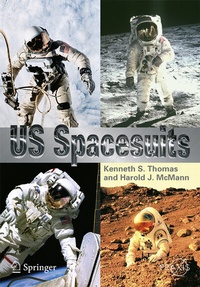
US Spacesuits
Description

Reviews / Votes
From the reviews:
"This excellent book ... presents the basics of the environment in which a space suit must operate, starting with the need for aircraft suit requirements in WW I. Thomas and McMann show the history of the development of suits for in-cabin use, space walking, escape systems, and general life support. ... For readers who seek detailed information on space suits. Summing Up: Recommended. Faculty; researchers; professionals." (W. E. Howard III, CHOICE, Vol. 43 (10), June, 2006)
"The authors provide the reader with an appreciation of spacesuits and U.S. suit efforts through development challenges to their role in space exploration. . The book details the technical evolution of U.S. spacesuits from their roots in high-altitude aviation and vacuum tube development to the present day, with an additional look into the future. . It also includes many technically and historically interesting efforts that never reached flight . ." (Quest, Vol. 13 (4), 2006)
"The authors describe in detail the development of the various spacesuits developed in the US . . In the process they provide a fair amount of 'spacesuit technology' by drawing our attention on the design requirements. . useful appendices of the book provide a summary of the actual operational suits that were produced as well as a detailed listing of the EVAs that were performed with these suits. The book is clearly aimed at spacesuit specialists, making it a unique and wonderful source of information." (Jos Heyman, Tiros Space Information, April, 2006)
"In his introduction, astronaut and spacewalker Storey Musgrave describes this book as 'historical, massively comprehensive, precise, informative, relevant and readable'. I completely agree: everything you ever wanted to know about US spacesuits is here, well illustrated, well set out and, for such a specialist topic, quite readable too. Strongly recommended for die-hard spaceflight enthusiasts,historians, or aerospace engineers with a professional interest." (John Davies, The Observatory, Vol. 126 (1195), December, 2006)
"Authors have been heavily involved in US spacesuit development, which ensures that this book is as technically accurate as it is historically interesting. . There are a great number of illustrations of the various suit types and their components . . There have been one or two other books on this subject published over the years, but nothing as detailed or as thorough as this one." (Liftoff, Issue 233, May/June, 2006)
"The authors helpfully describe the basic principles of space suits and the challenges that must be overcome. . Overall this is a book, which gives a fascinating mixture of historical and technical outlook on a vital piece of space history. . it is a well-written and researched piece of work, which would be of interest to space enthusiasts and engineers . . The armchair astronauts will find it interesting and easy to dip into." (Sharon Hough, Astronomy and Space, June, 2007)
More details
Other editions
Additional editions
Persons
Kenneth Thomas's and Joe McMann's careers mirror the story of US spacesuit development. As a second generation space engineer, Ken Thomas grew up with the U.S. advanced aviation and space programs. Having worked as a task-manger/engineer on the Shuttle Extravehicular Mobility Unit (EMU, NASA's current going-out-in-space suit-system) program and as principal investigator on next generational suit efforts, this background grew to in-depth experience. The experience was further supplemented by extensive personal research into spacesuit system developments. The result is a unique set of qualifications in the arena of spacesuit history.
Joe McMann's career has spanned over 40 years in the area of spacecraft environmental control and space suit systems. He joined NASA during Project Mercury, and has participated in every United States manned space endeavor, including the assembly of the International Space Station. He has been a project engineer, Extravehicular Activity (EVA) suit life support system manager, vacuum chamber test subject, real-time flight support console engineer, and overall EVA hardware manager in NASA's EVA Project Office. Following his retirement from NASA in 1997, he joined Hamilton Sundstrand as a technical specialist in the area of failure analysis and resolution. He retired from Hamilton-Sundstrand in 2002, and acts as consultant to NASA and the aerospace industry.
The authors, therefore, are unparalleled in their experience of US spacesuit development and have a unique set of photographs that will illustrate the book. This should make an excellent sister book to ABRAMOV/SKOOG: Russian Spacesuits which, since publication in June 2003, has sold 679 US and 209 ROW, total sales to date of 888.
