

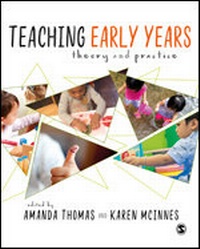
Teaching Early Years
Theory and Practice
1st Edition
Published on 23. October 2017
200 pages
978-1-5264-2689-5 (ISBN)
Description

This textbook focuses on the main areas of teaching young children, covering the 3-7 years age range that spans the early years and primary phases. The majority of chapters are written by both an academic and practitioner, reflecting a genuine theory and practice approach, and this helps the reader to set theoretical discussion in the context of real practice.
Key themes explored within the book include:
- Play and playfulness in the curriculum
- Child development in practice
- Literacy development and subject pedagogy
- Creativity and outdoor learning
Packed full of learning features such as case studies, reflective questions and lesson plans, Teaching Early Years is an essential resource for both students and practitioners, and will enhance your knowledge of how young children think and learn.
Key themes explored within the book include:
- Play and playfulness in the curriculum
- Child development in practice
- Literacy development and subject pedagogy
- Creativity and outdoor learning
Packed full of learning features such as case studies, reflective questions and lesson plans, Teaching Early Years is an essential resource for both students and practitioners, and will enhance your knowledge of how young children think and learn.
Reviews / Votes
This new book on 'Teaching Early Years' provides a fresh take on the effective translation of an Early Years curriculum into practice. It advocates an early years pedagogy, which is experiential in nature and playful in approach, but also explicitly emphasises the role of the early years practitioner in the learning process. A key strength of the book therefore is its ability to bridge the gap between the early years of education and the early years of primary schooling, catering for children aged 0-7 years. The book is particularly innovative in its strong interplay between cutting -edge theory and practice-based evidence, reinforced by the unique mix of shared authorship where each chapter reflects a blend of academic and practitioner perspectives, focusing on a broad range of curricular areas of learning. Each chapter is illustrated throughout with case studies of children aged 0-7 from a range of settings, lesson plans, short summaries of chapters, questions for practitioners and further reading, all of which successfully promote engagement on the part of the reader as well as fostering a culture of reflective teaching in practice.Teaching Early Years will be an invaluable resource for any student studying early childhood studies or training to teach at early years or primary levels. This book is also ideal for early years and primary practitioners. Although focused principally on a Welsh and English context, this book has much to offer Early Years students and practitioners across the globe. -- Glenda Walsh Throughout this book, practitioners have worked alongside academics to provide the reader with a fresh perspective on the Early Years curriculum, particularly play and playfulness, setting theory into meaningful contexts for practitioners. The text celebrates the uniqueness of the Early Years and helps readers to reflect on their own personal pedagogies around play and develop clear professional identities about what it means to teach young children.
The book is an engaging and accessible read, which would be particularly useful for students of Early Childhood Education and for students training to be Early Years teachers. The practical examples also make this essential reading for current practitioners in early years and the early primary phase. -- Patricia Burgess T??????eaching Early Years: Theory and Practice takes key aspects of theory and effectively explains and exemplifies them through the lens of the practitioner. The case studies in each chapter enable trainees to discuss and reflect on their theoretical knowledge in real life contexts and supports their professional development. The book brings together the different UK early years curricula so that trainees also gain an understanding of the varying approaches and age ranges that they cover. Thomas and McInnes have produced a most useful and practical text that will enable early years teachers to support the holistic development of young children in their care. -- Sally Pearse The strength of this very accessible book is the breadth of the practice and academic backgrounds of the contributors as well as the range of relevant areas covered. It is particularly helpful to have a specific focus on well-being in the early years and the vital importance of understanding child development, alongside maths, science and English. -- Eunice Lumsden This textbook focuses on the main areas of teaching young children. Its coverage of the 3-7 years age range means it bridges the gap between Reception classes and KS1, enabling pupils to have a smooth and coherent transition that uses the best of both worlds. The majority of chapters are written by both an academic and practitioner and this approach gives a practical knowledge-based approach that is very authoritative, enabling the reader to set theoretical discussion in the context of real practice... Packed full of learning features such as case studies, reflective questions and lesson plans, Teaching Early Years is an essential resource for both students and practitioners, and will enhance your knowledge of how young children think and learn. It offers plenty of food for thought and the varied range of case studies mean that everyone will find relevant material. An all-round approach to the teaching of young children that will be valuable for both students and experienced practitioners. -- Sarah Brew
More details
Edition
First Edition
Language
English
Place of publication
London
United Kingdom
Target group
College/higher education
Professional and scholarly
ISBN-13
978-1-5264-2689-5 (9781526426895)
Copyright in bibliographic data and cover images is held by Nielsen Book Services Limited or by the publishers or by their respective licensors: all rights reserved.
Schweitzer Classification
Other editions
Additional editions
Book
12/2017
1st Edition
SAGE Publications Ltd
€163.30
Shipment within 15-20 days
Book
12/2017
1st Edition
SAGE Publications Ltd
€95.90
Shipment within 15-20 days
Persons
Dr. Amanda Thomas is a Senior Lecturer in Early Years education at USW and teaches on the Early Years Education degree and the Working with Children and Families degree. She has taught in both Primary and Further Education before taking up her role in higher Education in 2011. Amanda currently teaches on a range of education modules including play, child development, pedagogy, and leading and managing others. She competed her PhD in 2018 exploring children's schemas in the Foundation Phase. She has had books and research published on Early Years education, Schemas and Transitions within education. Amanda has just completed a suite of materials for the Welsh Government on schemas. In her spare time, Amanda is a trustee of a charity trying to restore the former miners' institute in her local village.
Karen McInnes has recently moved to Norland College as Research Fellow Previously she was Programme Leader: Postgraduate and International in the Institute for Education at Bath Spa University. She has been an Award Leader for the MSc Play Therapy and MSc Play and Therapeutic Play at the University of South Wales and completed her PhD in play and learning in the early years and qualified as a play therapist whilst there. She has also been a Senior Researcher with Barnardo's UK Policy and Research Team researching various issues affecting children and their families and making policy recommendations based on her research. Karen has extensive experience working with young children as a play therapist, speech therapist and teacher. She has published on various aspects of early years education and play and is the co-author of The Essence of Play (Routledge, 2013).
Karen McInnes has recently moved to Norland College as Research Fellow Previously she was Programme Leader: Postgraduate and International in the Institute for Education at Bath Spa University. She has been an Award Leader for the MSc Play Therapy and MSc Play and Therapeutic Play at the University of South Wales and completed her PhD in play and learning in the early years and qualified as a play therapist whilst there. She has also been a Senior Researcher with Barnardo's UK Policy and Research Team researching various issues affecting children and their families and making policy recommendations based on her research. Karen has extensive experience working with young children as a play therapist, speech therapist and teacher. She has published on various aspects of early years education and play and is the co-author of The Essence of Play (Routledge, 2013).
Content
Chapter 1: Introduction - Amanda Thomas and Karen McInnes
Chapter 2: What can we learn from UK Early Years curricula? - Claire Pescott
Chapter 3: Child development in practice - Karen McInnes and Holly Gallan
Chapter 4: Play and playfulness: The foundation of learning and development - Karen McInnes and Natacha Yuen
Chapter 5: Understanding well-being in the Early Years - Alyson Lewis and Lucy Rees
Chapter 6: Playing with words - becoming a reader and writer - Rhiannon Packer, Philippa Watkins and Marc Hughes
Chapter 7: Developing mathematical confidence in the Early Years - Catherine Jones
Chapter 8: Becoming a scientist through an experiential pedagogy - Amanda Thomas, Karen Parker, Carole Carter and Clare Griffiths
Chapter 9: Inspiring creativity in the Early Years - Catherine Jones and Francine Davies
Chapter10: Into the great outdoors: Opportunities and experiences - Alyson Lewis and Rebecca Poole
Chapter 11: Conclusion - Amanda Thomas and Karen McInnes
Chapter 2: What can we learn from UK Early Years curricula? - Claire Pescott
Chapter 3: Child development in practice - Karen McInnes and Holly Gallan
Chapter 4: Play and playfulness: The foundation of learning and development - Karen McInnes and Natacha Yuen
Chapter 5: Understanding well-being in the Early Years - Alyson Lewis and Lucy Rees
Chapter 6: Playing with words - becoming a reader and writer - Rhiannon Packer, Philippa Watkins and Marc Hughes
Chapter 7: Developing mathematical confidence in the Early Years - Catherine Jones
Chapter 8: Becoming a scientist through an experiential pedagogy - Amanda Thomas, Karen Parker, Carole Carter and Clare Griffiths
Chapter 9: Inspiring creativity in the Early Years - Catherine Jones and Francine Davies
Chapter10: Into the great outdoors: Opportunities and experiences - Alyson Lewis and Rebecca Poole
Chapter 11: Conclusion - Amanda Thomas and Karen McInnes
