

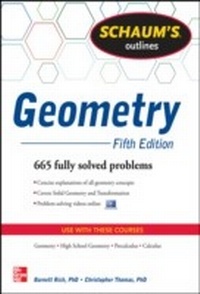
Schaum's Outline of Geometry, 5th Edition
665 Solved Problems + 25 Videos
1st Edition
Published on 13. November 2012
516 pages
978-0-07-179541-8 (ISBN)
Available for download
Description

Tough Test Questions? Missed Lectures? Not Enough Time?Fortunately, there's Schaum's.More than 40 million students have trusted Schaum's to help them succeed in the classroom and on exams. Schaum's is the key to faster learning and higher grades in every subject. Each Outline presents all the essential course information in an easy-to-follow, topic-by-topic format. You also get hundreds of examples, solved problems, and practice exercises to test your skills.This Schaum's Outline gives you665 fully solved problemsConcise explanations of all geometry conceptsSupport for all major textbooks for geometrycoursesFully compatible with your classroom text, Schaum's highlights all the important facts you need to know. Use Schaum's to shorten your study time--and get your best test scores!
More details
Other editions
Additional editions
Book
12/2012
5th Edition
McGraw-Hill Professional
€22.27
Article exhausted; check for reprint
Content
- Cover
- SCHAUM'S outline Geometry
- Copyright Page
- CD Page
- Preface to the First Edition
- Introduction
- Contents
- CHAPTER 1 Lines, Angles, and Triangles
- 1.1 Historical Background of Geometry
- 1.2 Undefined Terms of Geometry: Point, Line, and Plane
- 1.3 Line Segments
- 1.4 Circles
- 1.5 Angles
- 1.6 Triangles
- 1.7 Pairs of Angles
- CHAPTER 2 Methods of Proof
- 2.1 Proof By Deductive Reasoning
- 2.2 Postulates (Assumptions)
- 2.3 Basic Angle Theorems
- 2.4 Determining the Hypothesis and Conclusion
- 2.5 Proving a Theorem
- CHAPTER 3 Congruent Triangles
- 3.1 Congruent Triangles
- 3.2 Isosceles and Equilateral Triangles
- CHAPTER 4 Parallel Lines, Distances, and Angle Sums
- 4.1 Parallel Lines
- 4.2 Distances
- 4.3 Sum of the Measures of the Angles of a Triangle
- 4.4 Sum of the Measures of the Angles of a Polygon
- 4.5 Two New Congruency Theorems
- CHAPTER 5 Parallelograms, Trapezoids, Medians, and Midpoints
- 5.1 Trapezoids
- 5.2 Parallelograms
- 5.3 Special Parallelograms: Rectangle, Rhombus, and Square
- 5.4 Three or More Parallels
- Medians and Midpoints
- CHAPTER 6 Circles
- 6.1 The Circle
- Circle Relationships
- 6.2 Tangents
- 6.3 Measurement of Angles and Arcs in a Circle
- CHAPTER 7 Similarity
- 7.1 Ratios
- 7.2 Proportions
- 7.3 Proportional Segments
- 7.4 Similar Triangles
- 7.8 Mean Proportionals in a Right Triangle
- 7.9 Pythagorean Theorem
- 7.10 Special Right Triangles
- CHAPTER 8 Trigonometry
- 8.1 Trigonometric Ratios
- 8.2 Angles of Elevation and Depression
- CHAPTER 9 Areas
- 9.1 Area of a Rectangle and of a Square
- 9.2 Area of a Parallelogram
- 9.3 Area of a Triangle
- 9.4 Area of a Trapezoid
- 9.5 Area of a Rhombus
- 9.6 Polygons of the Same Size or Shape
- 9.7 Comparing Areas of Similar Polygons
- CHAPTER 10 Regular Polygons and the Circle
- 10.1 Regular Polygons
- 10.2 Relationships of Segments in Regular Polygons of 3, 4, and 6 Sides
- 10.3 Area of a Regular Polygon
- 10.4 Ratios of Segments and Areas of Regular Polygons
- 10.5 Circumference and Area of a Circle
- 10.6 Length of an Arc
- Area of a Sector and a Segment
- 10.7 Areas of Combination Figures
- CHAPTER 11 Locus
- 11.1 Determining a Locus
- 11.2 Locating Points by Means of Intersecting Loci
- 11.3 Proving a Locus
- CHAPTER 12 Analytic Geometry
- 12.1 Graphs
- 12.2 Midpoint of a Segment
- 12.3 Distance Between Two Points
- 12.4 Slope of a Line
- 12.5 Locus in Analytic Geometry
- 12.6 Areas in Analytic Geometry
- 12.7 Proving Theorems with Analytic Geometry
- CHAPTER 13 Inequalities and Indirect Reasoning
- 13.1 Inequalities
- 13.2 Indirect Reasoning
- CHAPTER 14 Improvement of Reasoning
- 14.1 Definitions
- 14.2 Deductive Reasoning in Geometry
- 14.3 Converse, Inverse, and Contrapositive of a Statement
- 14.4 Partial Converse and Partial Inverse of a Theorem
- 14.5 Necessary and Sufficient Conditions
- CHAPTER 15 Constructions
- 15.1 Introduction
- 15.2 Duplicating Segments and Angles
- 15.3 Constructing Bisectors and Perpendiculars
- 15.4 Constructing a Triangle
- 15.5 Constructing Parallel Lines
- 15.6 Circle Constructions
- 15.7 Inscribing and Circumscribing Regular Polygons
- 15.8 Constructing Similar Triangles
- CHAPTER 16 Proofs of Important Theorems
- 16.1 Introduction
- 16.2 The Proofs
- CHAPTER 17 Extending Plane Geometry into Solid Geometry
- 17.1 Solids
- 17.2 Extensions to Solid Geometry
- 17.3 Areas of Solids: Square Measure
- 17.4 Volumes of Solids: Cubic Measure
- CHAPTER 18 Transformations
- 18.1 Introduction to Transformations
- 18.2 Transformation Notation
- 18.3 Translations
- 18.4 Reflections
- 18.5 Rotations
- 18.6 Rigid Motions
- 18.7 Dihilations
- CHAPTER 19 Non-Euclidean Geometry
- 19.1 The Foundations of Geometry
- 19.2 The Postulates of Euclidean Geometry
- 19.3 The Fifth Postulate Problem
- 19.4 Different Geometries
- Formulas for Reference
- Answers to Supplementary Problems
- Index
- Download

