

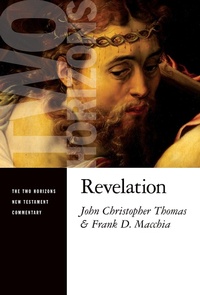
Revelation
Published on 11. April 2016
615 pages
978-1-4674-4549-8 (ISBN)
Description

The book of Revelation is perhaps the most theologically complex and literarily sophisticated - and also the most sensual - document in the New Testament. In this commentary John Christopher Thomas's literary and exegetical analysis makes the challenging text of Revelation more accessible and easier to understand. Frank Macchia follows up with sustained theological essays on the book's most significant themes and issues, accenting especially the underappreciated place of the Holy Spirit in the theology of Revelation.
More details
Other editions
Additional editions
John Christopher Thomas | Frank D. Macchia
Revelation
Book
04/2016
William B Eerdmans Publishing Co
€64.30
Shipment within 15-20 days
Person
Frank D. Macchia is professor of systematic theology at Vanguard University, Costa Mesa, California, former president of the Society for Pentecostal Studies, and the senior editor of Pneuma.
Content
- Intro
- The Two Horizons New Testament Commentary
- Title Page
- Copyright
- Dedication
- Table of Contents
- Preface
- Abbreviations
- INTRODUCTION
- Structure and Nature of the Book
- Literary Markers Recognized by a First-Time Hearer of Revelation
- Revelation as Visionary Drama
- Revelation as Christian Prophecy
- Revelation and the Apocalyptic Tradition
- Revelation as Intertext
- The Canonical Location and Function of Revelation
- Audience
- Geographic Location - Asia Minor
- The Johannine Community
- OT Literature (Intertextuality)
- People of the Spirit
- Women
- Witness and Persecution
- Opponents and Opposition
- Cosmic Opposition
- Concrete Expressions of Opposition
- Date
- Internal Indicators
- External Evidence
- A Modest Proposal with regard to Date
- Authorship
- John the Prophet
- Writing in the Spirit
- John the Prophet and the Other Johannine Literature
- John in Early Christian Tradition
- Revelation and Its Streams of Influence: The History of Effects
- Disastrous Interpretations of Revelation
- Other Johannine Apocalyptic Documents
- Art
- Music
- Poetry
- Film
- Commentaries
- COMMENTARY
- Prologue (1:1-8)
- "In the Spirit on the Lord's Day" (1:9-3:22)
- The Inaugural Vision of Jesus (1:9-20)
- The Seven Prophetic Messages to the Seven Churches of Asia (2:1-3:22)
- To the Angel of the Church in Ephesus (2:1-7)
- To the Angel of the Church in Smyrna (2:8-11)
- To the Angel of the Church in Pergamum (2:12-17)
- To the Angel of the Church in Thyatira (2:18-29)
- To the Angel of the Church in Sardis (3:1-6)
- To the Angel of the Church in Philadelphia (3:7-13)
- To the Angel of the Church in Laodicea (3:14-22)
- "In the Spirit in Heaven" (4:1-16:21)
- The Inaugural Vision of Heaven, the One Who Sits on the Throne, the Lamb, and the Scroll Sealed with Seven Seals (4:1-5:14)
- The Opening of the Scroll Sealed with Seven Seals (6:1-8:5)
- The Opening of the First Six Seals (6:1-17)
- The Interlude of the 144,000 and the Great Multitude (7:1-17)
- The Opening of the Seventh Seal and the Golden Altar (8:1-5)
- Seven Angels with Seven Trumpets (8:6-11:19)
- The Sounding of the First Six Trumpets (8:6-9:21)
- The Interlude of the Little Scroll and the Two Witnesses (10:1-11:14)
- The Sounding of the Seventh Trumpet (11:15-19)
- The Struggle of God's People in Cosmic Perspective (12:1-14:20)
- Signs in Heaven: The Woman Clothed with the Sun, and the Red Dragon (12:1-13:1a)
- The Two Beasts (13:1b-18)
- The Lamb and the 144,000, the Harvest and the Winepress (14:1-20)
- Seven Angels with Seven Bowls of Plagues (15:1-16:21)
- Another Great Sign in Heaven: The Seven Angels (15:1-8)
- The Pouring Out of the Seven Bowls (16:1-21)
- "In the Spirit" - Carried to a Wilderness (17:1-21:8)
- The Woman on the Beast: Babylon the Whore (17:1-18)
- The Destruction of Babylon (18:1-24)
- From Babylon the Great to the New Jerusalem - from the Last Judgment to the New Creation (19:1-21:8)
- Rejoicing in Heaven and on Earth and the Marriage Supper of the Lamb (19:1-10)
- The King of Kings and Lord of Lords (19:11-16)
- Victory over the King's Enemies (19:17-21)
- The Thousand-Year Reign (20:1-6)
- Satan's Final Rebellion and Defeat (20:7-10)
- The Final Judgment (20:11-15)
- The Descent of the New Jerusalem (21:1-8)
- "In the Spirit" - Carried to a Great High Mountain: The Description of the New Jerusalem (21:9-22:5)
- Epilogue (22:6-21)
- THEOLOGICAL HORIZONS OF REVELATION
- God
- Revelation and Biblical Theology
- Revelation
- Gospel of John and 1-3 John
- Matthew and Mark
- Luke and Acts
- Paul
- Other New Testament Voices
- Conclusion
- Revelation and Systematic Theology
- The Sovereign God of Classical Theism
- Doxology: The Point of Departure
- The Sovereign God of Resurrection
- The Sovereign God of Love and Grace
- The Sovereign God in Holiness
- The Sovereign God at War
- Conclusion
- Christ
- Revelation and Biblical Theology
- Revelation
- Gospel of John and 1-3 John
- Matthew and Mark
- Luke and Acts
- Paul
- Other New Testament Voices
- Conclusion
- Revelation and Systematic Theology
- Christological Method
- Worship and the Mediation of the Lamb
- Christ and the Challenge of Pluralism
- Toward a Nonviolent Christology
- Word of the Father and Man of the Spirit
- Conclusion
- Holy Spirit
- Revelation and Biblical Theology
- Revelation
- Gospel of John and 1-3 John
- Matthew and Mark
- Luke and Acts
- Paul
- Other New Testament Voices
- Conclusion
- Revelation and Systematic Theology
- The Need for Discernment
- The Deity and Person of the Spirit
- The Witness to the Nations
- The Spirit of Life
- Conclusion
- Church
- Revelation and Biblical Theology
- Revelation
- Gospel of John and 1-3 John
- Matthew and Mark
- Luke and Acts
- Paul
- Other New Testament Voices
- Conclusion
- Revelation and Systematic Theology
- The Trinitarian Founding of the Church
- The Worship of the Saints
- Missionary Ecclesiology
- The Witness of the Martyrs
- Israel and the Nations
- Conclusion
- Salvation
- Revelation and Biblical Theology
- Revelation
- Gospel of John and 1-3 John
- Matthew and Mark
- Luke and Acts
- Paul
- Other New Testament Voices
- Conclusion
- Revelation and Systematic Theology
- Salvation, Trinity, and Divine Pathos
- Atonement: Exclusion and Embrace
- An Ecumenical Geometry of Salvation
- Conclusion
- Eschatology
- Revelation and Biblical Theology
- Revelation
- John
- Matthew and Mark
- Luke and Acts
- Paul
- Other New Testament Voices
- Conclusion
- Revelation and Systematic Theology
- The Necessity of Eschatology
- The Question of Apocalyptic
- The Delay of Christ's Coming
- The Ultimate Embrace
- Uttering the Unutterable
- Conclusion
- Bibliography
- Index of Names
- Index of Subjects
- Index of Biblical and Other Ancient References
