

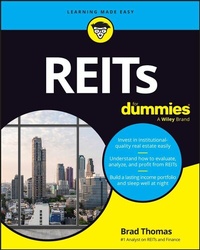
REITs For Dummies
Description

Are you looking for exciting--but responsible--new investment opportunities that go beyond simple stocks and bonds?
In REITs For Dummies, celebrated investing lecturer and author Brad Thomas delivers an easy-to-understand guide to getting started with real estate investment trusts--also known as "REITs." These flexible and lucrative investment tools package together individual properties so you can invest in land and buildings without the hassle of being a landlord.
In the book, you'll get a straightforward tour of REIT property sectors and the different ways you can invest in REITs. You'll also find:
* Strategies for selecting the best REITs for you and your family
* Ways to navigate the sector and generate durable income that helps you sleep well at night
* Options for those who want to go beyond the United States and investigate international REIT products.
You already know about the basics of stock and bond investing. Now it's time to learn about some of the other interesting financial products available to the responsible investor. In REITs For Dummies, you'll get the jargon-free and easy-to-follow guidance you need to wrap your head around this exciting opportunity.
More details
Other editions
Additional editions
Person
Content
Part 1: Getting Started with REITs 5
Chapter 1: Who Wants to Be a Virtual Landlord? 7
Chapter 2: It All Starts with Real Estate 15
Chapter 3: Unlocking the First Level of the REIT Universe 31
Chapter 4: Understanding How REITs Make Money 45
Chapter 5: REITs around the Globe 61
Part 2: Exploring the REIT Universe 83
Chapter 6: Exploring the Primary REIT Sectors 85
Chapter 7: Exploring Alternative REIT Sectors 105
Chapter 8: Putting on Your REIT Analyst Hat 125
Chapter 9: Separating the Wheat from the Chaff 149
Part 3: REITs for All Investors 161
Chapter 10: Building a Smart REIT Portfolio from the Ground Up 163
Chapter 11: The Big Fish REIT Investors 179
Chapter 12: Pressing the REIT Easy Button 195
Part 4: The Part of Tens 211
Chapter 13: More Than Ten FAQs About REITs 213
Chapter 14: Ten Mistakes to Avoid When Investing in REITs 223
Appendix A: Assessing Weighted Average Cost of Capital 233
Appendix B: Determining Net Asset Value 237
Appendix C: Calculating Adjusted Funds from Operations 241
Glossary 243
Index 261
Chapter 1
Who Wants to Be a Virtual Landlord?
IN THIS CHAPTER
Discovering what REITs are and what they do
Recognizing the sheer size of the publicly traded U.S. REIT sector
Checking out REITs on the street
Finding out why REITs are easy to love
Being a landlord can make you rich. That's what you want to hear, I know. And fortunately, it's true. Owning buildings and renting them out can be extremely rewarding as you collect income from the property you own. All the same, I wouldn't call being a landlord an easy road to wealth.
There's a lot involved in renting out property on a legal level and perhaps even more so on an ethical one. So many issues can (and do) come up, from structural considerations regarding the actual buildings and properties they sit on to weather-related hazards that can literally hit your holdings, to general nuisances and differences of opinion with tenants. For those who manage entire apartment buildings, those differences can present themselves on a daily basis.
But suppose you could bypass all that by being a virtual owner instead. Suppose you could be almost entirely oblivious of the day-to-day details of dealing with rentals and renters - yet still receive steady income from them every month or every quarter. Suppose you could go online, click a few buttons, and put a few hundred dollars down (or more, if you so choose) to become an almost instant virtual owner of commercial real estate.
Would you be interested? If so, this book about real estate investment trusts, or REITs, is for you.
Commercial Real Estate for the Masses
For centuries and even millennia, owning property was a wealthy person's venture. In fact, land was one of the biggest signifiers of wealth, with kings and lords fighting wars over who was entitled to what. Peasants and even noblemen stayed on land at the will of their superiors. And while that arrangement wasn't always the brutal, one-sided affair Hollywood likes to portray, it obviously was a far cry from an easy road toward wealth independence.
Even as global societies advanced and individuals started owning their own homes, commercial real estate and its benefits (potential pitfalls as well) remained firmly a resource for the rich. It wasn't until the mid-20th century that REITs (pronounced "reets") were introduced and we "little people" had a solid chance of benefiting from sizable property ownership, too. This game-changing category gives the average investor the same access to property-based money-making potential as the rich. I'd even go so far as to say that REITs exist to even out the playing field. (For more detail on when and where and how they were created, turn to Chapter 3.)
REITs are companies that own, manage, and/or finance real estate holdings. These holdings can be in the form of apartment buildings, hotels, shopping centers, self-storage facilities, warehouses, and even billboards, data centers, and woodlands. And that's the short list - a list that keeps growing every decade. In Chapters 6 and 7, I go through each REIT sector in detail, discussing their pros and cons, because there are definite positives and negatives to know about.
As I continuously stress throughout this book, there is no such thing as a perfect investment. So the more you know about REITs - or any other asset you want to put money into - the better off you'll be.
REITs Do the Work for You
You probably don't have the finances, time, or desire to start your own real estate investment trust. Which is perfectly fine. Even reasonable. But if you're reading this book, you probably do have the finances, time, and desire to buy into REITs that someone else started, developed, and continues to successfully run.
As I previously state, it takes very little money, comparatively speaking, to buy a few shares. And when it comes to publicly traded REITs - the ones you see listed on the stock market - it takes just a call to your broker or a series of clicks on your keyboard to get the deal done. That's all you need to become a landlord.
And not just any landlord, but a no-muss, no-fuss one. Because, again, you're a shareholder owner, not a hands-on owner. That means you don't have to deal with collecting rent, fixing roof leaks, paying insurance, or evicting problematic tenants and finding better ones.
Take it from me. I have more than three decades of experience in building and brokering over $1 billion of income-producing real estate transactions. I've been a landlord to drugstores, auto parts stores, casual-dining restaurants, fast-food restaurants, tire centers, grocery stores, movie theaters, bookstores, discount stores, warehouses, billboards, cell towers, office buildings, and fitness centers. So trust me when I say there's a lot involved.
Regular landlords have to deal with things like high leverage, partnership disputes, recessions, tenant bankruptcies, and even tornadoes. (My neck of the woods in South Carolina isn't part of Tornado Alley by most definitions, but we still get these forces of nature more often than I'd like.) In Chapter 3, I explain the three Ts most landlords wish they didn't have to deal with: toilets, trash, and taxes. By this, I mean all the parts and pieces they're responsible for - the physical structures complete with pipes, electrical wiring, windows, and doors - as well as services and those pesky obligations to Uncle Sam.
This all adds up, taking significant chunks out of the money landlords make.
Of course in a capitalistic society, they're not supposed to add up more than your profits. If you do it right (with perhaps a little bit of luck added in), you can make a really decent living. There are specific advantages to owning direct real estate, such as depreciation and lower volatility, as I explain in Chapter 2. But doing it right entails a lot of time, effort, and financing.
There's also the fact that even if you were making a seven-figure salary, it would still be difficult to personally buy up such properties as
- Caesars Palace in Las Vegas
- The Empire State Building in New York City
- The Hilton Waikoloa in Hawaii
The same goes for 195,000 acres of farmland, 226,000 cellphone towers, or over 12,000 free-standing properties worldwide - each set with a single purchase. And that's to say nothing about strings of properties in more than 40 countries and regions around the globe.
Yet REITs allow you to do exactly that. You don't get to own the entirety of those portfolios, of course. You're just one of hundreds, thousands, or even tens of thousands of other investors. But as I note in Chapter 3, fractional ownership still matters. Plus, you still get a piece of the rental profits, not just through share price appreciation but also through dividend payments multiple times per year.
This is because REITs, by law, have to pay out at least 90 percent of their taxable income to their shareholders in the form of dividends. As Chapter 3 details, this allows them to avoid taxes themselves. Shareholders still have to pay taxes on any gains you make, mind you. But they get higher dividends as a result of this corporate-level deal.
Get Paid While You Sleep
One of the reasons I decided to get into the real estate rental industry (so many moons ago) was because someone told me the best way to make money is while you're sleeping. It sounded like good advice, and I took it to heart along the way.
Being a landlord certainly helped me generate significant wealth by leveraging the most powerful tools of appreciation and compounding, as I discuss in Chapter 2. What I didn't know at the time though was that REITs provide all those benefits, plus the benefit of liquidity, along with transparency and diversification.
This is what makes so many REITs sleep well at night, or SWAN, investments. While I didn't coin the term, I use it to describe a high-quality stock that pays out dividends while you're sleeping . like so many of the REITs I explore in this book.
Size Does Matter
Here's another factor to appreciate about these commercial real estate assets: their sheer size. This is a big deal for a number of reasons. For one thing, the publicly traded U.S. REIT sectors magnitude makes it liquid, allowing investors to trade in and out largely at will. Another point to consider is how the wide, wide world of real estate investment trusts provides investors with considerable diversification benefits.
For instance, tech-centered investors who want something more affordable and less volatile than Facebook can look to Digital Realty, a massive (and growing) network of data centers around the world. Or if you think that brick-and-mortar retail isn't going away, you can consider my favorite REIT, Realty Income. This means that you (the investor) can design and build your portfolio based on your individual tastes and preferences. In Chapter 10, I provide a blueprint to consider strategies I've used over the years.
There are also basic REIT categories to consider above and beyond which properties they tend to buy, which means the larger asset class provides even more opportunity to diversify. I break them all down in Chapter 4 if you...
