

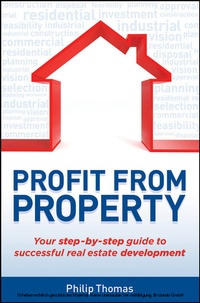
Profit from Property
Your Step-by-Step Guide to Successful Real Estate Development
1st Edition
Published on 9. May 2011
368 pages
978-1-74246-947-8 (ISBN)
Description

Profit from Property is the must-have guide for anyone who wants to make money out of property development.
Expert author Philip Thomas will show you step by step how to develop property the smart way—from purchasing the best development opportunity, to financing the development, through to completion and disposal of the property. His fool-proof system will have you buying, managing, developing and selling property like an expert, whether you're a first-time developer or an experienced investor wanting to make more out of your portfolio.
Inside you’ll discover:
- money-making strategies for residential, commercial and industrial properties
- handy tips and case studies that will save you time, cash and stress
- a proven development model that you can start using immediately with results
- how to become a successful property developer without a huge amount of cash behind you.
The best time to get into property is now. Read this book today and start profiting from property tomorrow!
More details
Other editions
Additional editions
Book
09/2010
1st Edition
Wiley
€42.23
Article exhausted; check different version
Content
- Profit From Property: Your Step-by-Step Guide to Successful Real Estate Development
- Contents
- About the author
- Acknowledgements
- Introduction
- The Montek development process
- Real estate is a proven wealth-creation tool
- A taste of things to come
- How to use this book
- Part I: Understanding property development
- Chapter 1: Real estate development 101
- Real estate development defined
- What real estate development is not
- A very powerful wealth-creation vehicle
- Real estate and value
- The wealth-creation zones
- How long will a development take?
- Chapter 2: Who's who in property development
- Who develops property?
- Who's involved in property development?
- Creating your development team
- Chapter 3: Comparing property types
- Residential real estate
- Commercial real estate
- Disadvantages of commercial property development
- Industrial real estate
- Overall comparison
- Where is the best place to start?
- Chapter 4: Understanding the market
- Market analysis
- Watching the world go round
- Chapter 5: Understanding finance
- Finance and leverage
- Securing fi nance
- Real estate risks
- Part II: The Montek property development model
- Stage 1: Vision
- What's possible
- Vision by evolution or design
- Type of vision
- And it's not all about the money!
- Mission
- Action step 1: Define your grand vision and your mission
- How to create the vision and the mission
- Who is involved?
- Stage 2: Selection parameters
- Common real estate selection parameters
- Parameters in summary
- Action step 2: Develop selection parameters
- How to develop selection parameters
- Who is involved?
- Stage 3: Site selection and feasibility
- The market analysis process
- Methods of site selection
- The feasibility
- Action step 3: Initial online search for property
- Finding a good site
- How to conduct your initial online search
- Who is involved?
- Action step 4: Validate properties
- How to validate properties within the financial model
- Define location and validate cost assumptions
- Who is involved?
- Action step 5: Evaluate supply and demand
- How to evaluate supply and demand within your selected region
- Who is involved?
- Action step 6: Refine costings
- Who is involved?
- Action step 7: Secure project finance
- Development finance
- Who is involved?
- Action step 8: Determine property holding structure
- Types of ownership
- How to determine the property holding structure
- Who is involved?
- Action step 9: Investigate potential use
- How to investigate potential use
- Who is involved?
- Action step 10: Site investigation
- How to conduct a site investigation
- Who is involved?
- Action step 11: Site inspection
- How to inspect the site
- Who is involved?
- Action step 12: Project vision
- How to get an architectural concept sketch
- Who is involved?
- Action step 13: Green-light the development
- How to green-light the development
- Who is involved?
- Stage 4: Planning and approvals
- Timing of the planning and approval process
- Site access for planning approval
- Types of planned development
- Stage development
- The cost of poor documentation
- Action step 14: Land survey
- How to organise a land survey
- Who is involved?
- Action step 15: Detailed architectural scheme and cost estimate
- How to get a detailed architectural scheme and cost estimate
- Who is involved?
- Action step 16: Other development application documentation
- Types of development assessment
- Who is involved?
- Action step 17: Development application lodgement and approval
- How to lodge the application for approval
- Planning and development approval process
- Who is involved?
- Action step 18: Construction application and approval
- How to lodge your construction application and get approval
- Who is involved?
- Action step 19: Current market assessment
- How to assess the current market
- Who is involved?
- Stage 5: Construction
- The Montek tender process
- Action step 20: Appoint project manager
- How to appoint a project manager
- Who is involved?
- Action step 21: Final market assessment and construction finance
- How to conduct the final market assessment
- How to initiate construction finance
- Who is involved?
- Action step 22: Appoint building contractor and consultants, and sign contracts - begin site works!
- How to begin site works
- Who is involved?
- Action step 23: Development consent requirements
- How to plan and meet development consent requirements
- Strata subdivisions
- Who is involved?
- Stage 6: Completion and disposal
- The role of the real estate agent
- Property area
- Action step 24: Lease and hold, or sell
- How to lease and hold, or sell the development
- Final costs and payments
- Who is involved?
- Action step 25: Compare original model with actual
- How to compare original with actual
- Who is involved?
- Final thoughts: balancing on two wheels
- Index
