

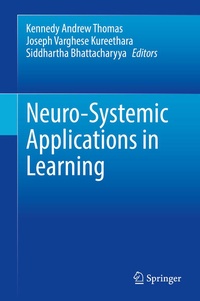
Neuro-Systemic Applications in Learning
Description

Neuroscience research deals with the physiology, biochemistry, anatomy and molecular biology of neurons and neural circuits and especially their association with behavior and learning. Of late, neuroscience research is playing a pivotal role in industry, science writing, government program management, science advocacy, and education. In the process of learning as experiencing knowledge, the human brain plays a vital role as the central governing system to map the images of learning in the human brain which may be called educational neuroscience. It provides means to develop a common language and bridge the gulf between educators, psychologists and neuroscientists. The emerging field of educational neuroscience presents opportunities as well as challenges for education, especially when it comes to assess the learning disorders and learning intentions of the students.
The most effective learning involves recruiting multiple regions of the brain for the learning task. These regions are associated with such functions as memory, the various senses, volitional control, and higher levels of cognitive functioning. By considering biological factors, research has advanced the understanding of specific learning difficulties, such as dyslexia and dyscalculia. Likewise, neuroscience is uncovering why certain types of learning are more rewarding than others. Of late, a lot of research has gone in the field of neural networks and deep learning. It is worthwhile to consider these research areas in investigating the interplay between the human brain and human formal/natural learning. This book is intended to bring together the recent advances in neuroscience research and their influence on the evolving learning systems with special emphasis on the evolution of a learner-centric framework in outcome based education by taking into cognizance the learning abilities and intentions of the learners.
More details
Other editions
Additional editions
Persons
Kennedy Andrew Thomas is the Director of Centre for Education Beyond Curriculum (CEDBEC) and Professor in Education, School of Education at Christ (Deemed to be) University, Bangalore, India. His Doctor of Philosophy, Master of Education and Bachelor of Education are f in Education from Bangalore University, and Master of Arts in Psychology from Annamalai University, India. He has published research articles in international and national journals, and authored and edited books/chapters of reputable in nature. He is a resource person in fields of research, education, technology, and delivered multiple sessions and organized numerous national and international seminars every year under the CEDBEC, Christ (Deemed to be) University, Bangalore. He is a research supervisor for Doctoral scholars, and Doctoral/MPhil researches have been completed under his guidance. He is an active member of multiple professional associations for the cause of research and education.
Joseph Varghese Kureethara completed his Doctorate in Decomposition of Graphs from Manonmaniam Sundarnar University, Tirunelveli. He has Master Degree in Economics and Mathematics from Madras University. He is a gold medalist in Bachelor degree and Postgraduate Degree in Mathematics and a recipient of National Merit Scholarship for Postgraduate Studies. He is currently a Professor of Mathematics CHRIST (Deemed to be University), Bengaluru. Dr. Joseph is a catholic priest. He has over sixteen years of experience in teaching and research at CHRIST (Deemed to be University), Bengaluru and has published over 100 articles in the fields of Graph Theory, Number Theory, History, Religious Studies and Sports both in English and Malayalam. He co-edited four books and authored two books. His blog articles, comments, facts and poems that has earned about 1.5 lakhs total pageviews. He is the Mathematics issue editor of Mapana Journal of Sciences and member of the Editorial Board and reviewer of several journals.
Siddhartha Bhattacharyya
,
[
FIET (UK)
,
FIEI (I)
,
FIETE
,
LFOSI
,
SMIEEE
,
SMACM
,
SMIETI
] has completed his PhD (Engg.) from Jadavpur University, India in 2008. He is currently Professor in Christ University, Bangalore, India. He served as a Senior Research Scientist at the Faculty of Electrical Engineering and Computer Science of VSB Technical University of Ostrava, Czech Republic, from October 2018 to April 2019. Prior to this, he was the Principal of RCC Institute of Information Technology, Kolkata, India. He is a co-author of 5 books and a co-editor of 75 books and has more than 300 research publications in international journals and conference proceedings to his credit. His research interests include soft computing, pattern recognition, multimedia data processing, hybridintelligence and quantum computing.
