

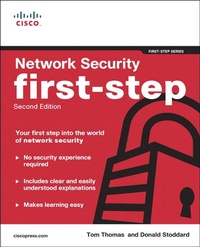
Network Security First-Step
2nd Edition
Published on 22. December 2011
448 pages
978-1-58720-412-8 (ISBN)
Description

Network Security first-step
Second Edition
Tom Thomas and Donald Stoddard
Your first step into the world of network security
No security experience required
Includes clear and easily understood explanations
Makes learning easy
Your first step to network security begins here!
Learn how hacker attacks work, from start to finish
Choose the right security solution for each type of risk
Create clear and enforceable security policies, and keep them up to date
Establish reliable processes for responding to security advisories
Use encryption effectively, and recognize its limitations
Secure your network with firewalls, routers, and other devices
Prevent attacks aimed at wireless networks
No security experience required!
Computer networks are indispensible, but they also are not secure. With the proliferation of security threats, many people and companies are looking for ways to increase the security of their networks and data. Before you can effectively implement security technologies and techniques, you need to make sense of this complex and quickly evolving world of hackers and malware, as well as the tools to combat them.
Network Security First-Step, Second Edition explains the basics of network security in easy-to-grasp language that all of us can understand. This book takes you on a guided tour of the core technologies that make up and control network security. Whether you are looking to take your first step into a career in network security or simply are interested in gaining knowledge of the technology, this book is for you!
Second Edition
Tom Thomas and Donald Stoddard
Your first step into the world of network security
No security experience required
Includes clear and easily understood explanations
Makes learning easy
Your first step to network security begins here!
Learn how hacker attacks work, from start to finish
Choose the right security solution for each type of risk
Create clear and enforceable security policies, and keep them up to date
Establish reliable processes for responding to security advisories
Use encryption effectively, and recognize its limitations
Secure your network with firewalls, routers, and other devices
Prevent attacks aimed at wireless networks
No security experience required!
Computer networks are indispensible, but they also are not secure. With the proliferation of security threats, many people and companies are looking for ways to increase the security of their networks and data. Before you can effectively implement security technologies and techniques, you need to make sense of this complex and quickly evolving world of hackers and malware, as well as the tools to combat them.
Network Security First-Step, Second Edition explains the basics of network security in easy-to-grasp language that all of us can understand. This book takes you on a guided tour of the core technologies that make up and control network security. Whether you are looking to take your first step into a career in network security or simply are interested in gaining knowledge of the technology, this book is for you!
More details
Edition
2nd edition
Language
English
Place of publication
Indianapolis
United States
Publishing group
Pearson Education (US)
Target group
College/higher education
File size
10,42 MB
ISBN-13
978-1-58720-412-8 (9781587204128)
Copyright in bibliographic data and cover images is held by Nielsen Book Services Limited or by the publishers or by their respective licensors: all rights reserved.
Schweitzer Classification
Other editions
Additional editions
Thomas Thomas | Donald Stoddard
Network Security First-Step
Book
01/2012
2nd Edition
Cisco Press
€54.03
Shipment within 3-4 weeks
Persons
Tom Thomas, CCIE No. 9360, claims he never works because he loves what he does. When you meet him, you will agree!
Throughout his many years in the networking industry, Tom has taught thousands of people how networking works and the secrets of the life of a packet. Tom is the author or coauthor of 18 books on networking, including the acclaimed OSPF Network Design Solutions, published by Cisco Press and now in its second edition. Beyond his many books, Tom also has taught computer and networking skills through his roles as an instructor and training-course developer.
In addition to holding the Cisco Certified Internetwork Expert (CCIE) certification-the pinnacle of networking certifications-Tom holds Cisco CCNP Security, CCDA, and CCNA certifications and is a certified Cisco Systems instructor (CCSI). These certifications support his industry-proven, problem-solving skills through technical leadership with demonstrated persistence and the ability to positively assist businesses in leveraging IT resources in support of their core business. He has also completed his Master of Science degree in network architecture and is looking at a doctorate next.
Tom currently is the CIO of Qoncert, a Cisco Gold Partner in Southern Florida that has an affiliated arm known as CCPrep.com, a Cisco Learning Partner, where he provides strategic direction and a little hands-on for customers of all types.
Donald Stoddard began his career in information technology in 1998, designing networks and implementing security for schools in North Dakota and South Dakota. He then went on to design and implement Geographical Information Systems (GIS) for a firm in Denver, Colorado. While there, he earned his Bachelor of Science degree in computer information systems management from Colorado Christian University. From Colorado, he then moved south, learned the ins-and-outs of Cisco VoIP, and began working through designing and securing VoIP solutions throughout the southeast. Don holds Microsoft MCSA and Linux+ and Security+ certifications and is presently wading through the CISSP material.
Currently, Don works for the Department of the Navy as the Information Assurance Officer for one of the premier Navy research and development labs, where he provides certification and accreditation guidance for the various projects being developed for implementation and deployment.
Throughout his many years in the networking industry, Tom has taught thousands of people how networking works and the secrets of the life of a packet. Tom is the author or coauthor of 18 books on networking, including the acclaimed OSPF Network Design Solutions, published by Cisco Press and now in its second edition. Beyond his many books, Tom also has taught computer and networking skills through his roles as an instructor and training-course developer.
In addition to holding the Cisco Certified Internetwork Expert (CCIE) certification-the pinnacle of networking certifications-Tom holds Cisco CCNP Security, CCDA, and CCNA certifications and is a certified Cisco Systems instructor (CCSI). These certifications support his industry-proven, problem-solving skills through technical leadership with demonstrated persistence and the ability to positively assist businesses in leveraging IT resources in support of their core business. He has also completed his Master of Science degree in network architecture and is looking at a doctorate next.
Tom currently is the CIO of Qoncert, a Cisco Gold Partner in Southern Florida that has an affiliated arm known as CCPrep.com, a Cisco Learning Partner, where he provides strategic direction and a little hands-on for customers of all types.
Donald Stoddard began his career in information technology in 1998, designing networks and implementing security for schools in North Dakota and South Dakota. He then went on to design and implement Geographical Information Systems (GIS) for a firm in Denver, Colorado. While there, he earned his Bachelor of Science degree in computer information systems management from Colorado Christian University. From Colorado, he then moved south, learned the ins-and-outs of Cisco VoIP, and began working through designing and securing VoIP solutions throughout the southeast. Don holds Microsoft MCSA and Linux+ and Security+ certifications and is presently wading through the CISSP material.
Currently, Don works for the Department of the Navy as the Information Assurance Officer for one of the premier Navy research and development labs, where he provides certification and accreditation guidance for the various projects being developed for implementation and deployment.
Content
Introduction
Chapter 1 There Be Hackers Here!
Chapter 2 Security Policies
Chapter 3 Processes and Procedures
Chapter 4 Network Security Standards and Guidelines
Chapter 5 Overview of Security Technologies
Chapter 6 Security Protocols
Chapter 7 Firewalls
Chapter 8 Router Security
Chapter 9 IPsec Virtual Private Networks (VPNs)
Chapter 10 Wireless Security
Chapter 11 Intrusion Detection and Honeypots
Chapter 12 Tools of the Trade
Appendix A Answers to Review Questions
Chapter 1 There Be Hackers Here!
Chapter 2 Security Policies
Chapter 3 Processes and Procedures
Chapter 4 Network Security Standards and Guidelines
Chapter 5 Overview of Security Technologies
Chapter 6 Security Protocols
Chapter 7 Firewalls
Chapter 8 Router Security
Chapter 9 IPsec Virtual Private Networks (VPNs)
Chapter 10 Wireless Security
Chapter 11 Intrusion Detection and Honeypots
Chapter 12 Tools of the Trade
Appendix A Answers to Review Questions
