

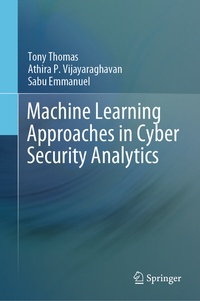
Machine Learning Approaches in Cyber Security Analytics
Description

This book introduces various machine learning methods for cyber security analytics. With an overwhelming amount of data being generated and transferred over various networks, monitoring everything that is exchanged and identifying potential cyber threats and attacks poses a serious challenge for cyber experts. Further, as cyber attacks become more frequent and sophisticated, there is a requirement for machines to predict, detect, and identify them more rapidly. Machine learning offers various tools and techniques to automate and quickly predict, detect, and identify cyber attacks.
More details
Other editions
Additional editions
Persons
Tony Thomas is an Associate Professor at the Indian Institute of Information Technology and Management, Kerala, India. He received his master's and Ph.D. degrees from IIT Kanpur. After completing his Ph.D., he pursued postdoctoral research at the Korea Advanced Institute of Science and Technology, Daejeon, South Korea. He later worked as a member of research staff at the General Motors Research Lab, Bangalore, India, and the School of Computer Engineering, Nanyang Technological University, Singapore. His current research interests include malware analysis, biometrics, cryptography, machine learning, cyber threat prediction and visualization, digital watermarking, multimedia security and digital forensics.
Athira P. Vijayaraghavan holds an M.Tech. degree in Information Security and Cyber Forensics from SRM Institute of Science and Technology (formerly known as SRM University), Chennai, India, and a B.Tech. degree in Information Technology from Calicut University, Kerala, India.She currently works at Acalvio Technologies, Bengaluru, Karnataka, as a member of technical staff. She worked as a Research Associate at the Indian Institute of Information Technology and Management, Kerala, India, till August 2019. Her current research interests include autonomous deception for malware detection, threat intelligence analysis, malware analysis, memory forensics and cyber threat prediction.
Sabu Emmanuel received his B.E. degree in Electronics and Communication Engineering from the Regional Engineering College, Durgapur (now NIT Durgapur), India, in 1988, his M.E. degree in Electrical Communication Engineering from the Indian Institute of Science, Bangalore, India, in 1998, and his Ph.D. degree in Computer Science from the National University of Singapore, Singapore, in 2002. He was an Assistant Professor at the School of Computer Engineering, Nanyang Technological University, Singapore; an Associate Professor at the Department of Computer Science, Kuwait University; and a Visiting Professor at IIT Palakkad. His current research interests include malware analysis, multimedia and software security and surveillance video processing.
Content
Chapter 1. Introduction.- Chapter 2. Machine Learning Algorithms.- Chapter 3. Machine Learning in Cyber Security Analytics.- Chapter 4. Applications of Support Vector Machines.- Chapter 5. Applications of Nearest Neighbor.- Chapter 6. Applications of Clustering.- Chapter 7. Applications of Dimensionality Reduction.- Chapter 8. Applications of other Machine Learning Methods.
