

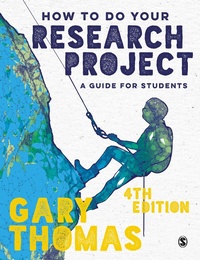
How to Do Your Research Project
A Guide for Students
4th Edition
Published on 2. November 2022
368 pages
978-1-5297-8627-9 (ISBN)
Description

Starting your research project can feel daunting, but this best-selling project guide has your back!
Now in its fourth edition, the book provides easy to follow advice to navigate every step of your research project, from choosing your research question, deciding on your research design and methodology, collecting and analysing your data, and writing up your finished project.
Presenting a clear and detailed roadmap to ensure you don't miss a step, the book includes:
* Case studies and real-life examples from a range of disciplines so you can learn from other researchers who have been in your shoes
* DIY activities so you can practise your skills and get to grips with key concepts
* Practical advice on how to organise your writing, develop your flow and build strong arguments
* Further guidance on assessing ethical risk, including examples of high, medium, and low risk projects
Written in Gary's signature straightforward style, this book is an essential companion for anyone undertaking a research project in the applied social sciences.
Now in its fourth edition, the book provides easy to follow advice to navigate every step of your research project, from choosing your research question, deciding on your research design and methodology, collecting and analysing your data, and writing up your finished project.
Presenting a clear and detailed roadmap to ensure you don't miss a step, the book includes:
* Case studies and real-life examples from a range of disciplines so you can learn from other researchers who have been in your shoes
* DIY activities so you can practise your skills and get to grips with key concepts
* Practical advice on how to organise your writing, develop your flow and build strong arguments
* Further guidance on assessing ethical risk, including examples of high, medium, and low risk projects
Written in Gary's signature straightforward style, this book is an essential companion for anyone undertaking a research project in the applied social sciences.
Reviews / Votes
One of the most impressive things that real experts do is to communicate complex ideas in a clear way for their readers. Gary Thomas' book has been doing this for university students over many years. It is deservedly a classic textbook, which is now in its 4th edition - a further mark of success! -- Dominic WyseMore details
Edition
Fourth Edition
Language
English
Place of publication
London
United Kingdom
Publishing group
Sage Publications Ltd (Digital)
Target group
College/higher education
Product notice
Reflowable
ISBN-13
978-1-5297-8627-9 (9781529786279)
Copyright in bibliographic data and cover images is held by Nielsen Book Services Limited or by the publishers or by their respective licensors: all rights reserved.
Schweitzer Classification
Other editions
Additional editions
Book
11/2022
4th Edition
SAGE Publications Ltd
€45.00
Article exhausted; check for reprint
Book
11/2022
4th Edition
SAGE Publications Ltd
€138.16
Shipment within 15-20 days
Person
Being of a nervous disposition as a child, Gary Thomas failed to write anything on his 11-plus examination paper, which inaction took him to secondary modern school.
He eventually became a teacher, then an educational psychologist, then a professor of education at the University of Birmingham, where his teaching, research and writing have focused on inclusive education and the methods used in social science research. He has led a wide range of research projects and has received research funding from the AHRC, the ESRC, the Nuffield Foundation, the Leverhulme Trust, the Department for Education, charities such as Barnardo's and the Cadmean Trust, local authorities and a range of other organisations. He has written or edited 30 books, lots of boring academic articles, and quite interesting essays on the state of education in the national press. He was the editor of journals such as the British Educational Research Journal and Educational Review.
He has two grown-up daughters, one daughter at school, and two grandchildren. He likes, in alphabetical order, birds, chess, cycling, dogs, his family, gardening, reading and writing.
Despite supporting Aston Villa football club, he maintains an optimistic outlook on life.
He eventually became a teacher, then an educational psychologist, then a professor of education at the University of Birmingham, where his teaching, research and writing have focused on inclusive education and the methods used in social science research. He has led a wide range of research projects and has received research funding from the AHRC, the ESRC, the Nuffield Foundation, the Leverhulme Trust, the Department for Education, charities such as Barnardo's and the Cadmean Trust, local authorities and a range of other organisations. He has written or edited 30 books, lots of boring academic articles, and quite interesting essays on the state of education in the national press. He was the editor of journals such as the British Educational Research Journal and Educational Review.
He has two grown-up daughters, one daughter at school, and two grandchildren. He likes, in alphabetical order, birds, chess, cycling, dogs, his family, gardening, reading and writing.
Despite supporting Aston Villa football club, he maintains an optimistic outlook on life.
Content
Your Introduction
Project Management, Ethics and Getting Clearance
The Literature Review, Part 1: Searching and Constructing
The Literature Review, Part 2: Sharpening Your Ideas
Methodology Part 1: Deciding on an Approach
Methodology Part 2: The Design Frame
Data Gathering
How to Analyse and Discuss the Information you Gather
Concluding and Writing up
Project Management, Ethics and Getting Clearance
The Literature Review, Part 1: Searching and Constructing
The Literature Review, Part 2: Sharpening Your Ideas
Methodology Part 1: Deciding on an Approach
Methodology Part 2: The Design Frame
Data Gathering
How to Analyse and Discuss the Information you Gather
Concluding and Writing up
