

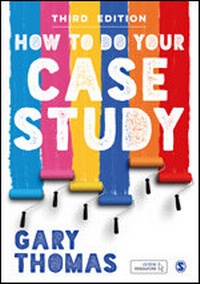
How to Do Your Case Study
3rd Edition
Published on 27. January 2021
320 pages
978-1-5297-5591-6 (ISBN)
Description

This accessible guide takes you through the process of designing, conducting and writing up a research project using case study methods. In his characteristic warm and friendly style, Gary Thomas covers each step at a confidence-building pace, helping you to get to grips with the theory and practice of doing a case study.
Focusing on vital issues like validity, reliability and quality in research, the author helps you ensure your research is rigorous and methodologically sound. This third edition:
? Offers an expanded discussion of key ethical issues in case study research
? Provides up to date information about using social media in research
? Presents a new navigation tool to help you plan your case study project
? Enables you to develop the skills you need to become a critical and reflexive researcher
Covering international examples of case study in practice and accompanied by downloadable checklists and templates, this book is the perfect companion to help you successfully complete a case study.
Focusing on vital issues like validity, reliability and quality in research, the author helps you ensure your research is rigorous and methodologically sound. This third edition:
? Offers an expanded discussion of key ethical issues in case study research
? Provides up to date information about using social media in research
? Presents a new navigation tool to help you plan your case study project
? Enables you to develop the skills you need to become a critical and reflexive researcher
Covering international examples of case study in practice and accompanied by downloadable checklists and templates, this book is the perfect companion to help you successfully complete a case study.
Reviews / Votes
The learning features are excellent. I love the highlight boxes and the 'If you take only one thing...' feature. It is also good to have further reading at the end of each chapter. Overall, this is an excellent book on case study design. -- Shirley LarkinMore details
Edition
Third Edition
Language
English
Place of publication
London
United Kingdom
Publishing group
Sage Publications Ltd (Digital)
Target group
College/higher education
ISBN-13
978-1-5297-5591-6 (9781529755916)
Copyright in bibliographic data and cover images is held by Nielsen Book Services Limited or by the publishers or by their respective licensors: all rights reserved.
Schweitzer Classification
Other editions
Additional editions
Gary Thomas
How to Do Your Case Study
Book
02/2021
3rd Edition
SAGE Publications Ltd
€52.55
Available immediately
Person
Being of a nervous disposition as a child, Gary Thomas failed to write anything on his 11-plus examination paper, which inaction took him to secondary modern school.
He eventually became a teacher, then an educational psychologist, then a professor of education at the University of Birmingham, where his teaching, research and writing have focused on inclusive education and the methods used in social science research. He has led a wide range of research projects and has received research funding from the AHRC, the ESRC, the Nuffield Foundation, the Leverhulme Trust, the Department for Education, charities such as Barnardo's and the Cadmean Trust, local authorities and a range of other organisations. He has written or edited 30 books, lots of boring academic articles, and quite interesting essays on the state of education in the national press. He was the editor of journals such as the British Educational Research Journal and Educational Review.
He has two grown-up daughters, one daughter at school, and two grandchildren. He likes, in alphabetical order, birds, chess, cycling, dogs, his family, gardening, reading and writing.
Despite supporting Aston Villa football club, he maintains an optimistic outlook on life.
He eventually became a teacher, then an educational psychologist, then a professor of education at the University of Birmingham, where his teaching, research and writing have focused on inclusive education and the methods used in social science research. He has led a wide range of research projects and has received research funding from the AHRC, the ESRC, the Nuffield Foundation, the Leverhulme Trust, the Department for Education, charities such as Barnardo's and the Cadmean Trust, local authorities and a range of other organisations. He has written or edited 30 books, lots of boring academic articles, and quite interesting essays on the state of education in the national press. He was the editor of journals such as the British Educational Research Journal and Educational Review.
He has two grown-up daughters, one daughter at school, and two grandchildren. He likes, in alphabetical order, birds, chess, cycling, dogs, his family, gardening, reading and writing.
Despite supporting Aston Villa football club, he maintains an optimistic outlook on life.
Content
Stage I: Getting Your Bearings
Chapter 1: What is a case study?
Chapter 2: The case study and research design
Chapter 3: The whole is more than the sum of the parts: seeing a complete picture
Chapter 4: Rigour and quality in your case study: what's important?
Chapter 5: Ethics
Stage II: Choosing a case and structuring your study
Chapter 6: Different kinds of case studies: selecting a subject for your case study
Chapter 7: Your purpose: thinking about the object of your study
Chapter 8: Your approach: theory testing or theory building; interpretation or illustration
Chapter 9: Your process: the shape, style and manner of your case study
Stage III: Collecting evidence, analysing and writing up
Chapter 10: Out in the field: some ways to collect data and evidence
Chapter 11: Analysis: a toolkit for analysing and thinking in case study
Chapter 12: Writing your study
Chapter 1: What is a case study?
Chapter 2: The case study and research design
Chapter 3: The whole is more than the sum of the parts: seeing a complete picture
Chapter 4: Rigour and quality in your case study: what's important?
Chapter 5: Ethics
Stage II: Choosing a case and structuring your study
Chapter 6: Different kinds of case studies: selecting a subject for your case study
Chapter 7: Your purpose: thinking about the object of your study
Chapter 8: Your approach: theory testing or theory building; interpretation or illustration
Chapter 9: Your process: the shape, style and manner of your case study
Stage III: Collecting evidence, analysing and writing up
Chapter 10: Out in the field: some ways to collect data and evidence
Chapter 11: Analysis: a toolkit for analysing and thinking in case study
Chapter 12: Writing your study
