

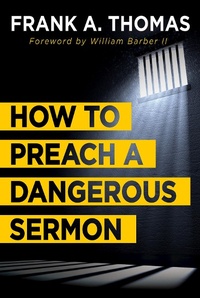
How to Preach a Dangerous Sermon
Description

Learn to use four characteristics of "preaching with moral imagination" to proclaim freedom for all. The author describes the four characteristics using examples like Robert F. Kennedy, Dr. Martin Luther King, Jr.,Prathia Hall, and the Moral Monday Movement, along with musicians and other artists of today. Moral imagination helps the hearer to see what they cannot see, to hear what they cannot hear--to inhabit the lives of others, so that they can embody Christ and true freedom for those others. This book equips and empowers preachers to transcend their basic skills and techniques, so that their proclamation of the Word causes actual turnaround in the hearts and lives of their hearers, and in their communities.
"Frank Thomas has written a passionate summons: amid the current destructive chaos of our society there is an urgent need for moral imagination. Such imagination is the antithesis of "diabolic" and "idolatrous" imagination that is all to the fore in our public discourse and practice. Thomas fleshes out "moral imagination" with close reflection on the practice of Robert F. Kennedy and Martin Luther King. Before he finishes Thomas shows how the urgency of "moral imagination" belongs peculiarly to the work of the preacher. This book is a welcome call for gospel-grounded courage and truth about the neighbor issued in a way that refuses the self-serving fakery that dominates our public life." --Walter Brueggemann, Columbia Theological Seminary
"Timely and prophetic, How to Preach a Dangerous Sermon presents a homiletic essential for our churches today. Thomas insists that it is up to the preacher to recapture and reclaim the moral imagination of our nation so that the Gospel's message of freedom is true for all people. With attention to specific figures whose witness models the qualities and characteristics of moral imagination, Thomas inspires the preacher toward powerful proclamation that both challenges and critiques any speech that subjugates or subordinates. How to Preach a Dangerous Sermon is must read for preachers to recover and reimagine the leadership role of the church for the sake of justice for all." --Karoline M. Lewis, Associate Professor of Biblical Preaching and the Marbury E. Anderson Chair of Biblical Preaching, Luther Seminary; author of She: Five Keys to Unlock the Power of Women in Ministry.
"In this lucid and compelling book, Frank Thomas plumbs the depths of American moral rhetoric for insights that will help preachers. How to Preach a Dangerous Sermon provides new and dramatic ways in which the moral imagination in a democratic society can be nurtured by visionary, empathic, wise, and artistic preachers."--John S. McClure, Charles G. Finney Professor of Preaching and Worship, Vanderbilt Divinity School
"Warning: Preachers, if you are comfortable with the status quo of white privilege, patriarchy, hetero-normativity, and classism, do not read this book. If you are comfortable with sermon series that reduce the gospel to self-help acronyms, don't read this book. But if you have the courage to look honestly at our landscape and bring the moral imagination of the Christian tradition to bear on it, open these pages and your sermons may never be the same again. But then again neither will the church--or the world--be the same anymore, if enough of us follow Thomas's advice." --O. Wesley Allen, Jr., Lois Craddock Perkins Professor of Homiletics, Perkins School of Theology, Southern Methodist University
More details
Other editions
Additional editions
Person
Frank A. Thomas currently serves as Nettie Sweeney and Hugh Th. Miller Professor of Homiletics and Director of the Academy of Preaching and Celebration at Christian Theological Seminary of Indianapolis, Indiana.
Content
- Cover
- Title
- Copyright
- Dedication
- Also by the Author
- Contents
- Foreword: The Terrible Joy of Dangerous Preaching
- Preface: A Call to Conscience and a Dangerous Sermon
- Introduction: The Critical Value of Moral Imagination
- Imagination Rules the World
- American Moral Imagination in the Twenty-First Century
- The Church and Moral Imagination
- 1. Race and Shrinking Whiteness: Four Qualities of the Moral Imagination of Robert F. Kennedy
- Race, the Ghetto, and Public Resources in America
- Shrinking Whiteness in America
- Robert F. Kennedy's Moral Imagination
- Four Qualities of Moral Imagination
- Concluding Thoughts
- 2. A Requiem-"I'm Happy Tonight": Four Qualities of the Moral Imagination of Martin Luther King Jr.
- The Exigencies of the Rhetorical Situation
- A Strategy of Biblical Typology
- A Close Reading of "I've Been to the Mountaintop"
- Movement One: "I'm happy that He's [God has] allowed me to be in Memphis."
- Movement Two: "Happy to see a relevant ministry."
- Movement Three: "Thank God for allowing me to be here."
- Movement Four: "I'm so happy that I didn't sneeze."
- Movement Five: "I'm happy tonight. I'm not worried about anything."
- Four Qualities of the Moral Imagination
- Requiem
- 3. Who Is the Moral Leader of Our Nation? Four Qualities of Moral Imagination and the New Moral Leadership
- The Moral Leader of Our Nation
- Envision equality and represent that by one's physical presence
- Empathy as a catalyst or bridge to create new opportunities for peace and justice
- Wisdom and truth in ancient texts: The wisdom of the ages
- The language of poetry and art that lifts and elevates
- A Vision of Moral Leadership
- 4. How to Preach a Dangerous Sermon: Four Qualities of Moral Imagination in a Sermon
- Perspectives of the Anti-Moral Imagination
- Anti-Moral Imagination Response to the Four Qualities of Moral Imagination
- Envision equality and represent that by one's physical presence
- Empathy as a catalyst or bridge to create opportunities to overcome the past and make new decisions for peace and justice
- Wisdom and truth in ancient texts: The wisdom of the ages
- The language of poetry and art that lifts and elevates by touching the emotive chords of wonder, hope, and mystery
- A Brief Homiletic Method for Preaching Moral Imagination
- Preaching Worksheet
- Behavioral Purpose Statement for Lamentations 3:20-23
- Five Questions of the Moral Imagination for Lamentations 3:20-23
- Where in this text do we find equality envisioned and represented by physical presence?
- Where in the text do we notice empathy as a catalyst or bridge to create opportunities to overcome the past and make new decisions for peace and justice?
- Where do we find wisdom and truth in this ancient text, the wisdom of the ages?
- Where is the language of poetry and art that lifts and elevates by touching the emotive chords of wonder, hope, and mystery?
- To what contemporary moral concern would you apply your responses in these four questions of the four qualities of the moral imagination?
- Moral Versus Political
- A Sermon of the Moral Imagination: "Did Heaven Make a Mistake?"
- 5. The Final Word: The "Freedom Faith" of Prathia L. Hall (1940-2002)
- Brief Biography of Prathia L. Hall
- "Freedom Faith" and Four Qualities of Moral Imagination
- "Freedom-Faith"
