

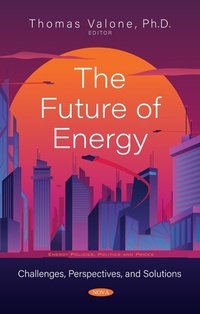
Future of Energy: Challenges, Perspectives, and Solutions
Published on 1. September 2020
379 pages
978-1-5361-8348-1 (ISBN)
Description

The anthology entitled, "The Future of Energy: Challenges, Perspectives, and Solutions" includes a wide range of topics related to the probable and also possible future developments of energy technologies. The collection of papers offers a series of unprecedented perspectives on energy science, unavailable elsewhere. The authors have considered developments in renewable energy, novel energy discoveries, environmental climate futures, possible technological advances, temporal distortion, and gravitational electromagnetism. Specific energy inventors reporting breakthrough results have also been showcased in individual chapters, including Searl, Manelas, Kozyrev, and Storms. The future of energy is presented with possible scenarios such as with microgrids, solar systems, fusion-fission reactors, smart cities, energy storage, electric vehicles, low energy nuclear reactors, electromagnetic devices, proton and electron conversion, theoretical antigravity, and time manipulation. Several interesting models have been considered to provoke and stretch the reader's imagination and awareness of the study of the future. This collection of works provides a broad range of conceptual understanding of energy conversion that is both conventional and unconventional. Each chapter includes a significant use of graphs and charts, as well as explanatory equations where necessary, with plenty of vital references and links to substantiate any new scientific concepts and assist further research. More than one new phenomena of electrical power production have been discovered and the results documented in detail within the pages of this anthology. While the time schedule and specific cause of global warming is detailed, the plan for advanced energy applications is also explored. The collection of works provides a unique perspective on the evolving landscape of future energy which is provocative and enlightening. The reader will find it enriches and enlivens the discussion of what is to come.
More details
Other editions
Additional editions
Book
08/2020
Nova Science Publishers Inc
€303.55
Shipment within 15-20 days
Content
- Intro
- Contents
- Preface
- Acronymns
- Chapter 1
- Future Energy Is Almost Here Along with Increasing Global Heat
- Abstract
- Introduction
- Future Energy to Transform the Environment
- Water Crisis, Salt Water, and Water Power
- Future of Land Energy - Unconventional Designs
- Piezoelectric Roadways
- Hot Magma Energy Conversion is Ten Times the Geothermal Norm
- Time for Adaptation to a Warming World
- Cool Roofs Make a Difference in a Hotter Climate
- Phase Change Insulation Is Ten Times Better
- Electricity for the Rest of the World
- Integrity Research Institute's Future Energy Program
- Carbon Capture: Global Warming into Cooling
- References
- Chapter 2
- Smart Cities and Energy Storage
- Abstract
- Introduction
- Material and Methods
- Theoretical Framework
- Results
- Charge of the Storage System
- Discharge of the Storage System
- Discussion
- Conclusion
- Appendix A
- Appendix B
- Appendix C
- References
- Chapter 3
- Energy Resiliency and Microgrids
- Abstract
- Introduction
- Material and Methods
- Modeling Approach
- The REopt® Model
- Assessment of the Economic Benefits of Renewable Energies and Electrochemical Storage
- Assessment of the Increase in Resilience Due to Renewable Energies and Electrochemical Storage
- Inputs of the Model
- Electricity Tariff
- Microgrid Configuration
- Resilience Assessment
- Economic Assumptions
- Results and Discussion
- Conclusion
- Appendices
- Appendix A. Results Comparison
- Appendix B. Summary of Model Inputs
- References
- Chapter 4
- Methods for 1D ZnO Nanostructures and Potential for Future Solar Cells
- Abstract
- Introduction
- Vapor-Liquid-Solid (VLS)
- Oxide-Assisted Growth (OAG)
- Vapor-Solid (VS)
- Solution-Liquid-Solid (SLS)
- Property of One Dimensional (1D) Nanomaterials
- Mechanical Property
- Thermal Property
- Electronic Property
- Magnetic Property
- Optical Property
- Zinc Oxide
- Methodologies for Achieving 1D ZnO Nanostructures
- Chemical Vapour Transport and Condensation (CVTC)
- Chemical Vapour Deposition (CVD)
- Metal-Organic Chemical Vapour Deposition (MOCVD)
- Chemical Solution Method
- Solar Cells
- Advantages of ZnO NWs/NRs Arrays
- Excitonic Solar Cells
- Conclusion
- References
- Chapter 5
- Possible Future Development of a Fusion-Fission Hybrid Reactor as a Clean Energy Generator
- Abstract
- Introduction
- Fusion and Fission Reactions
- Results and Discussion
- The Two Basic Types of Fission Fusion Hybrid Reactor
- The "Hybrid Breakeven" Criterion for Power Production
- Conclusion
- References
- Chapter 6
- Low Energy Nuclear Reactions: Documentation of Research Records
- Abstract
- Introduction
- Records Documentation Procedure
- Components
- Publications and Unpublished Reports
- Electronic Files
- Hardcopy Files
- Laboratory and Experiments
- Photos, Recordings and Other Media
- LENR Library
- Interviews
- Timeline
- Preservation
- Reporting
- Future Opportunities
- Pilot Project: Edmund Storms' Lenr Career
- Participants and Projects
- Summary and Future Directions
- Acknowledgments
- References
- Chapter 7
- Electric Vehicle
- Development by Arthur Manelas
- with Anomalous Results
- Abstract
- Introduction
- References
- Chapter 8
- Questioning the Future of Solar Energy
- Abstract
- Introduction and Overview
- Incentives
- Other Considerations
- Integrating Solar Energy with the Grid
- Concentrated Solar Power
- Applying Solar Experiences to Other Technologies
- References
- Chapter 9
- Nikolai Kozyrev: His Theory of Time and the True Position of Stars
- Abstract
- Nomenclature
- Introduction
- Nikolai A. Kozyrev
- Kozyrev's Theory of Time
- Experimental Work of Kozyrev
- Confirmations after Kozyrev's Death
- Astrophysical Experiments
- True Position of the Stars
- Experimental Set Up and Measured Data
- Selection of the Telescope
- Calibration to Kozyrev Time Impact Procedure
- Measurement Data
- Torsion Balance
- Conclusion
- Acknowledgments
- References
- Chapter 10
- Nonlinear Electromagnetic Energy Device and Potential Explanations
- Abstract
- Introduction
- Discussion
- A. Searl Device
- B. The Brown Device
- C. The Russian Godin and Roschin Device
- D. The Morningstar Energy Box
- E. Description of the Energy Box
- Results
- A. The Behavior of the Morningstar Energy Box
- B-1. Angular Momentum
- B-2. Gravito-Electro-Magnetism (GEM)
- B-3. Retarded Potentials
- B-4. Generation of Gravitational Waves
- B-5. Cogravitational Waves
- B-6. DeBroglie Matter Waves
- B-7. Dimensional Axis Transport
- C. Basic Considerations
- Conclusion
- Acknowledgments
- Appendix
- References
- Chapter 11
- Gravity/Anti-Gravity, Libration Points, and Relativity: Exposing the Light on Dark Matter
- Abstract
- Introduction
- Discussion
- A. Phenomenon and Anomalous Evidence
- A-1. Pioneer Effects
- A-2. The Kuiper Edgeworth Belt
- A-3. Linear Gravitation
- A-4. MOND
- A-5. Dark Matter
- B. Neutron stars, Black Holes, Magnetars and Rotation
- C. Gravitational Models
- C-1. Four-Derivative Theories
- C-2. Winterberg's Rule
- C-3. Jefimenko Gravitational Model and Variants
- C-4. Murad's Gravitational Model
- Analysis and Results
- A. Gravitational Hyperbolic Partial Differential Equation Model
- A-1. Transient Effects
- B. Trojan Asteroids: Libration Points and Anti-Gravity
- C. Relativistic Effects
- C-1. Relativistic Mechanics
- C-2. Solution Rationale
- D. An Electromagnetic and a Torsion Model
- E. A Consolidating Model
- F. AN Experimental Test
- Conclusion
- References
- Chapter 12
- Proton and Electron Production and Destruction as Sources of Energy
- Abstract
- Particle Production and Energy Conservation
- The Quantum Field
- Mass and Zero-Point Energy
- Primal and Secondary Production
- Produced Together
- Astronomical Observations
- Suggested Experiments
- Repeat the Skinner Experiment
- Magnetically or Inertially Confined Plasma
- SAFIRE Project Style Setup
- Alternating Current Vacuum Arc Discharge
- Pulsed Glow Discharge
- Testing for Proton and Electron Production
- Low Energy Fusion
- Conclusion
- References
- About the Editor
- Index
- Blank Page
