

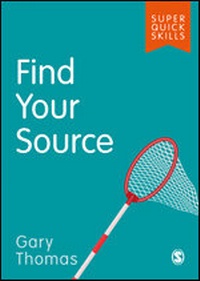
Find Your Source
1st Edition
Published on 24. June 2019
108 pages
978-1-5264-8973-9 (ISBN)
Description

The key to building a strong academic argument is finding the best sources. Find Your Source shows you how to cut to the chase and uncover the right sources for your project.
Hone your research skills and use your library effectively
Focus your online search so you don't get lost down a black hole
Sniff out quality sources (and reject the unreliable ones).
Super Quick Skills provides the essential building blocks you need to succeed at university - fast. Packed with practical, positive advice on core academic and life skills, you'll discover focused tips and strategies to use straight away. Whether it's writing great essays, understanding referencing or managing your wellbeing, find out how to build good habits and progress your skills throughout your studies.
Learn core skills quickly
Apply them right away and see results
Succeed in your studies and in life
Super Quick Skills gives you the foundations you need to confidently navigate the ups and downs of university life.
Hone your research skills and use your library effectively
Focus your online search so you don't get lost down a black hole
Sniff out quality sources (and reject the unreliable ones).
Super Quick Skills provides the essential building blocks you need to succeed at university - fast. Packed with practical, positive advice on core academic and life skills, you'll discover focused tips and strategies to use straight away. Whether it's writing great essays, understanding referencing or managing your wellbeing, find out how to build good habits and progress your skills throughout your studies.
Learn core skills quickly
Apply them right away and see results
Succeed in your studies and in life
Super Quick Skills gives you the foundations you need to confidently navigate the ups and downs of university life.
Reviews / Votes
Packed with concise information to help students succeed at university. Whether you are an undergraduate student or undertaking a postgraduate programme, you will be able to find a book that will help you develop your study skills.Of the three books I reviewed [Take Great Notes, Find Your Source and Plan Your Essay], all of them were easy to read and follow, with each book providing a 60 second summary before moving onto more detail in each section and providing reasoning throughout. -- Julie Quick * Journal of Perioperative Practice * This book has been a saviour especially at this time when I needed a host of resources for my dissertation. It opened my eyes to a variety of sources I didn't know exist. I would recommend this book to anyone who needs to find material for university course work. -- Edward Azumatse * Journal of Perioperative Practice *
More details
Series
Language
English
Place of publication
London
United Kingdom
Target group
College/higher education
ISBN-13
978-1-5264-8973-9 (9781526489739)
Copyright in bibliographic data and cover images is held by Nielsen Book Services Limited or by the publishers or by their respective licensors: all rights reserved.
Schweitzer Classification
Other editions
Additional editions
Gary Thomas
Find Your Source
Book
07/2019
1st Edition
SAGE Publications Ltd
€31.50
Shipment within 15-20 days
Person
Being of a nervous disposition as a child, Gary Thomas failed to write anything on his 11-plus examination paper, which inaction took him to secondary modern school.
He eventually became a teacher, then an educational psychologist, then a professor of education at the University of Birmingham, where his teaching, research and writing have focused on inclusive education and the methods used in social science research. He has led a wide range of research projects and has received research funding from the AHRC, the ESRC, the Nuffield Foundation, the Leverhulme Trust, the Department for Education, charities such as Barnardo's and the Cadmean Trust, local authorities and a range of other organisations. He has written or edited 30 books, lots of boring academic articles, and quite interesting essays on the state of education in the national press. He was the editor of journals such as the British Educational Research Journal and Educational Review.
He has two grown-up daughters, one daughter at school, and two grandchildren. He likes, in alphabetical order, birds, chess, cycling, dogs, his family, gardening, reading and writing.
Despite supporting Aston Villa football club, he maintains an optimistic outlook on life.
He eventually became a teacher, then an educational psychologist, then a professor of education at the University of Birmingham, where his teaching, research and writing have focused on inclusive education and the methods used in social science research. He has led a wide range of research projects and has received research funding from the AHRC, the ESRC, the Nuffield Foundation, the Leverhulme Trust, the Department for Education, charities such as Barnardo's and the Cadmean Trust, local authorities and a range of other organisations. He has written or edited 30 books, lots of boring academic articles, and quite interesting essays on the state of education in the national press. He was the editor of journals such as the British Educational Research Journal and Educational Review.
He has two grown-up daughters, one daughter at school, and two grandchildren. He likes, in alphabetical order, birds, chess, cycling, dogs, his family, gardening, reading and writing.
Despite supporting Aston Villa football club, he maintains an optimistic outlook on life.
Content
What is a source?
How do I know if it's a good source?
How are primary and secondary sources different?
Where do I go online to search?
What's the point of the library?
What's a database? And why is it good for me?
Where do I find stuff that's not in the big databases?
Who will help me?
Why can't find I anything?
How do I know if it's a good source?
How are primary and secondary sources different?
Where do I go online to search?
What's the point of the library?
What's a database? And why is it good for me?
Where do I find stuff that's not in the big databases?
Who will help me?
Why can't find I anything?
