

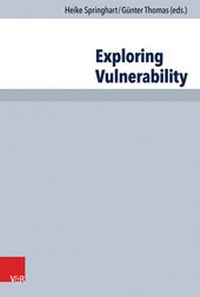
Exploring Vulnerability
1st Edition
Published on 2. October 2017
264 pages
978-3-647-54063-4 (ISBN)
Description

Vulnerability is an essential but also an intriguing ambiguous part of the human condition. This book con-ceptualizes vulnerability to be a fundamental threat and deficit and at the same time to be a powerful resource for transformation.The exploration is undertaken in multidisciplinary perspectives and approaches the human condition in fruitful conversations with medical, psychological, legal, theological, political and philosophical investiga-tions of vulnerability.The multidisciplinary approach opens the space for a broad variety of deeply interrelated topics. Thus, vulnerability is analyzed with respect to diverse aspects of human and social life, such as violence and power, the body and social institutions. Theologically questions of sin and redemption and eventually the nature of the Divine are taken up. Throughout the book phenomenological descriptions are combined with necessary conceptual clarifications. The contributions seek to illuminate the relation between vulnerability as a fundamental unavoidable condition and contingent actualizations related to specific dangers and risks. The core thesis of the book can be seen within its multi-perspectivity: A sound concept of vulnerability is key to a realistic, that is to say neither negative nor illusionary anthropology, to an honest post-theistic understanding of God and eventually to a deeply humanistic understanding of social life.
More details
Other editions
Additional editions
Heike Springhart | Günter Thomas
Exploring Vulnerability
Book
10/2017
1st Edition
Vandenhoeck & Ruprecht
€75.00
Shipment within 5-7 days
Persons
Editor
Prof. Dr. Dr. Günter Thomas ist ordinierter Pfarrer der Württembergischen Landeskirche, seit 2004 Professor für Systematische Theologie an der Ruhr-Universität Bochum und Mitglied der Synode der Evangelischen Kirche in Westfalen.
Dr. Heike Springhart ist Privatdozentin für Systematische Theologie an der Ruprecht-Karls-Universität Heidelberg und Studienleiterin des Theologischen Studienhauses Heidelberg. Sie ist ordinierte Pfarrerin der evangelischen Landeskirche in Baden und Mitglieder der Kammer für Theologie der EKD.
Contributions
Dr. Heike Springhart ist Privatdozentin für Systematische Theologie an der Ruprecht-Karls-Universität Heidelberg und Studienleiterin des Theologischen Studienhauses Heidelberg. Sie ist ordinierte Pfarrerin der evangelischen Landeskirche in Baden und Mitglieder der Kammer für Theologie der EKD.
Prof. Dr. Konrad Schmid ist Professor für alttestamentliche Wissenschaft und frühjüdische Religionsgeschichte an der Theologischen Fakultät der Universität Zürich.
Dr. Andrea Bieler ist Professorin für Praktische Theologie an der Theologischen Fakultät der Universität Basel.
Content
- Intro
- Title Page
- Copyright
- Body
- Heike Springhart / Günter Thomas: Introduction
- I. Theology and Religion
- Heike Springhart: Exploring Life's Vulnerability: Vulnerability in Vitality
- Vulnerability and anthropological realism
- Anthropological realism and vulnerability
- Acknowledgement of vulnerability versus striving for invulnerability
- Vulnerability and Resilience
- Valuing vulnerability as Enhancing of Life
- Dimensions of Vulnerability - a Matrix
- Love's vulnerability - Vision and vulnerability
- Günter Thomas: Divine Vulnerability, Passion and Power
- Introduction
- Historical orientations: Three views on divine vulnerability
- Christian faith and the 'root-disaster' of the cross
- The in/vulnerable God and the search for understanding the cross
- The suffering God in 20th century theology: A solution with a problem
- Conceptual orientations: Variations on vulnerability
- The cross of Jesus Christ: Divine vulnerability, risk and passion
- The cross in light of the incarnation as an act of passion
- The cross as dark possibility of a vulnerable life
- The resurrection of Jesus Christ: Creative response and limitation of the risks of vulnerability
- The resurrection as confirmation: vulnerable life and divine intentions
- The resurrection as rejection: the limitation of human vulnerability and the fight against the triumph of violence
- The resurrection as transformation: The power to maintain divine intentions over against resistance
- Divine vulnerability - Necessary differentiations
- Apparent divine vulnerability
- Self-constrained divine vulnerability
- Strong divine vulnerability
- Responsive divine vulnerability
- Kristine A. Culp: Vulnerability and the Susceptibility to Transformation
- A hurricane and the plague: Narrating and managing risk
- A society permeated by risk
- The plague in Wittenberg, 1527
- A theological account of vulnerability
- Theology in the thick of life
- Features of a theological account of vulnerability
- (a) Vulnerability addressed theologically in relation to an account of life before God
- (b) Vulnerability as an enduring feature of creaturely life
- (c) Vulnerability as susceptibility to change, for ill and for good
- (d) Vulnerability in contrast to strategies of invulnerability
- Resilience, Invulnerability, and Transformation
- Andrea Bieler: Enhancing Vulnerable Life: Phenomenological and Practical Theological Explorations
- Fundamental and Situated Vulnerability
- Oscillation of Having a Body and Being a Body
- Permeable Affectivity
- Duration and Perspectivity
- Becoming in the Realm of Creative Passivity
- Divine Vulnerability
- Andreas Schüle: "All Flesh": Imperfection and Incompleteness in Old Testament Anthropology
- Woundedness in Greek and Hebraic Storytelling
- Human Beauty and Anthropological Realism
- The Incompleteness of "All Flesh"
- Imperfection as the Reality of "All Flesh"
- Conclusions
- Dean Phillip Bell: Vulnerability in Judaism: Anthropological and Divine Dimensions
- Introduction
- Divine Dimensions of Vulnerability
- Anthropological Dimensions of Vulnerability
- Earthquakes
- Plagues
- Floods
- Conclusions: Understanding Vulnerability
- II. Ethics
- William Schweiker: Vulnerability and the Moral Life: Theological and Ethical Reflections
- Introduction
- A Typology of Beliefs
- Theological Insights
- What Direction for Ethics?
- Michael S. Hogue: Ecological Emergency and Elemental Democracy: Vulnerability, Resilience and Solidarity
- Introduction
- Panarchy, Vulnerability and Resilience
- Towards Elemental Democracy
- Stephen Lakkis: Enforcing Vulnerability in Contexts of Social Injustice: A View from Taiwan
- Introduction: Vulnerability as an issue of scale, rather than kind
- Outdoing the Other in Pursuit of Greater Invulnerability?
- Ontological Invulnerability and De-human-ization
- To Be-little the Mighty: Justice and the Enforcement of Vulnerability
- An unconscionable solution? A Taiwanese Postscript on the Sunflower Movement
- Pamela Sue Anderson: Arguing for "Ethical" Vulnerability: Towards a Politics of Care?
- Introduction
- Preliminary questions: care, justice and ethical vulnerability
- A brief Coda
- III. Law and Politics
- Charles Mathewes: Vulnerability and Political Theology
- Introduction
- Preliminaries: Context and Definition
- Vulnerability in Christian Theology
- Protological insights: Vulnerability as Creatureliness
- Christological and Eschatological Insights
- Vulnerability in Christian Political Theology
- Thinking Institutionally
- The Habitus it Commands: Humility and Gratitude
- Practices of Reformation
- Conclusion: The Churches and Public Philosophy
- Martha Albertson Fineman / Silas W. Allard: Vulnerability, the Responsive State, and the Role of Religion
- Introduction
- The "Still Face" of a Compassionately-Challenged Society
- Understandings of the Human and the Collective in Contemporary Society
- Vulnerability Theory
- Vulnerability, Religion, and the Responsive State
- The Religious Narrative and the Responsive Nomos
- The Role of Religious Institutions in the Responsive State
- Religious Exercise in the Responsive State
- Conclusion
- IV. Medicine and Philosophy
- Antje Miksch: Vulnerability and Health
- Anna F. Bialek: Vulnerability and Time
- Cavarero: Inclining the Sovereign Subject
- Coakley: Anticipation in Prayer
- Proposals
- Marina Berzins McCoy: Wounded Gods and Wounded Men in Homer's Iliad
- Mikkel Gabriel Christoffersen: Vulnerability and Risk
- Introduction
- Disaster Vulnerability
- Insurance and Vulnerability
- Personal Risk and Vulnerability
- Conclusion
- Authors
- Index
