

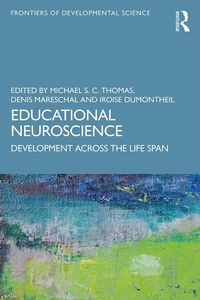
Educational Neuroscience
Development Across the Life Span
1st Edition
Published on 31. March 2020
570 pages
978-1-000-04075-3 (ISBN)
Description

The field of educational neuroscience uses new insights about the neural mechanisms of learning to improve educational practices and outcomes. The first volume to bring together the latest knowledge on the development of educational neuroscience from a life-span perspective, this important text offers state of the art, authoritative research findings in educational neuroscience before providing evidence-based recommendations for classroom practice.
Thomas, Mareschal, Dumontheil, and the team of expert international contributors assembled in this volume thoroughly explore four main themes throughout the book. The first theme is individual differences, or what makes children perform better or worse in the classroom. The second theme is the nature of individual differences at different stages in development, from early years into adulthood. The third theme addresses cognitive enhancement, summarizing research that has investigated activities that might give general benefits to cognition. And the fourth theme considers the translation of research findings into classroom practices, discussing broader ethical issues raised by educational neuroscience, and what teachers need to know about neuroscience to enhance their day-to-day practice. Specific topics explored include neuropsychological perspectives on socioeconomic disparities in educational achievement, reading difficulties, phonological skills, executive function, and emotional development.
Educational Neuroscience is essential reading for researchers and graduate students of educational psychology, developmental science, developmental psychology, and cognitive psychology, especially those specializing in emotion regulation.
Thomas, Mareschal, Dumontheil, and the team of expert international contributors assembled in this volume thoroughly explore four main themes throughout the book. The first theme is individual differences, or what makes children perform better or worse in the classroom. The second theme is the nature of individual differences at different stages in development, from early years into adulthood. The third theme addresses cognitive enhancement, summarizing research that has investigated activities that might give general benefits to cognition. And the fourth theme considers the translation of research findings into classroom practices, discussing broader ethical issues raised by educational neuroscience, and what teachers need to know about neuroscience to enhance their day-to-day practice. Specific topics explored include neuropsychological perspectives on socioeconomic disparities in educational achievement, reading difficulties, phonological skills, executive function, and emotional development.
Educational Neuroscience is essential reading for researchers and graduate students of educational psychology, developmental science, developmental psychology, and cognitive psychology, especially those specializing in emotion regulation.
More details
Series
Edition
1. Auflage
Language
English
Place of publication
London
United Kingdom
Publishing group
Taylor & Francis Ltd
Target group
College/higher education
Professional and scholarly
Illustrations
5 Tables, black and white; 11 Line drawings, black and white; 2 Halftones, black and white; 15 Illustrations, black and white
ISBN-13
978-1-000-04075-3 (9781000040753)
Copyright in bibliographic data and cover images is held by Nielsen Book Services Limited or by the publishers or by their respective licensors: all rights reserved.
Schweitzer Classification
Other editions
Additional editions
Michael S. C. Thomas | Denis Mareschal | Iroise Dumontheil
Educational Neuroscience
Development Across the Life Span
Book
04/2020
1st Edition
Routledge
€113.20
Shipment within 10-20 days

Michael S. C. Thomas | Denis Mareschal | Iroise Dumontheil
Educational Neuroscience
Development Across the Life Span
Book
04/2020
1st Edition
Routledge
€234.00
Shipment within 10-20 days
Persons
Michael S. C. Thomas obtained his PhD from the University of Oxford and completed a postdoctoral fellowship at the UCL Institute of Child Health. His research in developmental cognitive neuroscience focuses on the origins of cognitive variability, including developmental disorders. He is Director of the University of London Centre for Educational Neuroscience, UK.
Denis Mareschal is Director of the Centre for Brain and Cognitive Development, University of London, UK. He has published extensively on all aspects of learning and development across infancy and childhood and is a recipient of the Marr Prize (Cognitive Science Society, USA), the Young Researcher Award (International Society on Infant Studies, USA), and the Margaret Donaldson Prize (British Psychological Society, UK).
Iroise Dumontheil obtained a PhD from the University of Paris VI and then was a postdoctoral fellow in labs in London, Cambridge and Stockholm. She is a recipient of the Spearman Medal (British Psychological Society) and the Elizabeth Warrington Prize (British Neuropsychological Society). Her research focuses on the typical development of the brain, cognition and behaviour during adolescence, and on the implication of these findings for education.
Denis Mareschal is Director of the Centre for Brain and Cognitive Development, University of London, UK. He has published extensively on all aspects of learning and development across infancy and childhood and is a recipient of the Marr Prize (Cognitive Science Society, USA), the Young Researcher Award (International Society on Infant Studies, USA), and the Margaret Donaldson Prize (British Psychological Society, UK).
Iroise Dumontheil obtained a PhD from the University of Paris VI and then was a postdoctoral fellow in labs in London, Cambridge and Stockholm. She is a recipient of the Spearman Medal (British Psychological Society) and the Elizabeth Warrington Prize (British Neuropsychological Society). Her research focuses on the typical development of the brain, cognition and behaviour during adolescence, and on the implication of these findings for education.
Content
Introduction
Why is neuroscience relevant to education?
An introduction to brain and cognitive development - the key concepts you need to know
Development and variation: Nature vs. Nature
What has behavioral genetic research told us about the origins of individual differences in educational abilities and achievements?
Socioeconomic disparities in achievement: Insights on neurocognitive development and educational interventions
Discipline-specific abilities: literacy, numeracy, and science
Neuroscience in reading and reading difficulties
Reading acquisition and developmental dyslexia: Educational neuroscience and phonological skills
Sources of variability in mathematical development
Lifespan conceptual development in science: brain and behaviour
Discipline-general abilities: executive functions, social and affective development
The development of executive functions in childhood and adolescence and their relation to school performance
Understanding emotional thought can transform educators' understanding of how students learn
Leading methods for cognitive enhancement
Action video games: from effects on cognition and the brain to potential educational applications
Mindfulness and executive function: Implications for learning and early childhood education
The neuroscience of sleep and its relation to educational outcomes
The effectiveness of aerobic exercise for improving educational outcomes
The cognitive benefits and disadvantages of bilingualism across the lifespan and implications for education
Music training, individual differences, and plasticity
Into the classroom
Towards a science of teaching and learning for teacher education
Educational neuroscience: ethical perspectives
Educational neuroscience: so what does it mean in the classroom?
Conclusion
Key challenges in advancing educational neuroscience
Why is neuroscience relevant to education?
An introduction to brain and cognitive development - the key concepts you need to know
Development and variation: Nature vs. Nature
What has behavioral genetic research told us about the origins of individual differences in educational abilities and achievements?
Socioeconomic disparities in achievement: Insights on neurocognitive development and educational interventions
Discipline-specific abilities: literacy, numeracy, and science
Neuroscience in reading and reading difficulties
Reading acquisition and developmental dyslexia: Educational neuroscience and phonological skills
Sources of variability in mathematical development
Lifespan conceptual development in science: brain and behaviour
Discipline-general abilities: executive functions, social and affective development
The development of executive functions in childhood and adolescence and their relation to school performance
Understanding emotional thought can transform educators' understanding of how students learn
Leading methods for cognitive enhancement
Action video games: from effects on cognition and the brain to potential educational applications
Mindfulness and executive function: Implications for learning and early childhood education
The neuroscience of sleep and its relation to educational outcomes
The effectiveness of aerobic exercise for improving educational outcomes
The cognitive benefits and disadvantages of bilingualism across the lifespan and implications for education
Music training, individual differences, and plasticity
Into the classroom
Towards a science of teaching and learning for teacher education
Educational neuroscience: ethical perspectives
Educational neuroscience: so what does it mean in the classroom?
Conclusion
Key challenges in advancing educational neuroscience
