

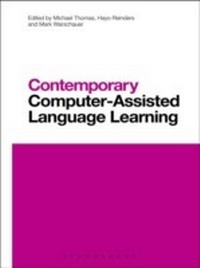
Contemporary Computer-Assisted Language Learning
1st Edition
Published on 22. November 2012
368 pages
978-1-4411-1300-9 (ISBN)
Description

Contemporary Computer-Assisted Language Learning (CALL) is a comprehensive, one-volume work written by leading international figures in the field focusing on a wide range of theoretical and methodological issues. It explains key terms and concepts, synthesizes the research literature and explores the implications of new and emerging technologies.
The book includes chapters on key aspects for CALL such as design, teacher education, evaluation, teaching online and testing, as well as new trends such as social media. The volume takes a broad look at CALL and explores how a variety of theoretical approaches have emerged as influences including socio-cultural theory, constructivism and new literacy studies. A glossary of terms to support those new to CALL as well as to allow those already engaged in the field to deepen their existing knowledge is also provided. Contemporary Computer-Assisted Language Learning is essential reading for postgraduate students of language teaching as well as researchers in related fields involved in the study of computer-assisted learning.
The book includes chapters on key aspects for CALL such as design, teacher education, evaluation, teaching online and testing, as well as new trends such as social media. The volume takes a broad look at CALL and explores how a variety of theoretical approaches have emerged as influences including socio-cultural theory, constructivism and new literacy studies. A glossary of terms to support those new to CALL as well as to allow those already engaged in the field to deepen their existing knowledge is also provided. Contemporary Computer-Assisted Language Learning is essential reading for postgraduate students of language teaching as well as researchers in related fields involved in the study of computer-assisted learning.
More details
Series
Language
English
Place of publication
New York
United States
Publishing group
Bloomsbury Publishing PLC (Digital)
Target group
Professional and scholarly
ISBN-13
978-1-4411-1300-9 (9781441113009)
Copyright in bibliographic data and cover images is held by Nielsen Book Services Limited or by the publishers or by their respective licensors: all rights reserved.
Schweitzer Classification
Other editions
Additional editions
Michael Thomas | Hayo Reinders | Mark Warschauer
Contemporary Computer-Assisted Language Learning
Book
06/2014
Bloomsbury Academic
€65.20
Shipment within 15-20 days
Michael Thomas | Hayo Reinders | Mark Warschauer
Contemporary Computer-Assisted Language Learning
Book
11/2012
Bloomsbury Academic USA
€268.50
Shipment within 15-20 days
Persons
Michael Thomas is Senior Lecturer in Language
Learning Technologies at the University of Central Lancashire, UK, and Editor
of International Journal of Virtual and Personal Learning Environments.
Hayo Reinders (www.innovationinteaching.org) is Head of Language and Learning Support at Middlesex University, London, UK, and Editor of Innovation in Language Learning and Teaching.
Learning Technologies at the University of Central Lancashire, UK, and Editor
of International Journal of Virtual and Personal Learning Environments.
Hayo Reinders (www.innovationinteaching.org) is Head of Language and Learning Support at Middlesex University, London, UK, and Editor of Innovation in Language Learning and Teaching.
Content
Notes on Contributors
\ Foreword by Mike Levy \ List of
Figures and Tables \ Chapter 1: Contemporary Computer-Assisted Language
Learning: The Role of Digital Media and Incremental Change, Michael Thomas,
Hayo Reinders and Mark Warschauer \ SECTION
I: The CALL Context \ Section
Introduction, Michael Thomas, Hayo Reinders and Mark Warschauer \ Chapter
2: Historical
Perspectives on CALL, Graham Davies, Sue E. K. Otto and Bernd Rueschoff \ Chapter 3: Researching
Language Learning in the Age of Social Media, Carla Meskill and Joy
Quah \ Chapter 4: Second Language Teacher Education for CALL:
An Alignment of Practice and Theory, Gary Motteram, Diane Slaouti and
Zeynep Onat-Stelma \ Chapter 5: Research on Computers in Language Testing:
Past, Present and Future, James Dean Brown \ Chapter 6:Materials
Design in CALL: Social Presence in Online Environments, Mirjam Hauck and Sylvia Warnecke \ SECTION II: CALL Learning Environments \ Section Introduction, Hayo Reinders,
Michael Thomas and Mark Warschauer \ Chapter 7: Telecollaboration and CALL, Robert O'Dowd
\ Chapter 8: Distance CALL Online, Marie-Noelle Lamy \ Chaper 9: Language Learning in Virtual Worlds: Research
and Practice, Randall Sadler
and Melinda Dooly \ Chapter 10: Digital Games and Language Learning, Chun
Lai, Ruhui Ni and Yong Zhao \ Chapter 11: Mobile-Assisted Language Learning, lGlenn
Stockwell \ Chapter 12: CALL in Low-Tech
Contexts, Dafne Gonzalez and Rubena
St. Louis \ SECTION III: CALL
in Language Education \ Section
Introduction, Michael Thomas, Hayo Reinders and Mark Warschauer \ Chapter
13: Intelligent
Computer-Assisted Language Learning, Mathias Schulze and Trude Heift \ Chapter
14: Technology-Enhanced
Reading Environments, Youngmin Park, Binbin Zheng, Joshua Lawrence and Mark
Warschauer \
Chapter 15: The Role of Technology in Teaching and Researching Writing, Volker
Hegelheimer and Jooyoung
Lee \ Chapter 16: CALL and Less Commonly Taught Languages, Richard
M. Robin \ Chapter 17: CALL and Digital Feedback, Paige Ware
and Greg Kessler \ Chapter 18: Task-Based Language Teaching and CALL, Michael
Thomas \
Chapter 19: CALL and Learner Autonomy: Affordances and
Constraints, Hayo Reinders and Philip Hubbard \ Glossary and Abbreviations
\ Foreword by Mike Levy \ List of
Figures and Tables \ Chapter 1: Contemporary Computer-Assisted Language
Learning: The Role of Digital Media and Incremental Change, Michael Thomas,
Hayo Reinders and Mark Warschauer \ SECTION
I: The CALL Context \ Section
Introduction, Michael Thomas, Hayo Reinders and Mark Warschauer \ Chapter
2: Historical
Perspectives on CALL, Graham Davies, Sue E. K. Otto and Bernd Rueschoff \ Chapter 3: Researching
Language Learning in the Age of Social Media, Carla Meskill and Joy
Quah \ Chapter 4: Second Language Teacher Education for CALL:
An Alignment of Practice and Theory, Gary Motteram, Diane Slaouti and
Zeynep Onat-Stelma \ Chapter 5: Research on Computers in Language Testing:
Past, Present and Future, James Dean Brown \ Chapter 6:Materials
Design in CALL: Social Presence in Online Environments, Mirjam Hauck and Sylvia Warnecke \ SECTION II: CALL Learning Environments \ Section Introduction, Hayo Reinders,
Michael Thomas and Mark Warschauer \ Chapter 7: Telecollaboration and CALL, Robert O'Dowd
\ Chapter 8: Distance CALL Online, Marie-Noelle Lamy \ Chaper 9: Language Learning in Virtual Worlds: Research
and Practice, Randall Sadler
and Melinda Dooly \ Chapter 10: Digital Games and Language Learning, Chun
Lai, Ruhui Ni and Yong Zhao \ Chapter 11: Mobile-Assisted Language Learning, lGlenn
Stockwell \ Chapter 12: CALL in Low-Tech
Contexts, Dafne Gonzalez and Rubena
St. Louis \ SECTION III: CALL
in Language Education \ Section
Introduction, Michael Thomas, Hayo Reinders and Mark Warschauer \ Chapter
13: Intelligent
Computer-Assisted Language Learning, Mathias Schulze and Trude Heift \ Chapter
14: Technology-Enhanced
Reading Environments, Youngmin Park, Binbin Zheng, Joshua Lawrence and Mark
Warschauer \
Chapter 15: The Role of Technology in Teaching and Researching Writing, Volker
Hegelheimer and Jooyoung
Lee \ Chapter 16: CALL and Less Commonly Taught Languages, Richard
M. Robin \ Chapter 17: CALL and Digital Feedback, Paige Ware
and Greg Kessler \ Chapter 18: Task-Based Language Teaching and CALL, Michael
Thomas \
Chapter 19: CALL and Learner Autonomy: Affordances and
Constraints, Hayo Reinders and Philip Hubbard \ Glossary and Abbreviations
