

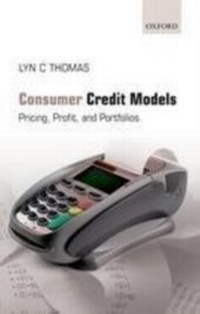
Consumer Credit Models
Pricing, Profit and Portfolios
1st Edition
Published on 29. January 2009
400 pages
978-0-19-155249-6 (ISBN)
Description

The use of credit scoring - the quantitative and statistical techniques to assess the credit risks involved in lending to consumers - has been one of the most successful if unsung applications of mathematics in business for the last fifty years. Now with lenders changing their objectives from minimising defaults to maximising profits, the saturation of the consumer credit market allowing borrowers to be more discriminating in their choice of which loans, mortgages and credit cards to use, and the Basel Accord banking regulations raising the profile of credit scoring within banks there are a number of challenges that require new models that use credit scores as inputs and extensions of the ideas in credit scoring. This book reviews the current methodology and measures used in credit scoring and then looks at the models that can be used to address these new challenges. The first chapter describes what a credit score is and how a scorecard is built which gives credit scores and models how the score is used in the lending decision. The second chapter describes the different ways the quality of a scorecard can be measured and points out how some of these measure the discrimination of the score, some the probability prediction of the score, and some the categorical predictions that are made using the score. The remaining three chapters address how to use risk and response scoring to model the new problems in consumer lending. Chapter three looks at models that assist in deciding how to vary the loan terms made to different potential borrowers depending on their individual characteristics. Risk based pricing is the most common approach being introduced. Chapter four describes how one can use Markov chains and survival analysis to model the dynamics of a borrower's repayment and ordering behaviour . These models allow one to make decisions that maximise the profitability of the borrower to the lender and can be considered as part of a customer relationship management strategy. The last chapter looks at how the new banking regulations in the Basel Accord apply to consumer lending. It develops models that show how they will change the operating decisions used in consumer lending and how their need for stress testing requires the development of new models to assess the credit risk of portfolios of consumer loans rather than a models of the credit risks of individual loans.
More details
Other editions
Additional editions
Book
01/2009
Oxford University Press
€139.28
Shipment within 15-20 days
Content
- Intro
- Contents
- Acknowledgements
- 1 Introduction to consumer credit and credit scoring
- 1.1 Introduction: importance and impact of consumer credit
- 1.2 Historical background of default-based credit scoring
- 1.3 Objectives of lenders
- 1.4 Tools for modelling lending decisions: influence diagrams, decision trees, and strategy trees
- 1.5 Probabilities, odds, information, and scores
- 1.6 Modifying scores: scaling, multiple levels, and time dependency
- 1.7 Lending returns and costs
- 1.8 Fundamentals of scorecard building
- 1.9 Using logistic regression to build scorecards
- 1.10 Other scorecard-building approaches
- 2 Measurement of scoring systems
- 2.1 Measuring scorecard quality
- 2.2 Discrimination measures: divergence, Kolmogorov-Smirnov statistic, and D-concordance statistic
- 2.3 ROC curve and Gini coefficient
- 2.4 Scorecard segmentation and measuring its impact on discrimination
- 2.5 Calibration measures of scorecard probability predictions
- 2.6 Measures of the correctness of categorical prediction
- 3 Risk-based pricing
- 3.1 Variable pricing in consumer lending
- 3.2 Risk-free response rate function and optimal pricing
- 3.3 Risk response relationship, adverse selection, and affordability
- 3.4 Risk-based response function and risk-based pricing
- 3.5 Acceptance scoring for multi-feature offers
- 3.6 A borrower-lender game model for pricing
- 4 Profit scoring and dynamic models
- 4.1 Behavioural scoring and dynamic account management
- 4.2 Profit scoring, risk/reward matrices to customer behaviour dynamics
- 4.3 Markov chain models of account behaviour
- 4.4 Markov decision process models of profitability
- 4.5 Survival analysis-based scoring systems and default estimation
- 4.6 Survival analysis-based profit models, including attrition and prepayment
- 5 Portfolio credit risk and the Basel Accord
- 5.1 Portfolio credit risk
- 5.2 Economic and regulatory capital
- 5.3 Summary of Basel Capital Accords
- 5.4 Basel II regulations and their impact on credit scoring
- 5.5 Regulatory capital and optimal cut-off policies
- 5.6 Modelling credit risk for portfolios of consumer and corporate loans
- 5.7 Basel stress testing of consumer portfolios: static and dynamic approaches
- Appendices
- A: Scores and runbook example
- B: Southampton bank application data
- References
- Index
- A
- B
- C
- D
- E
- F
- G
- H
- I
- J
- K
- L
- M
- N
- O
- P
- Q
- R
- S
- T
- U
- V
- W
- Y
- Z
