

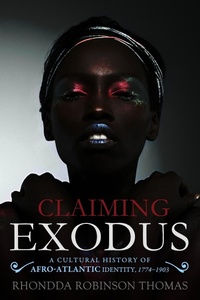
Claiming Exodus
Description

During the 18th century, American Puritans introduced migrant and enslaved Africans to the Exodus story. In contrast to the ways white Americans appropriated the texts to defend the practice of slavery, African migrants and slaves would recast the Exodus in defense of freedom and equality, creating narratives that would ultimately propel abolition and result in a wellspring of powerful writing.
Drawing on a broad collection of Afro-Atlantic authors, Rhondda Robinson Thomas shows how writers such as Absalom Jones, Daniel Coker, and W.E.B. Du Bois employed the Exodus metanarrative to ask profound, difficult questions of the African experience. These writers employed it as a literary muse, warranting, Thomas contends, that they be classified and studied as a unique literary genre. Through an arresting reading of works renowned to the largely unknown, Claiming Exodus uncovers in these writings a robust foundation for enacting political change and a stimulating picture of Africans constructing a new identity in an unfamiliar homeland.
More details
Other editions
Additional editions

Person
Content
Acknowledgments
List of Illustrations
Introduction
1. Exodus and the Politics of Liberty (1774-1800)
2. Exodus as the Blueprint for Building Free Black Communities (1800-1840)
3. Exodus in the Era of Manifest Destiny (1840-1861)
4. Exodus, the Civil War, and Reconstruction (1861-1877)
5. African Americans in the Nadir (1877-1900)
Afterword
Notes
Bibliography
Credits
Scripture Index
General Index
