

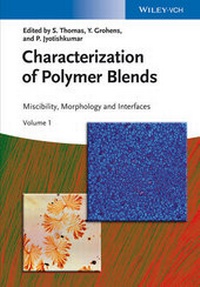
Characterization of Polymer Blends
Miscibility, Morphology and Interfaces
1st Edition
Published on 22. October 2014
994 pages
978-3-527-64562-6 (ISBN)
Description

Filling the gap for a reference dedicated to the characterization of polymer blends and their micro and nano morphologies, this book provides comprehensive, systematic coverage in a one-stop, two-volume resource for all those working in the field.
Leading researchers from industry and academia, as well as from government and private research institutions around the world summarize recent technical advances in chapters devoted to their individual contributions. In so doing, they examine a wide range of modern characterization techniques, from microscopy and spectroscopy to diffraction, thermal analysis, rheology, mechanical measurements and chromatography. These methods are compared with each other to assist in determining the best solution for both fundamental and applied problems, paying attention to the characterization of nanoscale miscibility and interfaces, both in blends involving copolymers and in immiscible blends. The thermodynamics, miscibility, phase separation, morphology and interfaces in polymer blends are also discussed in light of new insights involving the nanoscopic scale. Finally, the authors detail the processing-morphology-property relationships of polymer blends, as well as the influence of processing on the generation of micro and nano morphologies, and the dependence of these morphologies on the properties of blends. Hot topics such as compatibilization through nanoparticles, miscibility of new biopolymers and nanoscale investigations of interfaces in blends are also addressed.
With its application-oriented approach, handpicked selection of topics and expert contributors, this is an outstanding survey for anyone involved in the field of polymer blends for advanced technologies.
Leading researchers from industry and academia, as well as from government and private research institutions around the world summarize recent technical advances in chapters devoted to their individual contributions. In so doing, they examine a wide range of modern characterization techniques, from microscopy and spectroscopy to diffraction, thermal analysis, rheology, mechanical measurements and chromatography. These methods are compared with each other to assist in determining the best solution for both fundamental and applied problems, paying attention to the characterization of nanoscale miscibility and interfaces, both in blends involving copolymers and in immiscible blends. The thermodynamics, miscibility, phase separation, morphology and interfaces in polymer blends are also discussed in light of new insights involving the nanoscopic scale. Finally, the authors detail the processing-morphology-property relationships of polymer blends, as well as the influence of processing on the generation of micro and nano morphologies, and the dependence of these morphologies on the properties of blends. Hot topics such as compatibilization through nanoparticles, miscibility of new biopolymers and nanoscale investigations of interfaces in blends are also addressed.
With its application-oriented approach, handpicked selection of topics and expert contributors, this is an outstanding survey for anyone involved in the field of polymer blends for advanced technologies.
More details
Other editions
Additional editions
Sabu Thomas | Yves Grohens | P. Jyotishkumar
Characterization of Polymer Blends
Miscibility, Morphology and Interfaces
Book
12/2014
1st Edition
Wiley-VCH
€440.00
Article exhausted; check different version
Sabu Thomas | Yves Grohens | P. Jyotishkumar
Characterization of Polymer Blends
Miscibility, Morphology and Interfaces
Software
10/2014
Wiley-VCH
€596.36
No shipping information available
Persons
Sabu Thomas is a Professor of Polymer Science and Engineering and Director of
International and Inter University Centre for Nanoscience and Nanotechnology
at Mahatma Gandhi University, Kottayam (India). He is a Fellow of the Royal
Society of Chemistry and a Fellow of the New York Academy of Sciences. Thomas
has published over 530 papers in peer reviewed journals on polymer composites,
membranes separation, polymer blend and alloy, polymeric scaffolds for tissue
engineering, and polymer recycling research and has edited 40 books. He has
supervised 65 doctoral students. The H Index of Prof. Thomas is 66 and he has more
than 17,000 citations to his credit. Recently, Professor Thomas has been awarded
the MRSI and CRSI medals.
Yves Grohens is head of the Laboratory for Engineering of Materials (LIMATB)
located at the University of South Brittany, France. His research interests include
interface science in nano and bio-composites as well as confinement applications
and (bio)polymer behaviour in model thin films. Grohens has published more than
120 papers in international journals devoted to polymers and surface science.
Jyotishkumar Parameswaranpillai is DST INSPIRE Faculty at the Department of
Polymer Science and Rubber Technology, Cochin, Kerala (India). Dr. Jyotishkumar's
research focuses on thermosetting and thermoplastic polymer blends and
nanocomposites, smart thermosetting materials, biomaterials, bio-polymers and
bio-nanocomposites. He has won many awards as he advances his research career
including the recent INSPIRE Faculty Fellowship. Dr. Jyotishkumar has published
30 papers in international journals devoted to polymers.
International and Inter University Centre for Nanoscience and Nanotechnology
at Mahatma Gandhi University, Kottayam (India). He is a Fellow of the Royal
Society of Chemistry and a Fellow of the New York Academy of Sciences. Thomas
has published over 530 papers in peer reviewed journals on polymer composites,
membranes separation, polymer blend and alloy, polymeric scaffolds for tissue
engineering, and polymer recycling research and has edited 40 books. He has
supervised 65 doctoral students. The H Index of Prof. Thomas is 66 and he has more
than 17,000 citations to his credit. Recently, Professor Thomas has been awarded
the MRSI and CRSI medals.
Yves Grohens is head of the Laboratory for Engineering of Materials (LIMATB)
located at the University of South Brittany, France. His research interests include
interface science in nano and bio-composites as well as confinement applications
and (bio)polymer behaviour in model thin films. Grohens has published more than
120 papers in international journals devoted to polymers and surface science.
Jyotishkumar Parameswaranpillai is DST INSPIRE Faculty at the Department of
Polymer Science and Rubber Technology, Cochin, Kerala (India). Dr. Jyotishkumar's
research focuses on thermosetting and thermoplastic polymer blends and
nanocomposites, smart thermosetting materials, biomaterials, bio-polymers and
bio-nanocomposites. He has won many awards as he advances his research career
including the recent INSPIRE Faculty Fellowship. Dr. Jyotishkumar has published
30 papers in international journals devoted to polymers.
Content
VOLUME I
Polymer blends: State of the Art, New Challenges, and Opportunities
Miscible Blends Based on Biodegradable Polymers
Thermodynamics and Morphology and Compatibilization of Polymer Blends
Characterization of Polymer Blends: Rheological Studies
Characterization of Phase Behavior in Polymer Blends by Light Scattering
Characterization of Polymer Blends by X-ray Scattering: WAXS and SAXS
Characterization of Polymer Blends and Block Copolymers by Neutron Scattering: Miscibility and Nanoscale Morphology
Ultrasound in Polymer Blends
Characterization of Polymer Blends: Ellipsometry
Inverse Gas Chromatography
Thermal Analysis in Polymer Blends
Dynamic Mechanical Thermal Analysis of Polymer Blends
Thermomechanical Analysis and Processing of Polymer Blends
Water Sorption and Solvent Sorption Techniques
Modeling and Simulation
VOLUME II
Optical Microscopy (Polarized, Interference and Phase Contrast Microscopy) and Confocal Microscopy
Electron Microscopic Analysis of Multicomponent Polymers and Blends
Characterization of Polymer Blends using SIMS and Nano SIMS
Fluorescence Microscopy Techniques for the Structural Analysis of Polymer Materials
Characterization of Polymer Blends by FTIR Spectroscopy
Characterization of Polymer Blends by Solid-State NMR Spectroscopy
Characterization of Polymer Blends by Infrared, Near-Infrared and Raman Imaging
Electron Paramagnetic Resonance Spectroscopy and Forward Recoil Spectrometry
Characterization of Polymer Blends using UV-Visible Spectroscopy
Fluorescence Spectroscopy
Characterization of Polymer Blends by Dielectric Spectroscopy and Thermally Simulated Depolarization Current
Positron Annihilation Spectroscopy: Polymer Blends and Miscibility
Polymer blends: State of the Art, New Challenges, and Opportunities
Miscible Blends Based on Biodegradable Polymers
Thermodynamics and Morphology and Compatibilization of Polymer Blends
Characterization of Polymer Blends: Rheological Studies
Characterization of Phase Behavior in Polymer Blends by Light Scattering
Characterization of Polymer Blends by X-ray Scattering: WAXS and SAXS
Characterization of Polymer Blends and Block Copolymers by Neutron Scattering: Miscibility and Nanoscale Morphology
Ultrasound in Polymer Blends
Characterization of Polymer Blends: Ellipsometry
Inverse Gas Chromatography
Thermal Analysis in Polymer Blends
Dynamic Mechanical Thermal Analysis of Polymer Blends
Thermomechanical Analysis and Processing of Polymer Blends
Water Sorption and Solvent Sorption Techniques
Modeling and Simulation
VOLUME II
Optical Microscopy (Polarized, Interference and Phase Contrast Microscopy) and Confocal Microscopy
Electron Microscopic Analysis of Multicomponent Polymers and Blends
Characterization of Polymer Blends using SIMS and Nano SIMS
Fluorescence Microscopy Techniques for the Structural Analysis of Polymer Materials
Characterization of Polymer Blends by FTIR Spectroscopy
Characterization of Polymer Blends by Solid-State NMR Spectroscopy
Characterization of Polymer Blends by Infrared, Near-Infrared and Raman Imaging
Electron Paramagnetic Resonance Spectroscopy and Forward Recoil Spectrometry
Characterization of Polymer Blends using UV-Visible Spectroscopy
Fluorescence Spectroscopy
Characterization of Polymer Blends by Dielectric Spectroscopy and Thermally Simulated Depolarization Current
Positron Annihilation Spectroscopy: Polymer Blends and Miscibility
