

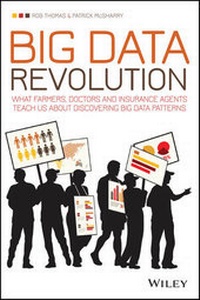
Big Data Revolution
Description

Big Data Revolution is a guide to improving performance,making better decisions, and transforming business through theeffective use of Big Data. In this collaborative work by an IBMVice President of Big Data Products and an Oxford Research Fellow,this book presents inside stories that demonstrate the power andpotential of Big Data within the business realm. Readers are guidedthrough tried-and-true methodologies for getting more out of data,and using it to the utmost advantage. This book describes the majortrends emerging in the field, the pitfalls and triumphs beingexperienced, and the many considerations surrounding Big Data, allwhile guiding readers toward better decision making from theperspective of a data scientist.
Companies are generating data faster than ever before, andmanaging that data has become a major challenge. With the rightstrategy, Big Data can be a powerful tool for creating effectivebusiness solutions - but deep understanding is key whenapplying it to individual business needs. Big DataRevolution provides the insight executives need to incorporateBig Data into a better business strategy, improving outcomes withinnovation and efficient use of technology.
* Examine the major emerging patterns in Big Data
* Consider the debate surrounding the ethical use of data
* Recognize patterns and improve personal and organizationalperformance
* Make more informed decisions with quantifiable results
In an information society, it is becoming increasingly importantto make sense of data in an economically viable way. It can drivenew revenue streams and give companies a competitive advantage,providing a way forward for businesses navigating an increasinglycomplex marketplace. Big Data Revolution provides expertinsight on the tool that can revolutionize industries.
More details
Other editions
Additional editions
Persons
Content
Introduction 7
PART I: THE REVOLUTION STARTS NOW: 9 INDUSTRIES TRANSFORMING WITH DATA 15
Chapter 1: Transforming Farms with Data 17
Chapter 2: Why Doctors Will Have Math Degrees 31
Chapter 3: Revolutionizing Insurance: Why Actuaries Will Become Data Scientists 45
Chapter 4: Personalizing Retail and Fashion 59
Chapter 5: Transforming Customer Relationships with Data 69
Chapter 6: Intelligent Machines 79
Chapter 7: Government and Society 89
Chapter 8: Corporate Sustainability 107
Chapter 9: Weather and Energy 119
PART II: LEARNING FROM PATTERNS IN BIG DATA 131
Chapter 10: Pattern Recognition 133
Chapter 11: Why Patterns in Big Data Have Emerged 141
Chapter 12: Patterns in Big Data 153
PART III: LEADING THE REVOLUTION 171
Chapter 13: The Data Opportunity 173
Chapter 14: Porsche 177
Chapter 15: Puma 181
Chapter 16: A Methodology for Applying Big Data Patterns 185
Chapter 17: Big Data Architecture 205
Chapter 18: Business View Reference Architecture 215
Chapter 19: Logical View Reference Architecture 223
Chapter 20: The Architecture of the Future 233
Epilogue 249
INDEX 255
Prologue
BERKELEY, 1930s
George Dantzig sat in his dorm room, contemplating the next 24 hours and what it would mean for his future. He came to the University of California, Berkeley, with many aspirations, but as often happens, life got in the way, and his best laid plans turned into dreams for another day. As he gazed over the building immediately in the foreground, he could see Sather Tower on Berkeley's campus, known for resembling Campanile di San Marco in Venice. George reassured himself that one of his major goals was still in his grasp; he could still earn a position on the faculty, providing an opportunity to teach the next group of eager students.
It was 3 p.m., and George had until 8 a.m. the next morning to prepare for what would become his defining exam at Berkeley. A passing grade virtually guaranteed his spot on the faculty. Anything less than his best, and his future would be once again uncertain. This was the kind of motivator that got him to reopen the books and apply himself throughout the night. The last time George looked up from his book, he saw 3 a.m. on the clock and decided he should get some rest.
As the sunrise slowly emanated around his room, George opened one eye and then the other, immediately wondering why he had not heard his alarm yet. He figured it must be an exceptionally clear day for that type of light to be coming through his eyelids before the 7:15 a.m. alarm that he set. Suddenly, George felt like something was not right, sat straight up in bed, grabbed his glasses, and looked at the clock: 8:30 a.m. The exam began 30 minutes ago! George quickly pulled on his pants and dashed for the door.
George sprinted into the exam hall, where the professor greeted him with a surprised look. Obviously, the professor concluded that George must be in the hospital or perhaps even dead to have missed the start of the exam. George, in a rushed voice, explained the situation as his professor handed him the exam. He also noted, "George, there are three additional problems that I have written on the board, once you complete the questions on the exam paper."
George, without any minutes to waste, sat in the front row and quickly started working through the questions. The exam was set for three hours, so when George arrived at 8:50 a.m., many of the students were nearly halfway through with the questions. Two hours later, as the clock approached 11 a.m., George finished the last question on the paper exam and shifted his attention to the three questions on the board. George was the only student left in the hall and clearly he would not have a chance to finish. He sheepishly walked up to his professor, re-explained the situation, and apologized that he did not have time to answer the questions on the board. In an unexpected act, his professor offered to let George have until midnight to try to complete the additional questions, and George excitedly ran back to his dorm room.
It was now 3 p.m., over 24 hours since he reflected on his future in his dorm room. George made progress on one of the questions but decided to give up on the others. He spent the next eight hours grinding on the first question, feeling confident that he had conquered the problem, and set out across campus to turn in his single answer. His disappointment was obvious in his posture - while he felt a great sense of accomplishment on one question, he knew that providing only one answer out of three would not be sufficient. George slid the paper under his professor's door, grabbed a small bite at the campus cafeteria, and collapsed into his bed at 1 a.m.
George was awakened by the shrill sound of his phone at 7 a.m., and he heard his professor on the line, "George, I can't believe it. You actually solved one of the equations on the board! This is truly an historic day." George, confused by what he was hearing, asked his professor to explain his amazement. His professor replied, "George, when I handed out the test, I told the class that I wrote three unsolvable equations on the board. I expected anyone with extra time to play around with them, but they weren't actually part of the test. You accomplished something that the rest of us KNEW was impossible!"
It's amazing what we can accomplish when we are not encumbered by what we believe is possible. It turns out that George had solved an algorithm around linear programming, which eventually became the simplex algorithm, the heart of Microsoft Excel's SOLVER function. If George had arrived on time to the exam hall and heard his professor tell the class to try to solve the unsolvable problems, he probably would have never accomplished this feat. He was not limited by what the world felt was impossible.
PATTERN RECOGNITION
In most great detective stories, the author typically uses a signature act or prop. The robber or murderer, either intentionally or unintentionally, leaves a signature mark at the scene of a crime. The detectives in pursuit do not notice it at first but eventually come to see a pattern. Often, it's about observing a non-obvious relationship between two data points, which leads to the recognition of a pattern. The conclusion: Insight can be found anywhere and hides in patterns. But are patterns valuable only to Sherlock Holmes and his contemporaries?
Patterns exist everywhere we look. However, it is the actual recognition of the pattern that can truly impact the world in which we live. When studying highly successful people, whether they're athletes or successful business professionals, Malcolm Gladwell argues in his best-selling book Outliers (Little, Brown and Company) that by studying the patterns of these individuals, we begin to understand that the environment from which they come from directly correlates to the amount of success they will have in life. By looking at hidden patterns of these individuals' upbringings, the month they were born, or the culture in which they were raised, we can predict whether they will reach their full potential or perhaps fall short.
The same can be said for data. By capturing and analyzing data, we can find patterns that will ultimately impact the future of industries and businesses. Often, observing a non-obvious relationship between two data points leads to the recognition of a pattern. The conclusion? Insight can be found anywhere and hides in patterns.
NELSON PELTZ
Nelson Peltz's coffee mug on his desk reads Sales Up . Expenses Down on one side, with Cash Is King on the other. These mantras helped him to build an $8.5-billion partnership focused on activist investing, one of the largest such partnerships in existence today. However, this was not handed to him; Peltz built this partnership through his ability to see, understand, and apply patterns across a variety of businesses.
Born in 1942 in Brooklyn, New York, Peltz worked his way through early school years and eventually decided to attend the Wharton School at the University of Pennsylvania. He dropped out a couple years later, in 1963, and set off to be a ski instructor. When that did not work out, he returned home to drive a delivery truck for his grandfather's company, A. Peltz & Sons. Eventually, he was given the reins to the company (Flagstaff) and grew it into a publicly held company. While Nelson did not finish a formal education, his on-the-job learning taught him all he would need to know later in his life.
In the 1980s, Nelson reunited with a former business partner from Flagstaff, Peter May, and they went on a hunting expedition: looking for companies to acquire, grow, and eventually sell. His first marked success was the sale of Triangle Industries to Pechiney in 1988. Nelson began to notice the value of spotting patterns in the operations of the companies that he acquired or considered acquiring.
Eventually, Trian Fund Management was founded, and still exists today. He became a force advocating for change and was an activist investor before the term was en vogue. But how did he do it?
Peltz believes that most activist investors and private equity companies focus on financial engineering. While that can make a difference in many cases, it gets you only so far. Very few individuals possess the insight to improve business operations, which is where you can drive substantial returns. And, in Peltz's view, improving business operations requires identifying and understanding patterns, and then acting on them.
To drive meaningful insight out of patterns, Peltz consciously (or unconsciously) focused much of his investment in two sectors: consumer packaged goods and food. With a focused competence, he can better compare and contrast patterns of performance. He believes in constantly assessing companies in his area of competence and looking at their strengths and weaknesses against the best performers in the industry. A sampling of the patterns that he looks for include:
- Ratios: Percent of sales spent on marketing.
- Overhead: Growth in overhead versus growth in sales.
- Rebates and allowances: Deals and allowances paid to retailers.
- Brand: He favors companies that have strong brands, but also have ratios that are out of line with the best performers.
Peltz believes that it's a more efficient use of capital to revitalize previously great brands than to try to build a new one. This is why he began to take an active interest in Heinz and Wendy's.
Heinz
When Peltz began analyzing H.J. Heinz Company in 2005, it was an immediate fit to his...
