

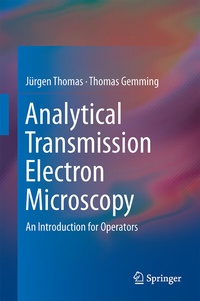
Analytical Transmission Electron Microscopy
Description

This work is based on experiences acquired by the authors regarding often asked questions and problems during manifold education of beginners in analytical transmission electron microscopy. These experiences are summarised illustratively in this textbook. Explanations based on simple models and hints for the practical work are the focal points.
This practically- oriented textbook represents a clear and comprehensible introduction for all persons who want to use a transmission electron microscope in practice but who are not specially qualified electron microscopists up to now.
More details
Other editions
Additional editions
Persons
Jürgen Thomas (born in 1948) studied physics at the TU Dresden from 1966 to 1971. In 1970 he had the first contact with electron microscopy and received finally his diploma and doctoral degree on topics of electron microscopy and electron-solid-interactions under supervision of Prof. Alfred Recknagel in Dresden. Between 1978 and 1989 he was responsible for the development of technologies for electron-beam welding and vacuum drying in the industrial research. In 1990 he went back to the electron microscopy and joined the Leibniz Institute for Solid State and Materials Research (IFW) Dresden where he has been working in the laboratory for analytical transmission electron microscopy until today.
Thomas Gemming (born in 1969) studied physics at the University Karlsruhe from 1988 to 1994. He received his doctoral degree on high-resolution transmission electron microscopy in the group of Prof. Manfred Rühle at the Max-Planck-Institut für Metallforschung in Stuttgart in 1998. Afterwards he expanded his field of work to analytical transmission electron microscopy. In 2000 he moved to the Leibniz Institute for Solid State and Materials Research (IFW Dresden) where he is currently working as a department head for Micro- and Nanostructures. Additionally he is currently the executive secretary of the German Society for Electron Microscopy (DGE).
Content
From the Contents: Why this effort?.- What should we know about electron optics and the construction of an electron microscope.- We prepare electron-transparent samples.- Let us start with the work.- Let us switch to electron diffraction.- Why do we see any contrasts in the images?.- We increase the magnification.- Let us switch to scanning transmission electron microscopy.- Let us use the analytical possibilities.- Basics explained in more detail (a little bit more mathematics).
