

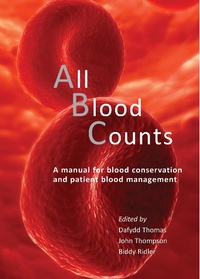
All Blood Counts
A manual for blood conservation and patient blood management
Published on 1. April 2016
350 pages
978-1-910079-51-5 (ISBN)
Description

This book gathers together the collected wisdom of an experienced group of practitioners from the world of blood conservation including surgeons, anaesthetists, haematologists, transfusion specialists, microbiologists, and legal advisors. Topics included are: an historical overview, transfusion-transmitted diseases, changing demographics and the projected impact on blood supplies, who needs transfusion, practicalities and tips - how to do it, the laboratory perspective, haemodilution, intra-operative cell salvage, surgical methods to minimise blood loss, anaesthetic methods to minimise blood loss, pharmacological methods to minimise blood loss, postoperative salvage, postoperative haemoglobin, cancer patients, patient consent and refusal, trauma management, patient ID and documentation, audit/clinical governance, the role of the Hospital Transfusion Team, education, national reports including European Directives, further information. Additional chapters will include pre-operative blood management, near-patient testing, the incidence and relevance of pre-operative anaemia, anaemia management in obstetrics, pre-operative anaemia in orthopaedics, haemostatic sealants, the effect of transfusion in cardiovascular surgery, transfusion alternatives.
More details
Language
English
Place of publication
Shrewsbury
United Kingdom
Target group
Professional and scholarly
File size
11,19 MB
ISBN-13
978-1-910079-51-5 (9781910079515)
Copyright in bibliographic data and cover images is held by Nielsen Book Services Limited or by the publishers or by their respective licensors: all rights reserved.
Schweitzer Classification
Other editions
Additional editions
Dafydd Thomas | John Thompson | Biddy Ridler
All Blood Counts
A manual for blood conservation and patient blood management
Book
03/2016
TFM Publishing Ltd
€56.00
Shipment within 3-4 weeks
Content
- All Blood Counts: A manual for blood conservation and patient blood management
- Title Page
- Copyright
- Contents
- Contributors
- Foreword
- Chapter 1: Historical perspective
- The provision of blood for transfusion
- Introduction
- Prior to the end of the First World War
- After the First World War
- Blood grouping
- Pre-transfusion matching
- Blood donation safety
- Conclusions
- Checklist summary
- References
- Chapter 2: Transfusion transmitted infections
- Background
- What makes a microbial agent important to blood safety?
- Which agents are relevant to transfusion?
- Viruses
- Bacteria
- Parasites
- Prions
- Other 'emerging' infections
- Residual risk
- Conclusions
- Checklist summary
- References
- Further reading
- Chapter 3: Changing demographics - projected impact on blood supplies/Blood Stock Management Scheme (BSMS)
- Background
- Evidence
- How much blood is there?
- How much blood do we need?
- Where does blood go?
- How can we influence blood usage and wastage?
- Inventory management by blood services
- Inventory management by hospitals
- Conclusions
- Checklist summary
- References
- Chapter 4: What patients and the public need to know about blood conservation - and why they need an advocate
- Background
- Evidence
- How to do it
- Involve people before they become patients
- Need to know basis
- Patient advocacy
- Research
- Conclusions
- Checklist summary
- References
- Chapter 5: Haemovigilance in 2020?
- Background
- Observations from the UK haemovigilance system (Serious Hazards of Transfusion - SHOT)
- Joint UK haemovigilance
- Patient safety
- The triangle of care and correct patient ID
- Acute transfusion reactions
- Acute reactions
- Allergic reactions
- Anti-D immunoglobulin (anti-D Ig) incidents
- Conclusions
- Checklist summary
- References
- Chapter 6: Patient safety
- Background
- How to do it
- How to prevent errors
- Centralised transfusion databases enhance patient safety
- Supporting and educating the prescriber when deciding if a patient needs to be transfused
- Conclusions
- Checklist summary
- References
- Chapter 7: NICE guidance and blood management
- Background
- A brief history of NICE
- Technology appraisals
- Clinical guidelines
- Interventional procedures
- Medical technologies
- NICE guideline on the assessment and management of blood transfusion
- Conclusions
- Acknowledgement
- Checklist summary
- References
- Chapter 8 Consent for blood transfusion in adults
- Background
- Evidence (best practice)
- Who can obtain consent for transfusion?
- Patient capacity to consent
- Patient refusal of consent
- Advanced decisions (or directives)
- The provision of information
- How much information to give?
- Has the patient understood the information I have given?
- How to do it
- Patients where a transfusion has been determined clinically necessary as a 'one-off' procedure
- Patients requiring long-term multiple transfusion episodes over an extended period of time (e.g. a patient with thalassaemia)
- Patients where it is thought that a transfusion may be required as part of a procedure, e.g. during surgery, but is not definite at the time of pre-procedure consent
- Emergency situations where it is not possible to consent the patient pre-transfusion
- Conclusions
- Checklist summary
- References
- Chapter 9: Patient consent in children
- Background
- Best interests
- Competence
- Background to competence in children
- Age, childhood and the threshold of adulthood
- Parental responsibility
- Consent between the ages of 16 and 18
- Consent in children under 16
- Refusal of treatment
- Clinical context of consent for blood transfusion in children
- Neonates and blood transfusions
- Emergencies and the incapacitated patient
- Situations where blood transfusions may be refused
- Documenting consent
- Practical guidance and information
- Conclusions
- Checklist summary
- References
- Chapter 10: Using clinical audit to improve transfusion practice
- Background
- A. Decide on a topic for audit
- High risk
- High cost
- High volume
- Local interest
- B. Agree the clinical behaviours to be audited, based on evidence-based guidance where possible
- Standards
- C to G. Agree what data should be collected/fed back to appropriate people
- Making a difference
- H. Allow some time for the information to be absorbed
- Clinical audit and clinical governance
- Conclusions
- Checklist summary
- References
- Chapter 11: Who needs transfusion?
- Background
- What do red cells do?
- Why do we transfuse red cells?
- Acute blood loss (Table 2)
- Recoverable anaemia in a haemodynamically stable patient (postoperative and other anaemias in patients without bone marrow failure) (Table 3)
- Bone marrow failure
- Thalassaemia
- Exchange transfusion
- Radiotherapy
- Risks of blood transfusion
- Conclusions
- Checklist summary
- References
- Chapter 12: Blood stock management from a laboratory perspective
- Background
- Determining stock levels
- Ordering blood products
- Rotating of blood stocks
- Issuing of blood products
- Returning of allocated units to stock
- Audit
- Specific considerations
- O negative red cells
- Frozen components
- Wastage of products
- Conclusions
- Checklist summary
- References
- Chapter 13: Prehabilitation
- Background
- Pre-operative anaemia
- Maintaining tissue oxygen delivery
- Nutrition and physical training
- Defining pre-operative anaemia
- Hepcidin and functional iron deficiency
- Diagnosis of anaemia and iron deficiency
- Pre-operative management of anaemia
- Minimisation of bleeding risk
- Conclusions
- Checklist summary
- References
- Further reading
- Chapter 14: Intra-operative cell salvage
- Background
- Evidence
- Vascular surgery
- Cardiothoracic surgery
- Orthopaedics
- Obstetrics and gynaecology
- Urology
- Other areas
- Adverse events
- ICS and tranexamic acid (TXA)
- How to do it
- Conclusions
- Checklist summary
- References
- Chapter 15: Surgical methods to prevent blood loss
- Background
- General approaches
- Reducing blood pressure
- Normothermia
- Interventional radiology
- Minimally invasive surgery and robotics
- Cell salvage
- Surgical instruments
- Lasers
- Ultrasound and water jet dissectors
- Topical haemostatic agents
- Conclusions
- Checklist summary
- References
- Chapter 16: Anaesthetic methods to minimise blood loss
- Background
- How to do it
- Patient positioning
- Tourniquets
- Vasoconstrictors
- Surgical technique
- Thermoregulation
- Balanced anaesthesia
- Permissive hypotension
- Acute normovolaemic haemodilution
- Conclusions
- Checklist summary
- References
- Chapter 17: Pharmacological methods for minimising blood loss
- Background
- Introduction
- Pharmacology of tranexamic acid (TXA)
- The efficacy of tranexamic acid in reducing traumatic bleeding
- Efficacy of tranexamic acid in reducing surgical bleeding
- Efficacy of tranexamic acid in postpartum haemorrhage
- Topical use of tranexamic acid
- Other areas where tranexamic acid is being trialled
- Dose of tranexamic acid
- Thrombotic risk
- Conclusions
- Checklist summary
- References
- Chapter 18: Postoperative blood salvage
- Background
- Evidence
- Efficacy of postoperative cell salvage
- Safety of unwashed blood
- How to perform postoperative blood salvage
- Devices
- Device selection
- Contraindications and precautions
- Actions to be taken
- Implications for everyday clinical practice
- Recipe for success
- Conclusions
- Checklist summary
- References
- Chapter 19: Haemostasis and sealing - the continuum concept
- Background
- Relevance to blood conservation
- Haemostats - an introduction
- Types of haemostats in clinical practice
- The importance of haemostats and blood transfusion
- Fibrin sealants - an introduction
- Fibrin sealants - applicability to clinical practice
- Safety
- Efficacy
- Health economic outcomes
- Synthetic sealants - introduction and types
- Anti-adhesion
- Sealants in blood conservation
- Portfolio approach to surgical challenges
- Conclusions
- Checklist summary
- References
- Chapter 20: Transfusion triggers for blood and blood products: the evidence
- Background
- Evidence
- Allogeneic red blood cell transfusion
- Fresh frozen plasma, platelets, cryoprecipitate and fibrinogen concentrate
- Risks associated with blood and blood products
- How to do it
- What is the clinical setting?
- Is there a need to transfuse?
- Old blood or new blood?
- What about blood products?
- Practicalities
- Conclusions
- Checklist summary
- References
- Chapter 21: Trauma-induced coagulopathy
- Background
- Revision of the classical description of coagulopathy
- Drivers of trauma-induced coagulopathy (Figure 1)
- Mechanisms of acute traumatic coagulopathy
- Systemic anticoagulation via protein C activation
- Hyperfibrinolysis
- Fibrinogen depletion
- Endothelial activation
- Platelet dysfunction
- Early diagnosis of trauma-induced coagulopathy
- Laboratory coagulation screens
- Fibrinogen measurement
- Point of care - viscoelastic haemostatic assays
- Clinical scoring systems
- Surrogate markers of TIC
- Conclusions
- Checklist summary
- References
- Chapter 22: Massive haemorrhage
- Background
- Evidence
- Red cell transfusion
- Coagulopathy
- Haemostatic blood component transfusion
- Pharmacological treatments
- Specific considerations
- Obstetrics
- Paediatrics
- Haematology
- Research
- How to do it
- Make it work for you
- Massive haemorrhage recognition and protocol activation
- Effective communication
- Conclusions
- Checklist summary
- References
- Chapter 23: Thromboelastography and thromboelastometry
- Background
- Types of POC haemostasis analyser and their main roles (Table 1)
- Evidence for the use of thromboelastography/thromboelastometry
- How do thromboelastometry analysers work?
- How to interpret the results
- The strength of the clot
- The time it takes for detectable clot to form
- Whether the clot remains strong or breaks down.
- How to set up a successful thromboelastometry service
- Conclusions
- Checklist summary
- References
- Chapter 24: Military management of massive haemorrhage
- Background
- Evidence
- How to do it
- Management of massive haemorrhage
- Massive transfusion policy
- Taking transfusion forward
- Continuity of care
- Blood on board
- Blood far forward
- Alternative components
- Lyophilised plasma
- Fibrinogen concentrate
- Cold storage for platelets
- Whole blood
- Mass casualty events
- Conclusions
- Checklist summary
- References
- Chapter 25: Obstetric haemorrhage
- Background
- Evidence
- Monitoring haemostasis
- Management strategies
- How to do it
- Identification of massive obstetric haemorrhage
- Multidisciplinary team
- Early identification of the cause of haemorrhage
- Surgical intervention
- Interventional radiology
- Maternal critical care
- Audit and simulation training
- Conclusions
- Checklist summary
- References
- Chapter 26: Cancer patients - blood health and surgery
- Background
- The evidence
- How to do it
- Consider the patient, not just the cancer
- Think blood health and cancer - careful clinical assessment and appropriate investigation
- Adequate preparation and planning - pre-surgery or pre-chemotherapy/radiotherapy
- Establish multidisciplinary review for high-risk cases
- Conclusions
- Acknowledgement
- Checklist summary
- References
- Chapter 27: Acute upper gastrointestinal bleeding
- Background
- Evidence
- Risk factors associated with poor outcome
- Scoring systems
- The colloid versus crystalloid debate
- Coagulopathy
- Novel anticoagulants (NOAC)
- How to do it
- Resuscitation and initial management
- Conclusions
- Checklist summary
- References
- Chapter 28: Accommodating patients who are Jehovah's Witnesses and their choice of treatment without blood transfusion
- Background
- The position of Jehovah's Witnesses
- Blood transfusion
- Plasma derivatives
- Autologous techniques
- Advance decision documents
- Blood-saving surgical equipment, techniques and strategies
- Hospital Liaison Committee network: a free resource for healthcare practitioners
- Conclusions
- Checklist summary
- References
- Chapter 29: Planning and running a study day
- Background
- Planning the study day
- Assemble the planning team
- Select the venue
- Funding the event
- Target audience
- Subject matter: avoid information overload
- Format for the day
- Speakers, chairpersons and facilitators
- Resources
- Refreshments
- Volunteers
- Publicity and booking
- The day itself
- Registration
- Housekeeping
- Timekeeping
- Moving the delegates
- Refreshments and lunch
- Closing remarks
- Evaluating the day
- Conclusions
- Checklist summary
- References
- Chapter 30: Policies and guidelines - how to write them: how to keep up with them
- Background
- Key aims of policies and guidelines
- How to write them
- So that's it?
- Keeping up with the guidelines
- Conclusions
- Checklist summary
- References
- Further reading
- Appendix I: Steps in the hospital transfusion process
- Appendix II: Safe blood administration
- Appendix III: Summary of the key recommendations of NICE NG24 on blood transfusion
- Appendix IV: Summary of UK SaBTO consent for transfusion recommendations, 2011
- Appendix V: SaBTO guidance for clinical staff to support patient consent for blood transfusion, 2011
- Appendix VI: SaBTO consent for blood transfusion: retrospective patient information - good practice guidance, 2011
- Appendix VII: Assessing a child's competence to give consent and refuse medical treatment
- Appendix VIII: Pre-operative patient blood management algorithm
- Appendix IX: Flow chart outlining the management of massive haemorrhage in adults
- Appendix X: Flow chart outlining the management of massive obstetric haemorrhage
- Appendix XI: Intra-operative cell salvage machines
- Advancis Surgical, Nottingham, UK
- Fresenius Kabi AG, Homburg, Germany
- Haemonetics Corporation, Braintree MA, USA
- LivaNova PLC, London, UK
- Medtronic Inc., Minneapolis, Minnesota, USA
- Terumo BCT, Inc., Lakewood, CO, USA
- Appendix XII: Useful contacts and information
- Index
